At a glance
| Patent number | CN205391005U (application CN201620061026) |
| Type | China utility model (实用新型) - protects product shape and structure |
| Original title | Coffee brewing device capable of automatically removing residues (一种自动掉渣的咖啡酿造装置) |
| Patent owner | Guangdong Xinbao Electrical Appliances Holdings Co Ltd |
| Inventors | Guo Jiangang, Wen Lingdan, Lin Jinru |
| Filing date | 2016-01-21 |
| Grant date | 2016-07-27 |
| Status (China) | Withdrawn - the owner abandoned the patent right (effective 2019-05-14) |
| Patent family | Chinese filings only - no US, European, Japanese, PCT or other filings listed |
| Cited by | 2 later documents |
| Source | Google Patents (search for CN205391005U) |
What the claims cover, in plain language
Claim 1 describes the core brewing device. It includes a machine body forming an inner cavity. A brewing assembly is fixed in the middle of this cavity. A brewing chamber is arranged at one end inside the cavity so it can move left and right; one end of the chamber sleeves over the brewing assembly and is driven by a driving device. At the opposite end of the cavity, a hydraulic cylinder contains a piston positioned facing the brewing chamber. The piston has an internal flow channel to supply water to the chamber, and a check valve sits inside that channel. Both the end face of the brewing seat and the end face of the piston are fitted with filter screen plates.
Claim 2 adds a slide bar between the brewing assembly and one end of the body, and a sleeve on the brewing chamber that rides along the slide bar. Claim 3 specifies that the sleeve’s outer surface carries tooth bars, and the driving device uses a motor turning a first gear that meshes with a second gear, which in turn engages the tooth bars. Claim 4 details the check valve: a plug resting at a stepped location in the flow channel, an adjusting nut threaded into the channel, and a spring connecting the plug and the nut. Claim 5 introduces a guide rod between the brewing assembly and the other end of the body, with the piston having a guide hole that slides along it. Claim 6 places a back-moving spring on the guide rod, supported between the piston end face and the brewing assembly. Claim 7 defines the brewing assembly as comprising a brewing seat fixed to the body and a brew head fixed to the seat, with the chamber sleeving over the seat.
This is a simplified reading for orientation only. The legal scope is defined by the exact claim wording in the official Chinese document.
What this means for US production
This patent was filed only in China and was withdrawn when the owner abandoned the patent right effective 2019-05-14, so it no longer restricts anyone in China either. It has no US or other foreign counterpart.
Two points to settle early:
- Other patents may exist. Automatic coffee brew groups, particularly mechanisms involving sliding chambers, hydraulic pistons, and puck ejection systems, are heavily patented by major European and Asian appliance corporations. A freedom-to-operate (FTO) review covering the specific gear-rack slide, the internal piston water channel, and the dual-screen gravity dump is essential before investing in tooling.
- Food contact materials. Every component touching water or coffee grounds must meet food safety standards, which dictates material selection from the start.
Customization and manufacturing
What can be customized
| Area | Options |
|---|---|
| Chamber volume | Sized for single or double espresso shots, or larger volumes for drip-style brewing |
| Filter screen mesh | Hole diameter and pattern adjusted for fine espresso grind or coarser drip grind |
| Check valve pressure | Spring stiffness and nut position tuned to open at specific bar ratings |
| Drive motor | Voltage and torque matched to regional electrical standards and desired cycle speed |
| Housing dimensions | Slide bar length and body cavity shaped to fit the client’s external machine shell |
| Materials | Food-grade stainless steel for the piston and seat; heat-resistant polymers for the sleeve and gears |
Things to plan for (US market)
- FDA 21 CFR 177 - materials contacting hot water and coffee must comply with FDA regulations for food-contact substances, including specific polymer and metal restrictions.
- UL 1082 / UL 197 - household and commercial electric coffee makers sold in the US typically require safety certification covering electrical insulation, thermal cutoffs, and grounding.
- FCC Part 15 - if the machine incorporates digital controls, displays, or wireless connectivity alongside the brew group, electromagnetic interference testing applies.
- California Prop 65 - brass fittings, lead-containing solders, or certain plastics used in the water path must be evaluated for listed chemicals.
How a project runs
- Inquiry - target beverage volume, machine footprint constraints, required certifications, and expected annual usage.
- Design - engineering the chamber dimensions, gear ratio, spring rates, and fluid channel geometry to match the client’s outer housing.
- Prototype - machining sample parts to verify the slide smoothness, seal integrity under pressure, and clean gravity drop of the puck.
- Pilot run - assembling a batch for thermal cycling tests, leak checks, and extraction consistency measurements.
- Production - die casting or CNC machining the metal bodies, injection molding the gears and sleeves, stamping the filter screens, and final assembly.
Quantities & timeline
Manufacturing requires precision molds for the plastic gears and sleeve, dies for the stainless steel piston and brewing seat, and specialized stamping tooling for the filter screens. Setting the check valve spring rate and verifying the gear-rack alignment under repeated thermal expansion take significant development time. Send us your target capacity, beverage specifications, material preferences, quantity and target price and we will reply with options.
Patent drawings
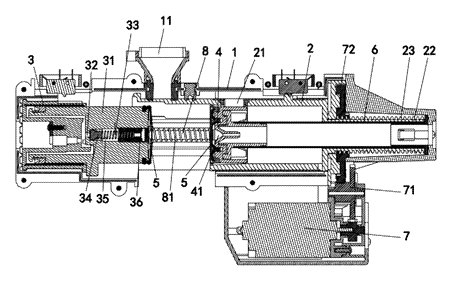
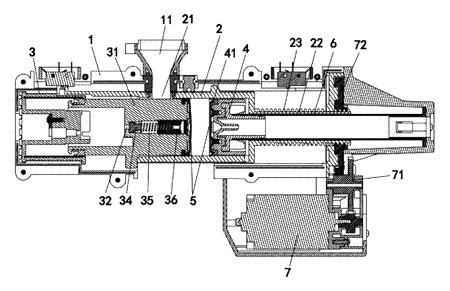
Drawings reproduced from the public patent document for reference.