
Patent CN205425108U
Updated November 6, 2026Removable Heat Element Guard for Air Fryers
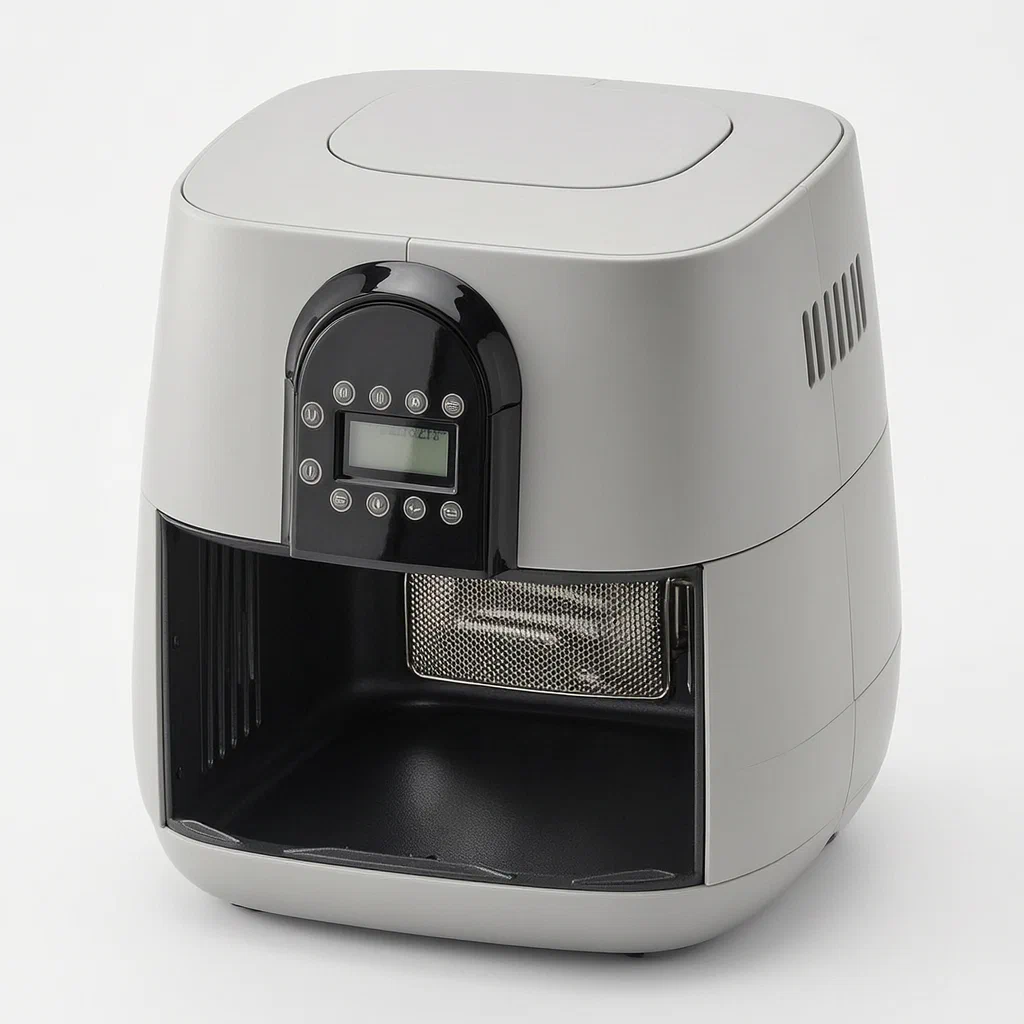
Grease from fried foods often coats the heating element in standard air fryers, leading to smoke, difficult cleaning, and potential burnout. This design introduces a removable isolation shield that sits above the frying basket but below the heating coil. Acting as a filter, the shield traps oil fumes before they reach the hot element. It is secured by one side using a screw through a threaded hole and by the other side using two symmetrical pins that plug into the basket's upper edge. To clean it, the user unscrews the fastener and pulls the shield out, separating the pins from the basket. This simple mechanism allows for quick removal and washing, keeping the internal environment cleaner and protecting the heating tube from direct grease contact.
- China utility model - expired
- No filings outside China
- Small kitchen appliances
- Removable filter shield, screw and pin attachment
Splat! What let you down?
🛡️
Isolation Shield
A removable cover sits between the basket and the heating element to block direct grease contact.
🧹
Easy Removal
Attaches with one screw and two snap-in pins, allowing quick detachment for washing.
🔥
Coil Protection
Filters oil fumes to help keep the heating tube clean and potentially extend its life.
🍳
Hygiene Focus
Designed to reduce germ breeding by maintaining a cleaner internal cooking environment.
Bring this product to market
- ✓ Patent review Patent family and legal status reviewed in the relevant jurisdictions.
- 2 Product brief · now How it works, uses and options written up
- 3 Prototype First samples for buyers to review
- 4 Pilot run Small first batch for launch customers
- 5 Volume production Repeat orders at scale
Buyer interest
– of 100 buyers needed to start prototyping
One click, no sign-up. Each vote is one real visitor, and products with the most interest go to prototyping first.
Build team: no members yet. Need a partner, co-funding or skills to build this? Join and we introduce the team once it forms.
Patent Rights & Team Participation
Before joining a development team, participants should ensure they have the necessary rights or authorization to participate in the project.
Participation is generally appropriate where:
- You own the relevant patent rights or have obtained permission or a license from the rights holder.
- The relevant patent rights have expired or have been legally invalidated in the jurisdictions where the planned activities will take place.
- The planned development, manufacturing, and commercialization activities have been independently assessed and do not infringe applicable patent rights in the relevant jurisdictions.
Important: Being located outside a country where a patent is protected does not automatically exempt you from patent infringement risks. Patent rights may apply based on where development, manufacturing, use, sale, or import activities take place.
IP2M does not grant any patent license or authorization through team participation. Joining a project does not provide permission to use, manufacture, or commercialize patented technology.
The problem
In many air fryers, the heating element is located directly above the food basket. As food cooks, fat renders out and creates oil fumes or splatter that rise toward the hot coil. Over time, this grease accumulates on the heating element. This buildup can cause several issues: it may produce unpleasant odors when reheated, create excess smoke during operation, and make the interior of the appliance difficult to clean because the heating element itself is often fixed and hard to access. Furthermore, heavy grease coating on the heating tube can lead to uneven heating or even damage the element over long periods of use, shortening the overall lifespan of the appliance. Users typically have to scrub the entire inner cavity or accept the grime, which is inconvenient and less hygienic.
The solution
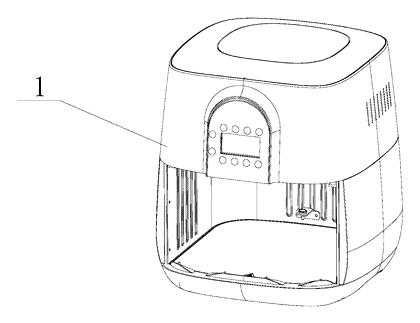
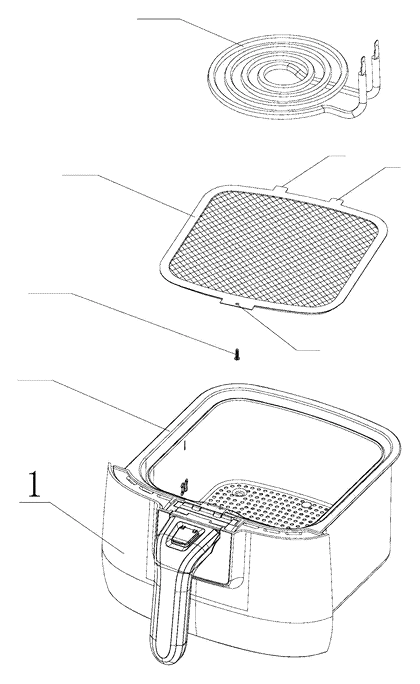
This patent describes a specific structural arrangement within the air fryer body to address these cleaning and maintenance challenges. The core of the solution is an easily detachable protective cover (item 3) installed on the upper side of the frying basket (item 5). This cover is positioned such that the heating pipe (item 2) is located on the upper part of the cover, effectively placing the cover between the food and the heat source.
The protective cover functions as an oil fume filter. When food is being fried, the oil fumes generated are intercepted and collected by the cover before they can settle directly onto the heating pipe. This keeps the heating element cleaner for longer.
To ensure the cover stays in place during operation but can be removed for cleaning, the design uses a hybrid attachment method. On one side of the cover, there is a threaded hole (c) that connects to the side of the frying basket using a screw (4). On the opposite side, the cover features two symmetrical pins (a and b) that plug into the upper edge of the frying basket. This configuration secures the cover firmly enough to withstand the airflow and vibration of cooking, yet loosely enough to be detached manually.
Who it is for
- Small Appliance Manufacturers: Brands looking to differentiate their air fryers by offering easier maintenance and better hygiene features compared to standard models where the heating element is exposed.
- OEM Suppliers: Companies providing components or complete units to major appliance brands who need solutions for common consumer complaints about difficult-to-clean interiors.
- Repair and Replacement Parts Sellers: Businesses selling accessories like baskets and covers; this specific cover design could be marketed as a replacement part for older air fryer models or as an upgrade kit for compatible units.
- Kitchenware Designers: Professionals seeking inspiration for modular designs that allow users to interact with critical components (like filters) without complex tools, enhancing user experience.
How it works
The main parts
| No. | Part | What it does |
|---|---|---|
| 1 | Fryer Body | The main housing containing the electronics and fan. |
| 2 | Heating Pipe | The heat source, described as a mosquito-coil type structure for uniform heating. |
| 3 | Protective Cover | A removable shield acting as an oil fume filter, placed above the basket. |
| 4 | Screw | Fastener used to secure one side of the cover to the basket. |
| 5 | Frying Basket | The container holding the food, to which the cover attaches. |
| a, b | Pins | Two symmetrical protrusions on the cover that plug into the basket edge. |
| c | Threaded Hole | Located on the cover side, aligning with the basket for screw insertion. |
Operating steps
- Installation: The protective cover is placed on top of the frying basket. The two pins (a and b) are aligned with the holes or slots on the upper edge of the basket and pushed in. The other side of the cover is brought against the basket wall, and the screw (4) is tightened into the threaded hole (c) to lock it in place.
- Cooking: Food is placed in the basket. As it heats up, oil fumes rise. They hit the underside of the protective cover (3), where they are trapped or filtered, preventing them from reaching the heating pipe (2) directly.
- Cleaning: After use, the user loosens the screw (4). The cover is then pulled out, causing the pins (a and b) to disengage from the basket edge. The cover can be washed separately, removing the collected grease. The heating pipe remains relatively clean, requiring less frequent deep cleaning.
Applications
Residential Air Fryers
This design is most suitable for countertop air fryers used in homes. Homeowners often struggle with greasy residues on heating elements. By adding a removable filter shield, manufacturers can offer a product that promises easier upkeep, appealing to consumers who value convenience and hygiene in their kitchen appliances.
Commercial Compact Kitchens
In small cafes or office pantries where space is limited and cleaning staff may not be available, easy-maintenance appliances are preferred. This cover allows non-specialized users to quickly remove and wash the filter part, ensuring the machine stays sanitary between multiple uses throughout the day without extensive disassembly.
Rental and Shared Appliances
For air fryers used in shared living spaces, dormitories, or rental properties, durability and ease of cleaning are key. The protection offered to the heating element can reduce wear and tear from grease buildup, potentially lowering maintenance costs for property managers while making it easier for tenants to keep the unit clean.
Where it is less suitable
- High-Capacity Industrial Fryers: Large commercial fryers often have different airflow dynamics and cleaning protocols (such as automated spray systems) that may render a small manual cover ineffective or unnecessary.
- Models with Fixed Heating Elements: If the air fryer design does not allow for a gap between the basket and the heater, or if the basket shape cannot accommodate the pin-and-screw attachment, this specific cover mechanism would require significant redesign of the base unit.
- Users Seeking Zero Maintenance: While this reduces cleaning frequency, it still requires the user to remember to remove and wash the cover. Those who prefer fully self-cleaning technologies might find this manual step burdensome.
Patent & Production
At a glance
| Patent number | CN205425108U (application CN201620270634) |
| Type | China utility model (实用新型) - protects product shape and structure |
| Original title | No-clean heat pipe isolation protective cover used in air fryer (一种空气炸锅中使用的、免清洗的发热管隔离防护罩) |
| Patent owner | NINGBO LEMEIJIA ELECTRIC TECHNOLOGY Co Ltd |
| Inventors | Luo Qifeng |
| Filing date | 2016-03-31 |
| Grant date | 2016-08-03 |
| Status (China) | Expired - a China utility model lasts at most 10 years from filing; the term ended on 2026-03-31 |
| Patent family | Public record shows Chinese filings only - no US, European, Japanese, PCT or other filings listed |
| Cited by | 78 later documents |
| Source | Google Patents (search for CN205425108U) |
What the claims cover, in plain language
Claim 1 defines an air fryer assembly comprising a fryer body (1) with an internal frying basket (5). An easily detachable protective cover (3) is situated on the upper side of the basket, and a heating pipe (2) is located on the upper part of this cover. The cover serves to isolate the heating pipe from the basket area.
Claim 2 specifies the attachment mechanism: one side of the protective cover has a threaded hole (c) connected to the basket side via a screw (4). The other side features symmetrical pin one (a) and pin two (b) that plug into the upper edge of the frying basket.
Claim 3 states that the heating pipe (2) utilizes a mosquito-coil type coil structure, intended to provide more uniform heating.
Claim 4 identifies the easily detachable protective cover (3) specifically as an oil fume filter, designed to intercept and collect fumes generated during cooking.
This is a simplified reading for orientation only. The legal scope is defined by the exact claim wording in the official Chinese document.
What this means for US production
This patent was filed in China and has expired, so it no longer restricts anyone in China either. The public record shows no US or other foreign counterpart.
Two points to settle early:
- Other patents may exist. Sharkninja Operating LLC holds numerous later patents citing this technology (e.g., US10390656B2, US11033146B2), and Guangdong Shunde Ouning Technology Electrical Appliance Co., Ltd. also has a related application (US20240197103A1). These indicate active IP activity in the air fryer field. A freedom-to-operate (FTO) review is essential to ensure your specific implementation does not infringe on these newer, potentially active rights.
- Safety Standards. Air fryers are electrical appliances subject to strict safety regulations. The addition of a removable cover must not compromise thermal management or electrical safety, requiring careful validation against UL standards.
Customization and manufacturing
What can be customized
| Area | Options |
|---|---|
| Cover Material | Stainless steel mesh, perforated aluminum, or heat-resistant plastic (depending on temperature proximity). |
| Filter Density | Mesh size adjusted to balance grease trapping vs. airflow restriction. |
| Attachment Type | Variation in screw length/head type or pin geometry for easier user handling. |
| Shape | Curvature of the cover to match specific basket diameters and heating element profiles. |
| Finish | Non-stick coatings or polished surfaces to facilitate washing. |
Things to plan for (US market)
- UL 1082 / IEC 60335-2-9: Safety standard for household electrically operated cooking appliances. Any modification to the airflow path (like adding a filter) must be tested to ensure it does not cause overheating of the motor or housing.
- FDA Compliance: If the cover comes into indirect contact with food vapors, materials should be compliant with food-contact safety guidelines, though it is primarily a structural barrier.
- Proposition 65: Ensure any plastics or coatings used do not contain restricted chemicals above safe harbor levels.
How a project runs
- Inquiry - Define basket dimensions, heating element wattage, and desired filtration level.
- Design - CAD modeling of the cover, simulating airflow and heat distribution to ensure the filter does not overheat the element or block necessary convection.
- Prototype - 3D print or CNC machine sample covers for fit testing and basic airflow checks.
- Testing - Thermal imaging tests to verify the heating element temperature remains within safe limits with the cover installed.
- Production - Stamping or wire EDM for metal mesh covers, injection molding for plastic frames, and assembly of pins/screws.
Quantities & timeline
Metal mesh covers typically involve stamping or laser cutting processes, while plastic components require injection molds. The integration of the screw and pin mechanism adds minor assembly steps. Tooling for custom pin shapes and mesh patterns will dictate initial setup time. Send us your basket diameter, heating power, material preference, quantity and target price and we will reply with options.
Patent drawings
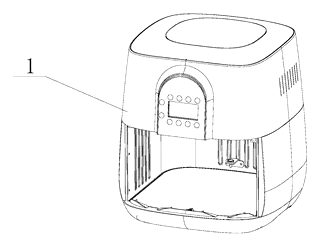
Drawings reproduced from the public patent document for reference.
Production notes
Tooling and process
Likely, the protective cover would be produced using stamping if made from metal sheet stock, or injection molding if constructed from heat-resistant polymers. The pins and screw interfaces suggest a need for precise mold cavities to ensure consistent engagement with the basket. Assembly would likely rely on snap-fit mechanisms for the pins and screws for the primary attachment, avoiding adhesives due to high temperatures.
Cost drivers
Costs depend heavily on the number of molds and cavities required for the plastic frame components. Material grade selection is critical; using standard PP may fail near the heating element, necessitating higher-cost heat-resistant ABS or stainless steel. Surface finish requirements for easy cleaning add to processing time.
Prototyping path
A 3D model and interference check would first verify the cover fits within the existing air fryer housing without blocking airflow. Create a 3D-printed body for physical fit and handling tests. Use CNC or simple tool methods to fabricate stressed parts like the pins to test durability. Proceed to functional sample testing under real cooking conditions.
What we would change before tooling
Before finalizing tooling, we would likely adjust the mesh density based on prototype airflow data to prevent overheating. We might also refine the pin geometry to reduce stress concentration points, ensuring they do not break after repeated removal cycles. Verifying the thermal clearance between the cover and the heating element is crucial to avoid warping.
Common failure points
Potential issues include thin walls warping or sinking due to prolonged heat exposure. Trapped water or residue in crevices around the pins could lead to corrosion or hygiene problems if not designed for drainage. Thread engagement and fastener torque must be robust enough to stay secure during vibration but loose enough for user removal. Finally, coating wear at contact points where the cover rubs against the basket could degrade aesthetics and functionality over time.
Frequently asked questions
How does the cover attach to the basket?
It uses a dual-point system. One side connects via a screw going through a threaded hole on the cover into the basket side. The opposite side uses two symmetrical pins that simply plug into the upper edge of the basket. This makes it secure during cooking but easy to remove for cleaning.
Is the cover safe to put in the dishwasher?
The patent describes it as an oil fume filter attached to the basket. While it doesn’t specify dishwasher safety, typical materials like stainless steel mesh or heat-resistant plastics are usually dishwasher-safe. However, you should confirm the specific material grade and coating used in your final design, as some non-stick finishes may degrade in harsh detergents.
Does the cover affect cooking performance?
The cover acts as a filter, which may slightly alter airflow. The patent mentions the heating pipe is a “mosquito-coil type” for uniform heating. In practice, the mesh density needs to be balanced to trap grease without restricting the convection currents necessary for air frying. Prototype testing is recommended to tune the airflow.
What happens if the cover gets too dirty?
The design is built for easy removal. You unscrew the single fastener and pull the cover out, releasing the pins. This allows you to wash off the collected oil and grease separately from the main appliance body, helping to keep the heating element clean and reducing smoke or odor issues.
Can this be added to existing air fryers?
Only if the basket and housing have sufficient clearance between the food area and the heating element. The cover requires specific mounting points (holes for pins and threads for screws) on the basket rim. Retrofitting would likely require modifying the basket itself.
Are there safety risks with adding a filter?
Any obstruction near a heating element carries a risk of overheating if airflow is blocked. The design must ensure the filter material can withstand high temperatures and that the open area percentage is sufficient to maintain safe operating temperatures for the appliance’s internal components.
Can this design be made and sold in the US?
The patent was filed in China and has expired, and the public record shows no US counterpart, so it does not restrict the design in the US or in China. However, newer patents from companies like Sharkninja Operating LLC cite this work, so a freedom-to-operate check is advised to avoid infringing on active US intellectual property.
Are you affiliated with the patent owner?
No. IP2M is an independent design and manufacturing service working from the public patent document.
Request a quote
Click Request a Quote below to see our email address - copy it, or open your email app with a ready-made message. Please mention patent CN205425108U in the subject.
Helpful details to include:
- Your company and channel (appliance brand, OEM manufacturer, spare parts distributor)
- Basket dimensions and heating element specifications
- Material preference (metal mesh, plastic frame, etc.)
- Quantity and target price
- Timeline - when you would like samples and the first shipment
You can also reach us at (332) 203-9997.
Page editor: Daniel Chen, Product Research Editor · IP2M
Last updated November 6, 2026. If something on this page looks wrong, email [email protected] and we will check it against the patent.
Interested in building this?
Tell us your target market, quantity and timeline. We reply with options for prototyping, small-batch runs or volume production.
Send your inquiry to
Please put CN205425108U in the subject line and tell us your company, country, estimated quantity and timeline.
Prefer to talk? Call (332) 203-9997.
More product-ready patents
All Home, Kitchen & Cleaning patents →
Home, Kitchen & Cleaning
Self-Wringing Flat Mop with Fold-Away Wringer
Flat mop with a built-in wringer that opens only when you wring and folds flat against the pole when you mop.
Patent CN207734114U
Home, Kitchen & Cleaning
Magnetic Double-Sided Window Cleaner with Dial-Set Magnet Strength
Magnetic window cleaner with a sealed, sliding magnet, dial-set strength for different glass thicknesses and a spring-held idle position.
Patent CN209360543U
Home, Kitchen & Cleaning
Metal Kettle with Magnetic Lid That Stays On When Pouring
Metal teapot/kettle with a magnet-held lid that does not fall off when pouring, and an insulated, vented lid knob.
Patent CN210540477U
Home, Kitchen & Cleaning
Reinforced Disposable Soup Spoon
Disposable soup spoon with a handle-to-bowl rib, stiffened edges and a ring foot to resist breaking.
Patent CN206964482U
Home, Kitchen & Cleaning
Self-Switching Double-Squeegee Window Cleaner
Cleaning head with two squeegee blades that switch automatically with the direction of movement.
Patent CN212630655U
Home, Kitchen & Cleaning
Self-Rinsing Roller Scrub Brush with Dirty-Water Tank
Powered roller brush that rinses and spins its bristles clean inside the body and stores the dirty water.
Patent CN210076909U
Browse by category
- Apparel & Accessories (43)
- Baby & Kids (28)
- Bags & Luggage (16)
- Bath & Personal Care (29)
- Car Accessories (23)
- Furniture, Bedding & Storage (22)
- Garden & Outdoor (29)
- Health & Wellness (13)
- Home, Kitchen & Cleaning (46)
- Lighting (22)
- Packaging & Containers (11)
- Pet Products (10)
- Phone & Camera Accessories (9)
- Retail Display (23)
- School, Office & Art (33)
- Sports & Recreation (41)
- Tools & Workshop (50)
- Toys & Games (21)
This page is based on the public patent document CN205425108U, assigned to NINGBO LEMEIJIA ELECTRIC TECHNOLOGY Co Ltd. IP2M is an independent manufacturing service and is not affiliated with, endorsed by or licensed by the patent owner. Images marked as concept renderings are illustrations, not photos of an existing product. Patent status information is provided for reference only and is not legal advice; confirm freedom to operate for your market before production. Full disclaimer.