At a glance
| Patent number | CN205487209U (application CN201620267280) |
| Type | China utility model (实用新型) - protects product shape and structure |
| Original title | A performance figure movable digital advertising panel (一种表现图形可移动式数字广告板) |
| Patent owner | Xingtai Polytechnic College |
| Inventors | Ma Hongxia |
| Filing date | 2016-04-04 |
| Grant date | 2016-08-17 |
| Status (China) | Lapsed - terminated for non-payment of annual fees (recorded 2018-04-20) |
| Patent family | Chinese filings only - no US, European, Japanese, PCT or other filings listed |
| Cited by | 10 later documents |
| Source | Google Patents (search for CN205487209U) |
What the claims cover, in plain language
Claim 1 - an advertising panel comprising a shell, LEDs and an electromagnet. The shell has an upper transparent plate and a bottom reflector with multiple LEDs between them. A transparent conductive film is on the inner surface of the upper plate, and a reflective conductive film is on the inner surface of the bottom reflector. Each LED includes a lamp bead, a ferromagnetic base, a return spring and a leaf spring. The lamp bead’s lower end is fixed to the top of the ferromagnetic base. The leaf spring is at the upper end of the lamp bead and contacts the transparent conductive film. The return spring is fixed to the underside of the ferromagnetic base and contacts the reflective conductive film. The positive and negative voltage inputs of the lamp bead connect to the return spring and the leaf spring respectively. The electromagnet is located on the outside of the bottom reflector.
Claim 2 - the ferromagnetic base is a frustum cone structure, and its diameter equals the diameter of the lamp bead; the diameter of the electromagnet also equals the diameter of the ferromagnetic base.
Claim 3 - a conduction disk is fixedly installed at the lower end of the return spring.
This is a simplified reading for orientation only. The legal scope is defined by the exact claim wording in the official Chinese document.
What this means for US production
This patent was filed only in China and has lapsed due to non-payment of annual fees (termination recorded 2018-04-20), so it no longer restricts anyone in China either. It has no US or other foreign counterpart.
Two points to settle early:
- Other patents may exist. Magnetically manipulated display elements and conductive-film lighting panels are explored by various display technology companies, so a freedom-to-operate (FTO) review of the specific spring-contact and electromagnetic sliding mechanism is recommended before committing to tooling.
- Electrical safety. Moving current-carrying springs against conductive films requires careful material selection to prevent arcing, wear-through or short circuits during repeated repositioning.
Customization and manufacturing
What can be customized
| Area | Options |
|---|---|
| Panel size | Overall dimensions of the shell to fit standard retail frames or custom mounts |
| LED spacing and count | Grid density or free-form arrangement capacity based on the target graphic resolution |
| Plate materials | Glass or polycarbonate for the upper transparent plate; aluminum or coated steel for the bottom reflector |
| Conductive films | ITO (indium tin oxide) coating, silver nanowire mesh or other transparent conductors suited to the chosen plate material |
| Electromagnet | Design, power capacity, and magnetic field strength tuned to the spring rate |
| Power supply | Low-voltage DC input with appropriate connectors for retail or venue wiring |
| Frame and mounting | Wall brackets, freestanding easel bases or window suction cups |
Things to plan for (US market)
- UL 962 / UL 48 - Standard for Household and Commercial Furnishings or Signs; any illuminated sign plugged into US mains typically requires evaluation by a Nationally Recognized Testing Laboratory (NRTL) for fire and shock hazards.
- FCC Part 15 - If the panel incorporates any digital control circuitry or wireless features beyond the basic DC supply, it must meet unintentional radiator limits.
- California Proposition 65 - Materials used in the shell, conductive films, solder and magnets must be screened for listed chemicals.
- RoHS / REACH alignment - Though primarily European, many US commercial buyers request compliance documentation for lead, cadmium and phthalates in electronic assemblies.
How a project runs
- Inquiry - panel size, LED count, intended environment and quantity.
- Design - select plate materials, specify conductive film thickness, calculate spring rates for the return spring and leaf spring, and dimension the electromagnet to match the ferromagnetic base.
- Prototype - build sample shells, coat films, assemble LED modules and test the sliding action, contact resistance and brightness uniformity.
- Pilot run - cycle-test the repositioning mechanism hundreds of times to evaluate film wear and spring fatigue; run electrical safety pre-tests.
- Production - plate forming, film deposition, LED module assembly, final wiring, quality inspection and packaging alongside the electromagnets.
Quantities & timeline
Manufacturing requires tooling for the shell frame, a process for depositing or laminating the conductive films onto the plates, and precision winding for the return springs and leaf springs to ensure consistent contact pressure. The electromagnets need their own coil assembly. Safety certification testing (such as UL listing) adds significant lead time before volume shipments. Send us your panel dimensions, LED count, mounting style, estimated quantity and target price and we will reply with options.
Patent drawings
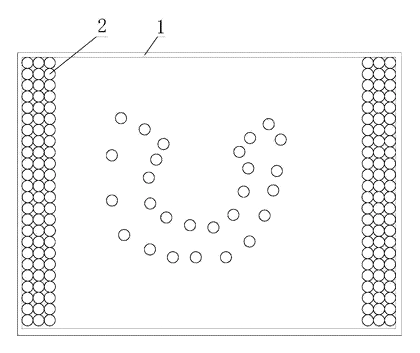
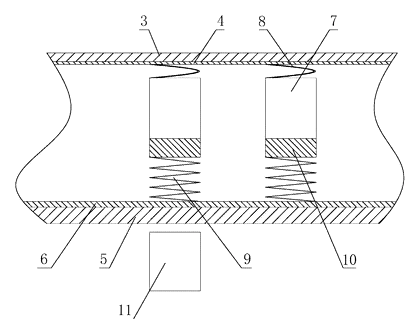
Drawings reproduced from the public patent document for reference.