
Patent CN205625287U
Updated November 3, 2026Cross-Linking Folding Chair Support with Sliding Joint Mechanism
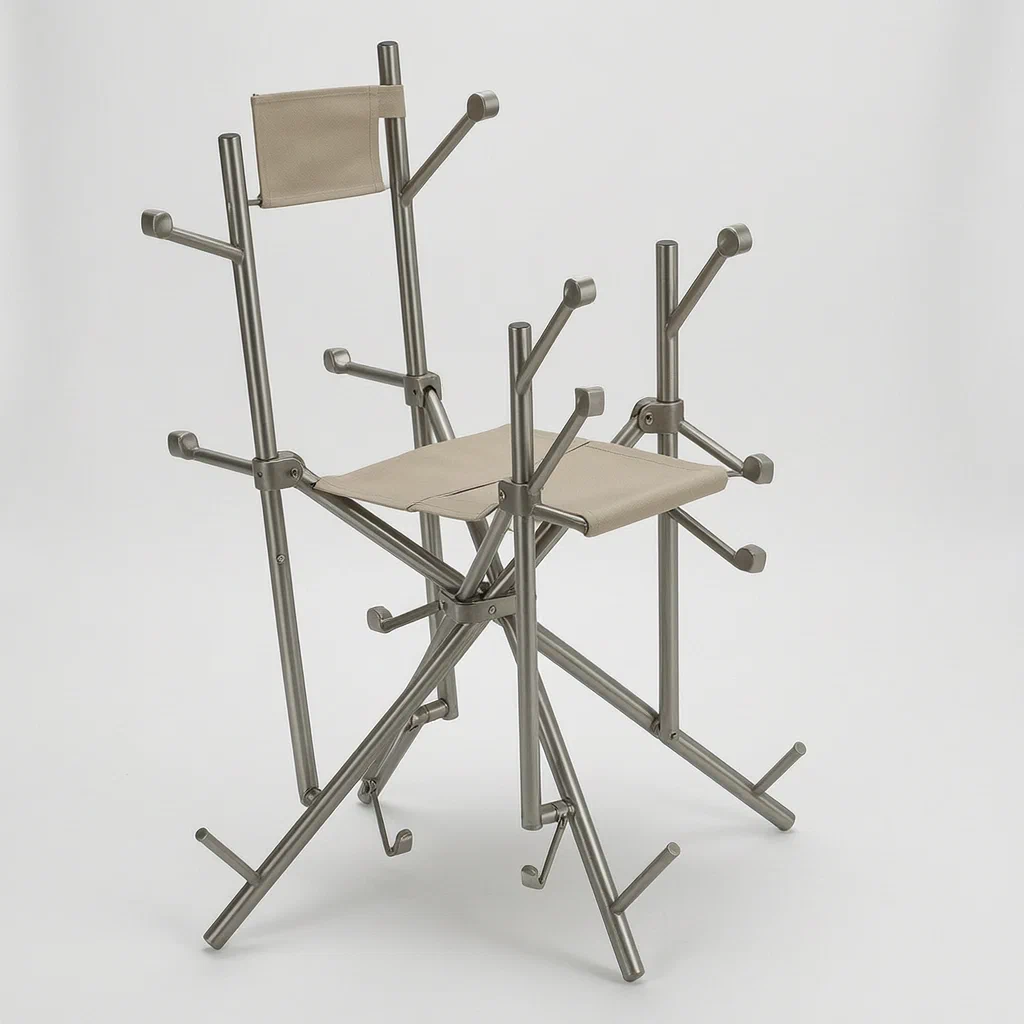
Traditional folding chairs often struggle with bulky folded profiles or complex hinge mechanisms that fail under load. This support system solves this by using a cross-linked pole arrangement. Base poles are hinged at the bottom to a fixed seat but connect at their tops to sliders on the opposing backrest or armrest poles. As the chair opens or closes, these sliders move along the poles, guiding the legs into a parallel, compact stack. The result is a sturdy frame that folds down to minimal thickness, perfect for transport and storage without sacrificing structural integrity during use.
- China utility model - expired
- No filings outside China
- Portable furniture hardware
- Steel tube frames, sliding joint mechanism
Splat! What let you down?
🔗
Cross-Linked Poles
Base poles connect to sliders on opposing backrest poles, ensuring smooth folding.
📏
Compact Folded Profile
The sliding mechanism aligns all poles parallel, minimizing storage space.
🛠️
Simple Assembly
Uses standard hinges and sliding sleeves; no complex gears or springs.
🧵
Detachable Cushion
Frame supports removable fabric seats for easy cleaning and replacement.
Bring this product to market
- ✓ Patent vetted China-only family and legal status checked
- 2 Product brief · now How it works, uses and options written up
- 3 Prototype First samples for buyers to review
- 4 Pilot run Small first batch for launch customers
- 5 Volume production Repeat orders at scale
Buyer interest
– of 100 buyers needed to start prototyping
One click, no sign-up. Each vote is one real visitor, and products with the most interest go to prototyping first.
Build team: no members yet. Need a partner, co-funding or skills to build this? Join and we introduce the team once it forms.
The problem
Many folding chairs suffer from two main issues: bulkiness when stored and mechanical complexity that leads to failure. Traditional designs often require large, heavy hinges or multiple locking bars that add weight and cost. When folded, these chairs frequently retain a thick profile because the legs do not stack neatly against the seat plane. This makes them difficult to transport in vehicles or store in tight retail spaces. Furthermore, the repeated stress on simple pivot points can cause joints to loosen over time, leading to instability during use. Manufacturers need a solution that simplifies the kinematic chain while achieving a truly flat fold.
The solution
This patent describes a folding chair support that replaces complex multi-bar linkages with a cross-linked pole system.
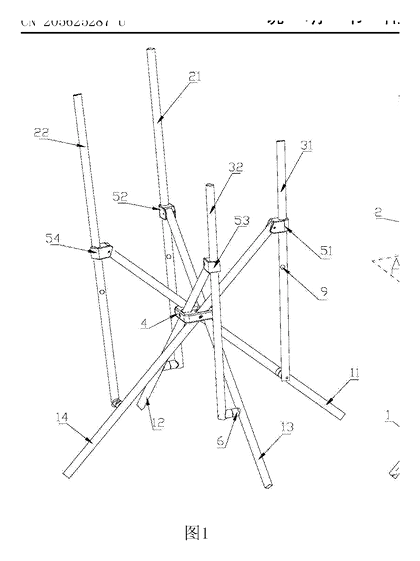
- A fixed seat (4) serves as the anchor point, containing four fixed through holes.
- Four base poles (1) are hinged into these holes. These include two front and two rear poles.
- Two backrest poles (2) and two armrest poles (3) have their bottoms hinged to specific sections of the base poles.
- Crucially, the upper parts of the backrest and armrest poles carry sliding parts (sliders).
- Each slider is hinged to the top of a base pole located on the opposite side of the chair. For example, the left front armrest slider connects to the right rear base pole’s top.
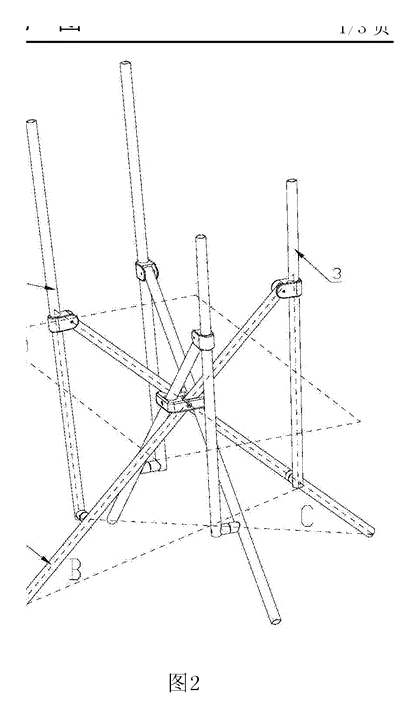
- This geometric crossing creates parallel planes of motion. As the user pushes the seat down or pulls it up, the sliders travel along the length of the backrest and armrest poles, forcing the base poles to swing inward and align perfectly for a compact fold.
Who it is for
- Outdoor furniture brands seeking lightweight, packable camping chairs that fold flatter than standard models.
- Event rental companies needing durable, easy-to-store seating for conferences and weddings where quick setup and teardown are critical.
- Retailers of compact home furniture looking for stools or side chairs that disappear into closets or under tables.
- Product designers exploring alternative folding kinematics that reduce part count compared to traditional scissor mechanisms.
How it works
The main parts
| No. | Part | What it does |
|---|---|---|
| 1 | Base Pole | Hinged at the seat, slides against opposing poles when folded. |
| 2 | Backrest Pole | Supports the back cushion; carries the backrest slider. |
| 3 | Armrest Pole | Supports the side cushion; carries the armrest slider. |
| 4 | Fixed Seat | Central hub with through holes for base pole pivots. |
| 5 | Slider/Sleeve | Moves along the backrest/armrest pole; hinged to the opposite base pole top. |
| 6 | Connector/Hinge | Joins pole bases to the seat or lower pole sections. |
| 7 | Cushion | Detachable fabric seat/back assembly. |
Opening and closing
- Unfold: Pull the armrests outward. The sliders move toward the bottom of the backrest poles.
- Lock Position: The base poles spread apart until they hit limit stops or reach full extension, forming a stable tripod-like base per side.
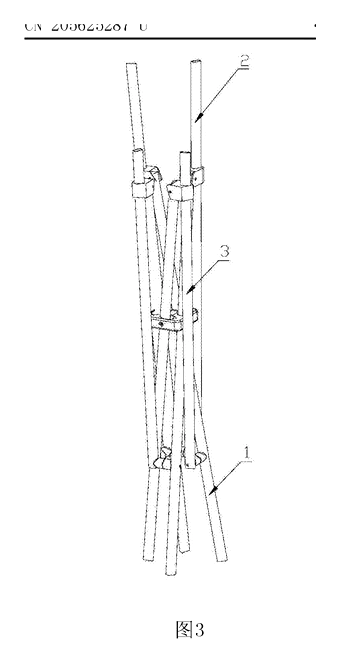
- Fold: Push the seat downward. The weight shifts, causing the sliders to move upward along the backrest poles.
- Collapse: Because the sliders are connected to the opposite base poles, the movement forces the base poles to rotate inward and lie flat against the backrest poles, creating a thin sandwich of metal tubes.
Applications
Camping and Outdoor Events
The compact folded profile allows these chairs to fit easily into car trunks or backpacks, making them ideal for festivals, beach trips, and hiking rest stops where space is premium.
Conference and Wedding Rentals
Venue operators benefit from the rapid setup and teardown speed. The chairs stack efficiently in transport trucks, reducing logistics costs for large-scale events requiring hundreds of seats.
Small Apartment Living
Urban dwellers with limited floor space can store these chairs in narrow closets or slide them completely under dining tables when not in use, keeping living areas uncluttered.
Retail Display Units
Store fixtures often need temporary seating for customers. This design offers a sleek, low-profile look when deployed and disappears quickly when shelf space needs to be reclaimed.
Where it is less suitable
- Heavy-duty industrial tasks: The sliding sleeve mechanism may wear faster if used for frequent high-load lifting rather than static sitting.
- Extreme weather exposure: Without significant coating upgrades, standard steel tubes may rust in saltwater environments unless specifically treated.
Frequently asked questions
How does the sliding mechanism actually work?
Instead of a single hinge, the chair uses a cross-linking system. The top of a leg (base pole) is attached to a slider that moves up and down the backrest pole on the opposite side. When you fold the chair, the sliders travel along the poles, pulling the legs inward and flattening the entire structure into a thin package.
Is this design stronger than a standard X-frame chair?
The patent focuses on the folding geometry rather than claiming superior strength. However, the direct connection of base poles to the central seat and the guided movement of sliders can reduce lateral wobble compared to loosely pinned X-frames. Strength depends on the tube gauge and weld quality chosen in production.
Can I use different materials for the frame?
Yes. The patent describes the structural relationships, not the materials. You can manufacture the poles from steel, aluminum, or even wood, provided they maintain the necessary rigidity and the sliding parts function correctly.
What happens if the sliders get stuck?
If dirt accumulates in the sleeve or the pole bends, the slider can bind. Proper design includes tolerances for smooth movement. In production, using nylon or POM for the slider sleeve against a powder-coated steel pole reduces friction and sticking risks.
Does it come with a cushion?
The patent includes claims for the complete chair with a detachable cushion. The cushion attaches to the tops of the armrest and backrest poles. It can be made from canvas or other fabrics and is designed to be removed for washing or replacement.
Is there a risk of pinching fingers?
Any folding mechanism has potential pinch points. The design uses sliding sleeves and hinged joints. To mitigate risk, manufacturers should ensure clearances meet safety standards (like ASTM F1938) and potentially add guards or rounded edges to moving parts.
Can this design be made and sold in the US?
The patent was filed only in China and has expired, so it does not restrict the design in the US or in China. However, folding chair mechanisms are heavily patented globally. We recommend a freedom-to-operate check to ensure no active US patents cover this specific cross-linked slider geometry.
Are you affiliated with the patent owner?
No. IP2M is an independent design and manufacturing service working from the public patent document.
Request a quote
Click Request a Quote below to see our email address - copy it, or open your email app with a ready-made message. Please mention patent CN205625287U in the subject.
Helpful details to include:
- Your company and channel (outdoor brand, event rental, furniture retailer)
- Target dimensions (seat height, width, folded thickness)
- Material preference (steel, aluminum, wood)
- Weight capacity requirements
- Estimated quantity and target price
- Timeline - when you would like samples and the first shipment
You can also reach us at (332) 203-9997.
Explore this product
Interested in building this?
Tell us your target market, quantity and timeline. We reply with options for prototyping, small-batch runs or volume production.
Send your inquiry to
Please put CN205625287U in the subject line and tell us your company, country, estimated quantity and timeline.
Prefer to talk? Call (332) 203-9997.
More product-ready patents
All Furniture, Bedding & Storage patents →
Furniture, Bedding & Storage
Roll-Up Travel Neck Pillow with Buckles
U-shaped travel pillow with a front buckle and a back buckle that holds it rolled up for carrying.
Patent CN206543091U
Furniture, Bedding & Storage
Width-Adjustable Slide Rail for Pull-Out Baskets
Basket slide rail on a slotted, scaled adjusting plate, so one pull-out basket fits several cabinet widths.
Patent CN208909382U
Furniture, Bedding & Storage
Lift-Up Storage Bed with Four-Bar Linkage That Slides the Deck Away from the Headboard
Storage bed deck that rises on four-bar linkages and gas springs, clearing the headboard as it opens.
Patent CN210870645U
Furniture, Bedding & Storage
Self-Leveling, Nesting Table Base with a Torsion-Ring Leg Hub
Four-leg base that self-levels through a torsion-ring hub and nests sideways with flip-top tables.
Patent CN211483640U
Furniture, Bedding & Storage
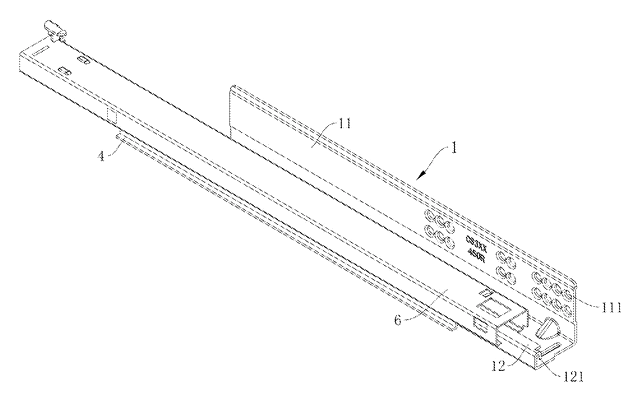
Rack-and-Pinion Synchronized Drawer Slide with a Folded-In Fixed Rail
Full-extension drawer slide: a pinion between two racks keeps the rails moving in step.
Patent CN206314843U
Furniture & Bedding
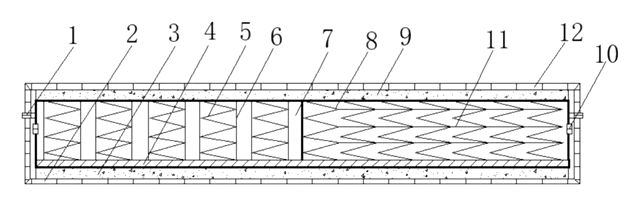
Dual-Zone Split-Spring Mattress with Removable Fabric Cover
Half-pocket, half-standard spring mattress sharing one base plate, with a removable cover.
Patent CN208355064U
Browse by category
- Apparel & Accessories (36)
- Baby & Kids (25)
- Bags & Luggage (15)
- Bath & Personal Care (25)
- Car Accessories (21)
- Furniture, Bedding & Storage (19)
- Garden & Outdoor (27)
- Health & Wellness (12)
- Home, Kitchen & Cleaning (40)
- Lighting (20)
- Packaging & Containers (10)
- Pet Products (9)
- Phone & Camera Accessories (7)
- Retail Display (21)
- School, Office & Art (30)
- Sports & Recreation (37)
- Tools & Workshop (46)
- Toys & Games (19)
This page is based on the public patent document CN205625287U, assigned to Individual. IP2M is an independent manufacturing service and is not affiliated with, endorsed by or licensed by the patent owner. Images marked as concept renderings are illustrations, not photos of an existing product. Patent status information is provided for reference only and is not legal advice; confirm freedom to operate for your market before production. Full disclaimer.