
Patent CN205639076U
Updated November 2, 2026Involute-Channel Blower Fan for Powered Respiratory Masks
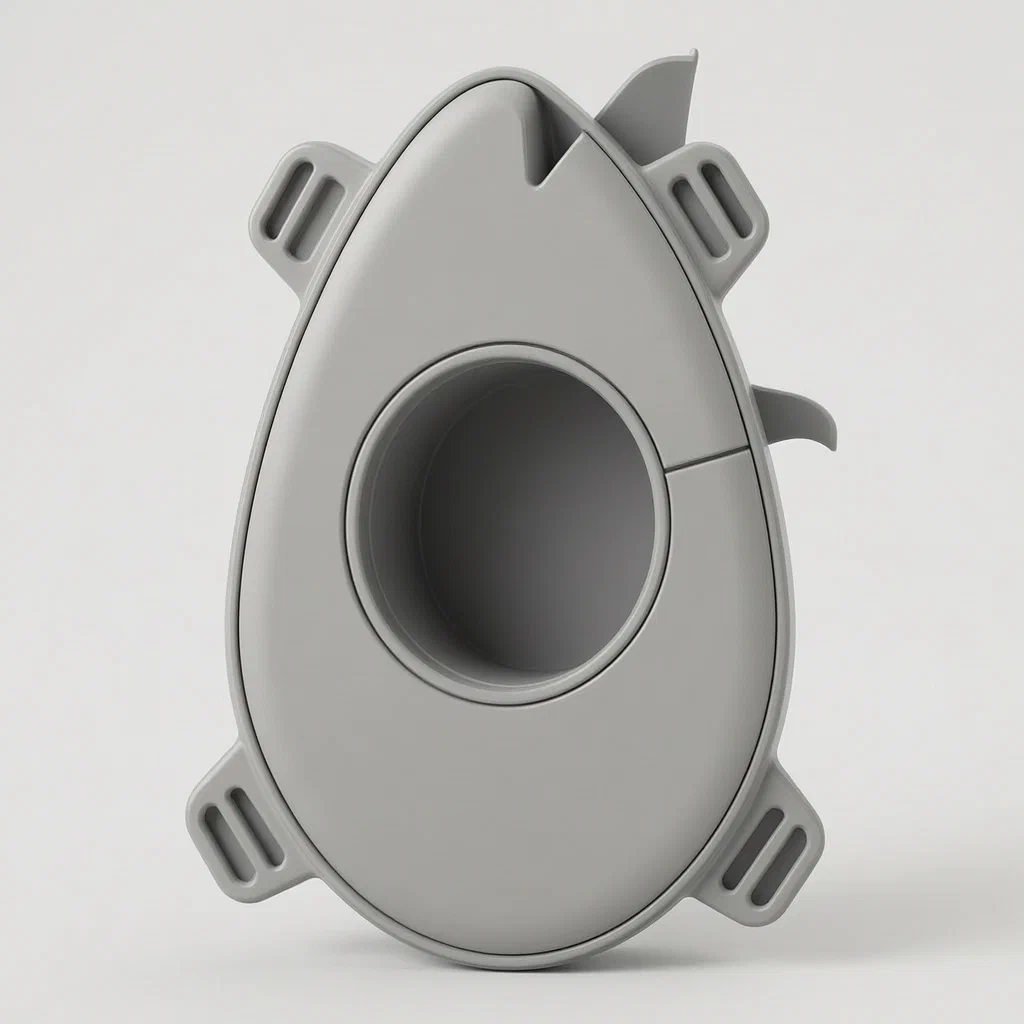
Standard fans in powered masks often struggle with noise and uneven airflow distribution, causing discomfort and battery drain. This utility model introduces a specialized involute air channel within the fan housing. By widening the channel progressively along the fan's rotational path, the design optimizes pressure conversion, delivering higher air volume at lower power. Integrated V-shaped curved baffles further refine the exit flow, directing air gently to both sides of the nose. The result is a quieter, more efficient blower unit specifically engineered for the ergonomic demands of wearable respiratory protection devices.
- China utility model - lapsed
- No filings outside China
- Health & Personal Protection
- Plastic housing, motorized impeller, baffle assembly
Splat! What let you down?
🌀
Involute Air Channel
The cavity wall widens gradually along the fan's rotation, optimizing air expansion.
🔇
Reduced Noise Profile
**According to the patent,** the channel geometry lowers energy use and dampens operational sound.
💨
V-Shaped Baffles
Curved dividers at the outlet split and guide airflow smoothly toward the nostrils.
🔋
Integrated Power System
Housing includes compartments for the motor, battery, and circuit board with external switch.
Bring this product to market
- ✓ Patent vetted China-only family and legal status checked
- 2 Product brief · now How it works, uses and options written up
- 3 Prototype First samples for buyers to review
- 4 Pilot run Small first batch for launch customers
- 5 Volume production Repeat orders at scale
Buyer interest
– of 100 buyers needed to start prototyping
One click, no sign-up. Each vote is one real visitor, and products with the most interest go to prototyping first.
Build team: no members yet. Need a partner, co-funding or skills to build this? Join and we introduce the team once it forms.
The problem
In powered respiratory masks, traditional blower units often produce turbulent airflow and significant mechanical noise. When air is forced through a straight or uniform cross-section channel, the transition from high-pressure compression at the impeller to low-pressure delivery at the outlet can be inefficient. This inefficiency requires higher motor speeds to achieve adequate ventilation, which increases power consumption and drains batteries quickly. Furthermore, uneven airflow exiting the mask can cause discomfort around the nose and mouth, leading users to adjust their fit frequently or discontinue use due to irritation. The challenge is to create a compact fan assembly that delivers sufficient air volume for breathing comfort without excessive noise or energy loss.
The solution
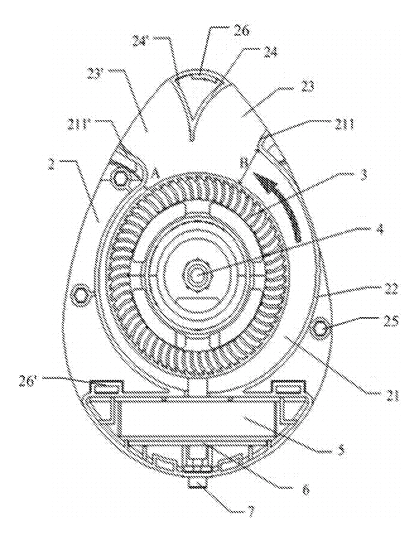
- The housing consists of a front cover (1) and a rear lid (2). The front cover contains a central air inlet (11), sized larger than the inner diameter of the fan blades but smaller than the outer diameter.
- The rear lid forms a cavity (21) that acts as the air channel. A fan (3) with a motor is mounted in the middle of this cavity.
- The key feature is the sidewall (22) of the cavity, which is shaped as an involute. It gradually widens from the edge of the fan in the direction of the fan’s rotation. One end near the outlet is closest to the fan edge, while the opposite end is furthest.
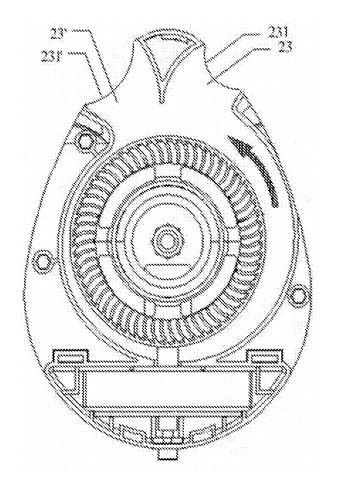
- At the top of the sidewall, there are air outlets (23, 23’). These outlets may include notches (231) to facilitate smooth air release.
- Inside the outlet area, curved baffles are installed. A first curved baffle (24) and a second curved baffle (24’) form a V-structure. These baffles divert the wind, splitting it into two streams that flow toward the sides of the nose.
- Arc flanges (211) are placed at the ends of the sidewall near the outlets to further control the wind direction.
Who it is for
- Respiratory device manufacturers seeking to improve the ergonomics and battery life of powered air-purifying respirators (PAPRs) or smart masks.
- Medical equipment brands developing lightweight, low-noise ventilation aids for patients requiring assisted breathing in non-clinical settings.
- Consumer electronics companies entering the personal health market with wearable air quality solutions that prioritize user comfort.
- OEM integrators looking for a pre-engineered blower module that reduces acoustic testing requirements by leveraging passive aerodynamic noise reduction.
How it works
The main parts
| No. | Part | What it does |
|---|---|---|
| 1 | Front Cover | Houses the air inlet; connects to the rear lid via dowels and clips. |
| 2 | Rear Lid | Forms the main cavity and holds the motor/battery compartment. |
| 3 | Fan/Motor | Draws air in and pushes it into the expanding channel. |
| 11 | Air Inlet | Circular opening sized to optimize intake relative to blade span. |
| 21 | Cavity | The internal space acting as the air channel. |
| 22 | Sidewall | Involute shape that widens along the rotation direction. |
| 23/24 | Outlets/Baffles | Directs and splits airflow using V-shaped curved structures. |
Operating Steps
- Intake: Air enters through the circular air inlet (11) on the front cover. The inlet size is calibrated to allow active draught without turbulence.
- Compression & Expansion: The fan (3) rotates, pushing air into the cavity (21). Because the sidewall (22) follows an involute curve, the channel volume increases gradually in the direction of rotation. This expansion converts kinetic energy into static pressure efficiently.
- Diversion: As the air approaches the outlets (23), it encounters the V-shaped baffles (24, 24’). These curved surfaces split the single stream into two distinct flows.
- Delivery: The split streams are guided by the arc flanges and baffles toward the user’s nostrils, providing balanced and gentle ventilation.
Applications
Smart Respiratory Masks
Wearable masks equipped with small blowers need to operate quietly to avoid social embarrassment. The involute channel reduces the motor speed required for adequate airflow, lowering noise levels for public use.
Medical Ventilation Aids
For patients using portable oxygen concentrators or CPAP-like devices, consistent airflow is critical. The V-baffles ensure air is delivered evenly to both nostrils, preventing dry spots and improving compliance with therapy.
Industrial Dust Protection
Workers in dusty environments require powered respirators that run for long shifts. The energy-efficient design extends battery life, allowing for longer periods of protection between charges.
Automotive Cabin Air Systems
Compact blowers can be adapted for localized air circulation in vehicle interiors. The directional baffles help focus airflow to specific zones, such as the driver’s face, without wasting energy on the entire cabin.
Where it is less suitable
- High-volume industrial ventilation: This design is optimized for low-power, compact applications like masks, not for moving large quantities of air in factory settings.
- Static-only filtration: If no motor is present, the involute channel provides no benefit over standard passive vents.
- Extreme temperature environments: Plastic housings and standard motors may degrade faster in very hot or cold conditions compared to metal-bodied industrial fans.
Frequently asked questions
Why is the air channel “involute”?
An involute shape widens gradually along the direction of the fan’s rotation. This geometry allows the compressed air to expand smoothly rather than abruptly. According to the patent, this design achieves greater air output with less energy consumption and reduced noise compared to straight-channel fans.
How do the baffles improve breathing?
The V-shaped curved baffles at the outlet split the airflow into two streams. These streams are directed toward the left and right sides of the user’s nose. This prevents concentrated, uncomfortable blasts of air and ensures even distribution across the nasal passages.
Is the fan loud?
The patent describes the involute channel as a method to reduce noise generated by the rotating blades. Actual decibel levels depend on the motor selection and RPM settings chosen during production, but the aerodynamic design helps minimize turbulence-related sound.
What materials are used?
The patent specifies a housing with a front cover and rear lid, typically made from molded plastic. Materials like ABS or PC are common choices for durability and ease of cleaning, though the specific polymer is determined by the manufacturer’s design needs.
Can I change the battery size?
Yes. The rear lid includes a containing cavity for the battery and circuit board. You can customize the battery capacity to match your desired runtime, provided the physical dimensions fit within the mold tooling.
Does this work with standard filters?
The patent focuses on the blower mechanism. However, the front cover’s air inlet can be adapted to connect with various filter holders. Integrating a standard HEPA or electrostatic filter cartridge requires additional design work beyond the base patent claims.
Can this design be made and sold in the US?
The patent was filed only in China and is now lapsed due to unpaid fees. It does not restrict manufacturing or sales in the US. However, powered mask systems are subject to other active patents and strict regulatory frameworks (FDA, NIOSH). We recommend a freedom-to-operate check before launching a commercial product.
Are you affiliated with the patent owner?
No. IP2M is an independent design and manufacturing service working from the public patent document.
Request a quote
Click Request a Quote below to see our email address - copy it, or open your email app with a ready-made message. Please mention patent CN205639076U in the subject.
Helpful details to include:
- Your company and channel (medical device maker, consumer electronics brand, industrial supplier)
- Target airflow (CFM) and noise limit (dB)
- Battery capacity and runtime requirements
- Filter compatibility needs
- Estimated quantity and target price
- Timeline - when you would like samples and the first shipment
You can also reach us at (332) 203-9997.
Explore this product
Interested in building this?
Tell us your target market, quantity and timeline. We reply with options for prototyping, small-batch runs or volume production.
Send your inquiry to
Please put CN205639076U in the subject line and tell us your company, country, estimated quantity and timeline.
Prefer to talk? Call (332) 203-9997.
More product-ready patents
All Apparel & Accessories patents →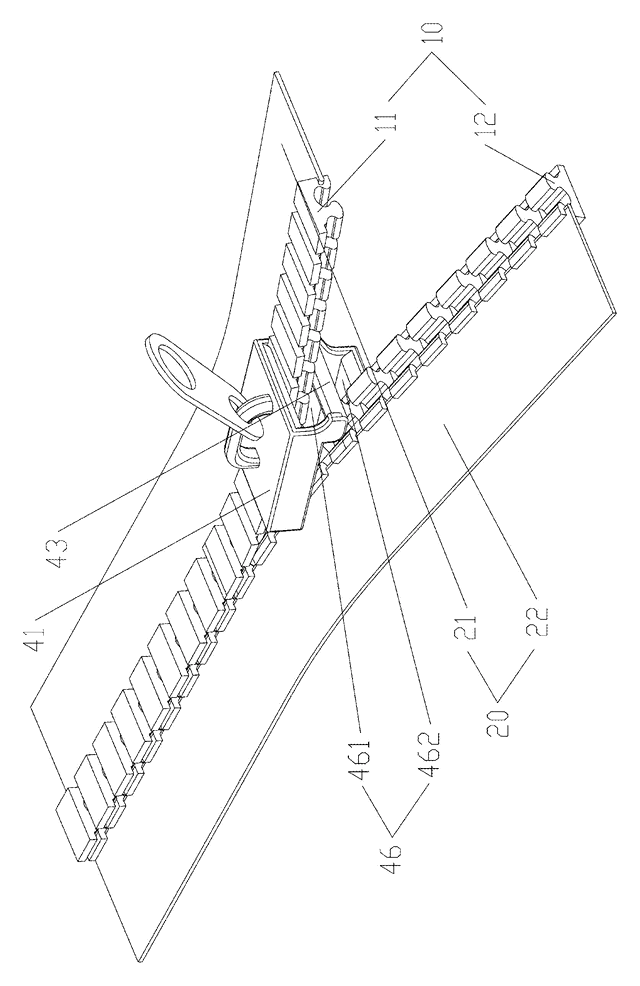
Apparel & Accessories
Stacked Zipper with Teeth That Mesh Top-to-Bottom
Zipper whose two identical tooth rows mesh on top of each other, closed by a simplified slider.
Patent CN205795062U
Apparel & Accessories
Impact-Resistant Glove with a 3D-Printed Lattice Layer
Work glove with a 3D-printed lattice impact layer, TPU knuckle guards and a light mounting area.
Patent CN213785583U
Apparel & Accessories
Massage Insole with Spring-Back Silicone Nubs and a Removable Top Layer
Layered insole: silicone nubs rise through a removable perforated top sheet and sink under each step.
Patent CN208286505U
Apparel & Accessories
Heel-Less Carbon Plate Running Shoe Sole for Forefoot Strikers
Running sole for forefoot strikers: no ground-touching heel, winged carbon plate between two midsoles.
Patent CN216723354U
Apparel & Accessories
Waterproof Magnetic Zipper Stop That Snaps the Two Halves Together
Separating-zipper stop with sealed magnets: pin and box snap together one-handed, safe in rain and wash.
Patent CN215075936U
Apparel & Accessories
Left-Right Specific Soccer Socks: Grip for the Plant Foot, Touch Pads for the Kicking Foot
Soccer socks knitted as a left-right pair: grip zones for the plant foot, pads for the kicking foot.
Patent CN212728807U
Browse by category
- Apparel & Accessories (30)
- Baby & Kids (20)
- Bags & Luggage (13)
- Bath & Personal Care (21)
- Car Accessories (16)
- Furniture, Bedding & Storage (15)
- Garden & Outdoor (21)
- Health & Wellness (10)
- Home, Kitchen & Cleaning (32)
- Lighting (16)
- Packaging & Containers (8)
- Pet Products (7)
- Phone & Camera Accessories (6)
- Retail Display (17)
- School, Office & Art (24)
- Sports & Recreation (31)
- Tools & Workshop (36)
- Toys & Games (16)
This page is based on the public patent document CN205639076U, assigned to Nature Of Environmental Science And Technology Co Ltd (beijing). IP2M is an independent manufacturing service and is not affiliated with, endorsed by or licensed by the patent owner. Images marked as concept renderings are illustrations, not photos of an existing product. Patent status information is provided for reference only and is not legal advice; confirm freedom to operate for your market before production. Full disclaimer.