At a glance
| Patent number | CN205639076U (application CN201620414265) |
| Type | China utility model (实用新型) - protects product shape and structure |
| Original title | Fan reaches electronic gauze mask including this fan (风机及包括该风机的电动口罩) |
| Patent owner | Nature Of Environmental Science And Technology Co Ltd (beijing) |
| Inventors | Wang Hongbing |
| Filing date | 2016-05-09 |
| Grant date | 2016-10-12 |
| Status (China) | Lapsed - terminated for non-payment of annual fees (recorded 2024-05-17) |
| Patent family | Chinese filings only - no US, European, Japanese, PCT or other filings listed |
| Cited by | 1 later document |
| Source | Google Patents (search for CN205639076U) |
What the claims cover, in plain language
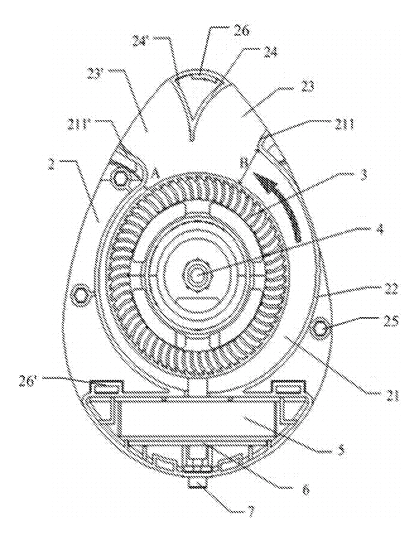
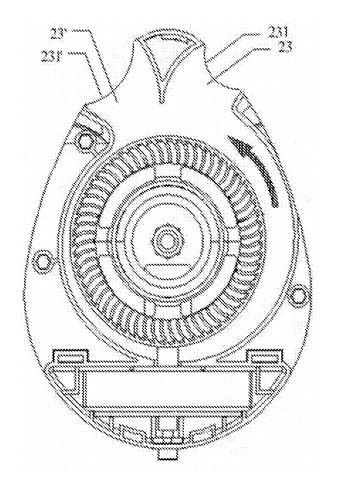
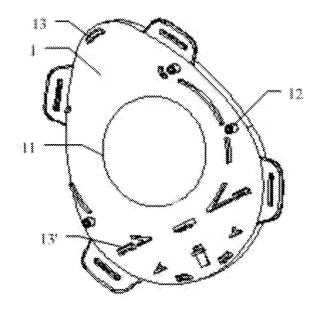
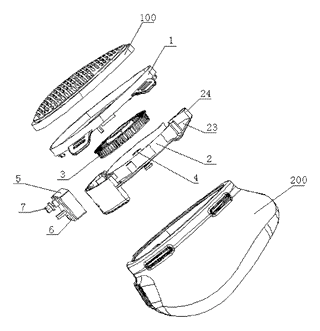
Claim 1 - a blower fan comprising a housing made of a front cover and a rear lid. The front cover has a central air inlet. The rear lid forms a cavity serving as an air channel, with a fan mounted in the middle. The top of the cavity’s sidewall has an air outlet. Crucially, the sidewall is arranged in an involute shape along the fan’s direction of rotation.
Claim 2 - specifies the distance of the sidewall from the fan edge varies, being minimum at one end of the outlet and maximum at the other. Claim 3 - adds a first curved baffle at the upper part of the air outlet for wind diversion. Claim 4 - introduces a second curved baffle forming a V-structure with the first baffle. Claim 5 - describes arc flanges at the two ends of the sidewall near the outlet. Claim 6 - defines the air inlet diameter as larger than the fan blade inner diameter but smaller than the outer diameter. Claims 7-9 - detail the mounting mechanisms (dowels, holes, clips), the inclusion of a motor, battery, and circuit board within the rear lid’s containing cavity, and an external switch. Claim 10 - claims an electric mask including any of the aforementioned blower fans.
This is a simplified reading for orientation only. The legal scope is defined by the exact claim wording in the official Chinese document.
What this means for US production
This patent was filed only in China and is currently lapsed due to non-payment of fees. Consequently, the specific structural claims do not restrict manufacturing or sale in China anymore. There is no corresponding US patent application or grant associated with this family.
Two points to settle early:
- Other patents may exist. While this specific involute channel design is lapsed, the field of powered respirators and mask blowers is heavily patented globally. LG Electronics (listed as citing this patent in Korea) and Ingenio Technology hold related IP. A freedom-to-operate (FTO) review is essential to ensure your specific motor integration, battery management, and overall mask assembly do not infringe on active US patents held by major medical device or consumer electronics players.
- Component sourcing. The patent describes a generic motor and battery setup. Sourcing components that meet US safety standards (UL) for lithium-ion batteries and electrical insulation is a separate compliance task not covered by the patent text.
Customization and manufacturing
What can be customized
| Area | Options |
|---|---|
| Material | ABS, PP, or PC plastics for the housing; silicone seals for the interface. |
| Motor Type | Brushless DC (BLDC) for longevity; brushed for cost-efficiency. |
| Battery Capacity | Sized based on desired runtime (e.g., 4 hours vs. 8 hours continuous use). |
| Baffle Geometry | Adjust curvature of V-baffles to fine-tune airflow dispersion pattern. |
| Filter Integration | Housing can be modified to accept replaceable HEPA or N95 filter cartridges. |
| Control Interface | Simple on/off switch vs. variable speed dial or digital display. |
Things to plan for (US market)
- FDA Registration: If marketed for medical purposes (respiratory aid), the device must be registered with the FDA. If sold as general wellness/consumer, labeling must strictly avoid medical claims.
- UL 62368-1: Safety standard for audio/video, information, and communication technology equipment, often applied to consumer electronics with batteries.
- UN 38.3: Transport testing for lithium-ion batteries if shipping internationally or domestically via air freight.
- FCC Part 15: Electromagnetic interference certification for the motor and circuit board to ensure they do not disrupt other wireless devices.
- NIOSH Approval: If the final mask assembly is intended for occupational respiratory protection, it requires NIOSH certification, which involves rigorous testing of the entire system (filter + blower + seal).
How a project runs
- Concept & CAD: Define dimensions, airflow targets, and aesthetic style. Model the involute channel precisely.
- Tooling Design: Create molds for the front cover, rear lid, baffles, and fan blades.
- Prototyping: Print SLA/SLS prototypes to test airflow and noise levels. Iterate on baffle angles.
- Electronics Integration: Assemble motor, battery, and PCB. Test heat dissipation and vibration isolation.
- Certification Prep: Submit samples for FCC, UL, and potentially FDA/NIOSH depending on marketing claims.
Quantities & timeline
Precision injection molding is required for the involute channel to maintain aerodynamic efficiency. Tooling lead times typically range from 4-6 weeks for complex multi-cavity molds. Assembly lines must accommodate automated screw driving and seal checking. Send us your target CFM, noise level, battery capacity, and monthly volume and we will reply with options.
Patent drawings
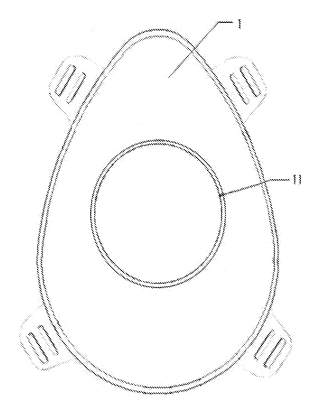
Drawings reproduced from the public patent document for reference.