
Patent CN205730107U
Updated October 24, 2026Competition Kettlebell Made from Pressed Steel Halves
Most kettlebells are cast iron, poured into a sand mold for every single bell - a slow, dusty process that leaves rough surfaces and wide weight tolerances. This patent makes the bell like a pressure tank. Two hemispheres are drawn from steel plate on a hydraulic press; the top half is punched with two oval holes; a steel bar is bent into a U-shaped handle, polished and plated, and its ends are pushed through the holes and welded. The bottom is pressed flat, the halves are welded together at the seam, the shell is filled to the target weight through the handle holes, and only then is the handle welded in and the bell painted. Every bell can share one outer shell, as competition bells do.
- China utility model - lapsed
- No filings outside China
- Kettlebells & strength training
- Deep-drawn steel shell, bent steel handle
Splat! What let you down?
🏭
Pressed, not cast
Two hemispheres are deep-drawn from steel plate and welded - no sand casting.
⚖️
Filled to weight
The hollow shell is filled with a mass, so one shell size can carry different weights.
🔩
Welded-in handle
A bent steel bar passes through two oval holes in the top half and is welded in.
🏷️
Flat logo areas
Flat faces front and back take printed weights and logos; the base is pressed flat.
Bring this product to market
- ✓ Patent vetted China-only family and legal status checked
- 2 Product brief · now How it works, uses and options written up
- 3 Prototype First samples for buyers to review
- 4 Pilot run Small first batch for launch customers
- 5 Volume production Repeat orders at scale
Buyer interest
– of 100 buyers needed to start prototyping
One click, no sign-up. Each vote is one real visitor, and products with the most interest go to prototyping first.
Build team: no members yet. Need a partner, co-funding or skills to build this? Join and we introduce the team once it forms.
The problem
Kettlebells are simple objects with an awkward way of being made. Cast iron bells need a sand mold for each pour, and the finish, wall thickness and final weight vary from bell to bell. Competition kettlebells - used in kettlebell sport (girevoy sport) - add another demand: every weight is expected to have the same outer size and handle, so the lifter’s technique does not change as the weight goes up. Cast-steel competition bells meet that, but they are expensive. The patent proposes making the bell from pressed sheet steel instead.
The solution
The patent builds the kettlebell from formed and welded parts:
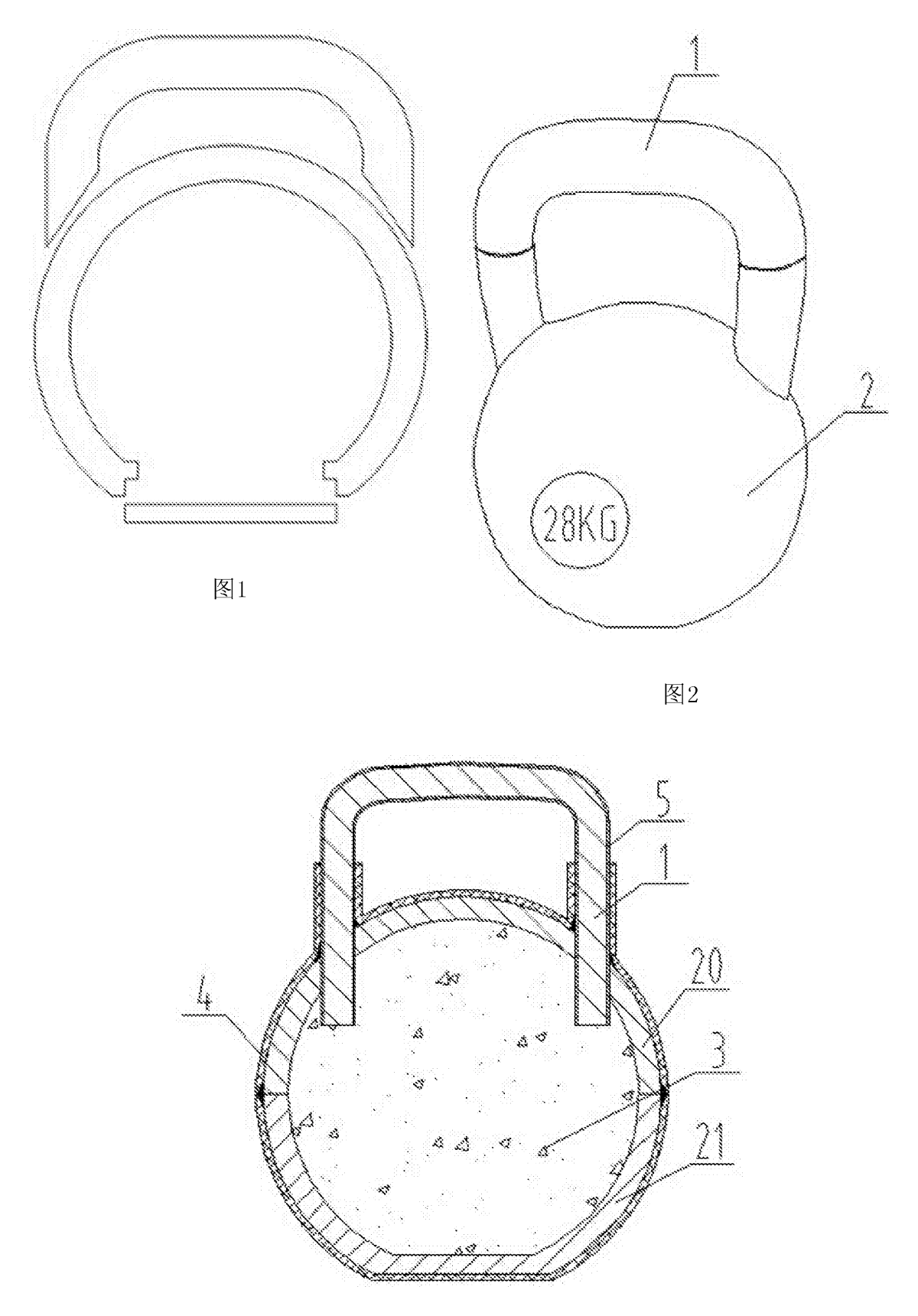
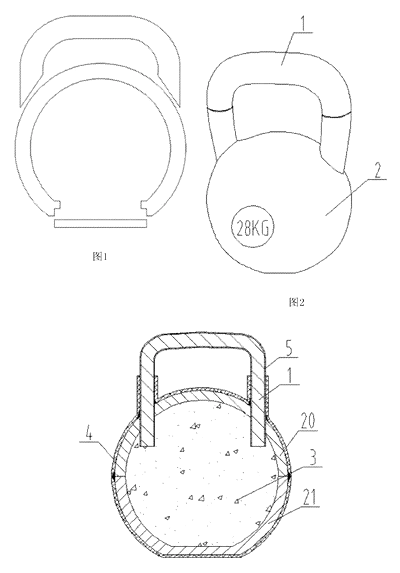
- The body is a spherical shell (2) made of an upper half (20) and a lower half (21), each deep-drawn from steel plate on a hydraulic press.
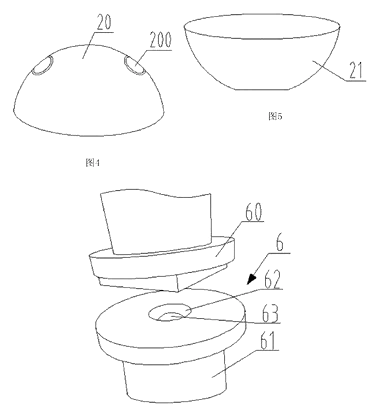
- The upper half is punched with two oval holes (200), and the two halves are welded together at the seam.
- The shell is filled through the holes with a mass (3) that brings the bell to its weight - the patent lists materials such as sand, iron ore, steel balls and shot.
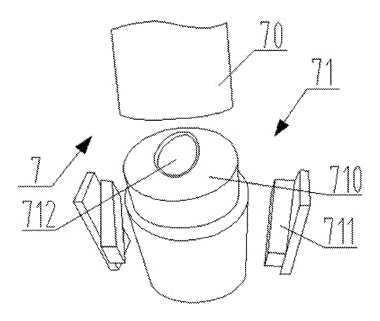
- A U-shaped handle (1), bent from steel bar, is pushed into the holes and welded to the shell, closing them.
- The bottom is pressed flat so the bell stands steady; the front and back have flat faces for the logo and weight.
- The shell gets a paint layer (4) that extends onto the handle, and the handle is electroplated (5).
Who it is for
- Fitness equipment brands that want competition-style bells at a lower cost than cast steel.
- Gym and CrossFit-style box suppliers buying full sets where every bell must look and feel the same.
- E-commerce fitness sellers looking for a cleaner, more uniform finish than budget cast iron.
- Kettlebell sport clubs and coaches ordering branded bells for training groups.
How it works
The main parts
| No. | Part | What it does |
|---|---|---|
| 1 | Handle | U-shaped steel bar; ends welded into the upper half. |
| 2 | Shell | Hollow steel ball welded from two halves. |
| 20 | Upper half | Deep-drawn hemisphere with two oval holes (200) for the handle. |
| 21 | Lower half | Deep-drawn hemisphere with a flat bottom. |
| 3 | Fill | Mass inside the shell that sets the weight. |
| 4 | Paint layer | Covers the shell and runs onto the handle. |
| 5 | Plating | Electroplated finish on the handle. |
How the bell is made
The patent lists the steps:
- Handle - draw steel bar, cut, bend into a U, shape, grind, polish and plate.
- Blanking - cut steel plate into blanks for the two halves.
- Deep drawing - press each blank into a hemisphere in a drawing die on a four-column hydraulic press.
- Trimming - grind, deburr and trim the edges.
- Punching - punch the two oval handle holes in the upper half.
- Flattening - press the bottom of the lower half flat.
- Welding - size both halves, fit them together, weld the seam and grind it smooth.
- Filling - fill the shell to the nominal weight through the handle holes.
- Handle - insert the handle ends into the holes, weld them and grind the welds flat.
- Finishing - inspect and true the surface, then paint with the handle grip masked.
Applications
Commercial gyms
Matched sets where every weight shares one shell size, ordered in gym colors with the club logo.
Kettlebell sport training
Competition-style dimensions so lifters keep the same technique from light to heavy bells.
Home gyms
A smooth, uniform finish that is kinder to floors and easier to clean than rough cast iron.
Corporate wellness and hotel gyms
Branded bells with flat logo faces for printing.
Physical-training programs
Uniform bells for schools, teams and fitness classes.
Where it is less suitable
- Very heavy bells outdoors without care - a welded, filled shell must be sealed well so moisture cannot get inside.
- Buyers who require official competition approval - federation-approved bells follow exact specifications that must be confirmed separately.
Frequently asked questions
How is this different from a cast iron kettlebell?
A cast bell is poured into a sand mold one at a time. This bell is made from two hemispheres pressed from steel sheet, welded together, filled to weight through the handle holes and closed by welding in a bent steel bar as the handle, then painted. Pressing gives a smoother, more uniform shell.
What is a competition kettlebell?
In kettlebell sport, bells of every weight have the same outer size and handle, so technique stays the same as the weight increases. A hollow shell that is filled to weight suits that idea.
What is inside the shell?
The patent fills the shell through the handle holes before the handle is welded in, and lists fill materials such as sand, iron ore, steel balls and shot, mixed to suit the nominal weight. For the US we use lead-free fills and pack them so the bell does not rattle or shift.
Which weights can be made?
The patent does not list a weight range; one drawing shows a bell marked 20 kg. Which weights can share one shell is set in design, depending on shell volume and fill density.
Will the weld or handle fail?
The handle ends pass through two holes in the upper half and are welded, and the halves are welded at the seam. We test handle pull strength and drop the bells onto hard floors on samples before production.
Can I get color-coded bells with our logo?
Yes. The front and back faces are flat for printed logos and weights, and the paint can be color-coded by weight.
Can this design be made and sold in the US?
The patent was filed only in China and has lapsed, so it does not restrict the design in the US or in China. Kettlebell designs may be covered by other US patents - see Patent & Production - so we recommend a freedom-to-operate check before volume production.
Are you affiliated with the patent owner?
No. IP2M is an independent design and manufacturing service working from the public patent document.
Request a quote
Click Request a Quote below to see our email address - copy it, or open your email app with a ready-made message. Please mention patent CN205730107U in the subject.
Helpful details to include:
- Your company and channel (fitness brand, gym supplier, club, resale)
- Weight range and units (kg or lb)
- Finish and colors - paint, powder coat, color coding, base pad
- Logo and markings
- Estimated quantity per weight and target price
- Timeline - when you would like samples and the first shipment
You can also reach us at (332) 203-9997.
Explore this product
Interested in building this?
Tell us your target market, quantity and timeline. We reply with options for prototyping, small-batch runs or volume production.
Send your inquiry to
Please put CN205730107U in the subject line and tell us your company, country, estimated quantity and timeline.
Prefer to talk? Call (332) 203-9997.
More product-ready patents
All Sports & Recreation patents →
Sports & Recreation
Compact Torsion-Spring Bike Bell
Mini bike bell with a standard torsion spring and a rubber-floated dome - small size, clear tone, quick strap mount.
Patent CN205819384U
Sports & Recreation
Padded Toe-Box Shield for Sneakers
Ventilated, silicone-lined toe-box insert that supports the front of a sneaker and cushions the toes.
Patent CN209473731U
Sports & Recreation
Reversible Fishing Seat-Box Lid with Backrest
Fishing seat-box lid that flips on removable hinge pins: cushion, backrest and storage on one face.
Patent CN208624426U
Sports & Recreation
Swivel-Pin Skateboard Truck with Rubber Sleeve
Skateboard truck with a turning center pin, a tilting axle clamp and a rubber sleeve that centers it.
Patent CN216777880U
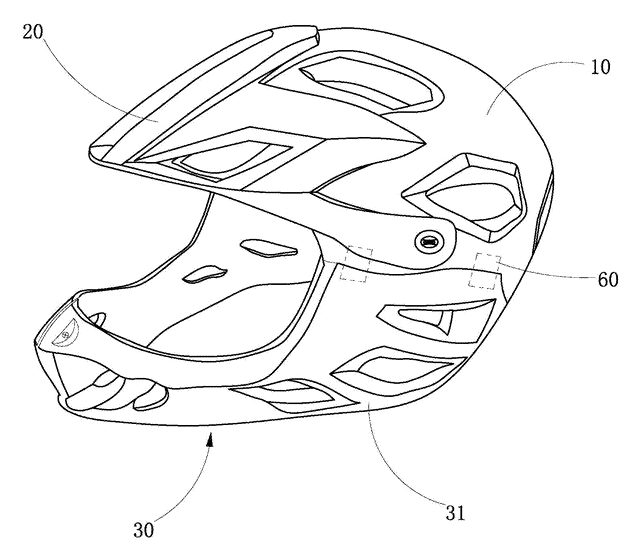
Sports & Recreation
Full-Face Bike Helmet with Magnetic Detachable Chin Bar
Full-face cycling helmet whose chin bar clips on and off with magnetic, latching side connectors.
Patent CN206630067U
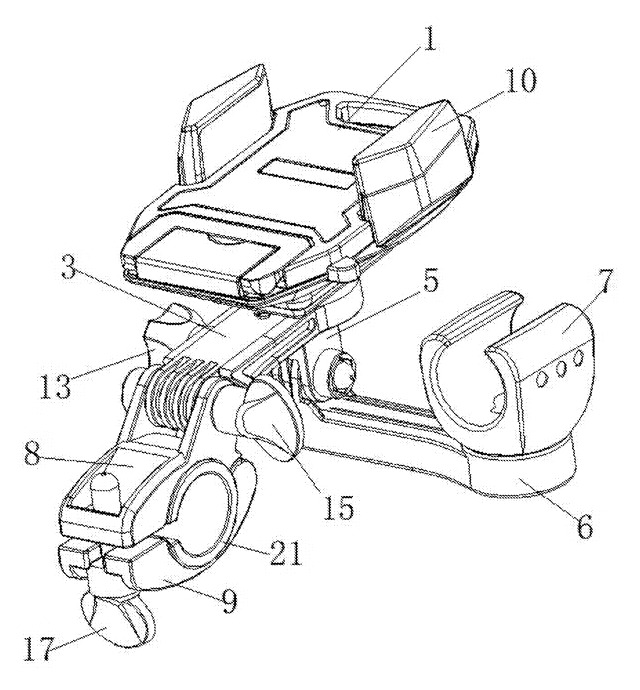
Sports & Recreation
Bike Phone Holder with Built-In Flashlight Clamp
Handlebar mount with a phone cradle on top and a flashlight clamp below, on one arm.
Patent CN206077485U
Browse by category
- Apparel & Accessories (22)
- Baby & Kids (16)
- Bags & Luggage (9)
- Bath & Personal Care (16)
- Car Accessories (10)
- Furniture, Bedding & Storage (12)
- Garden & Outdoor (18)
- Health & Wellness (8)
- Home, Kitchen & Cleaning (24)
- Lighting (12)
- Packaging & Containers (6)
- Pet Products (6)
- Phone & Camera Accessories (4)
- Retail Display (13)
- School, Office & Art (19)
- Sports & Recreation (25)
- Tools & Workshop (27)
- Toys & Games (12)
This page is based on the public patent document CN205730107U, assigned to Rudong Tongye Fitness Equipment Co., Ltd.. IP2M is an independent manufacturing service and is not affiliated with, endorsed by or licensed by the patent owner. Images marked as concept renderings are illustrations, not photos of an existing product. Patent status information is provided for reference only and is not legal advice; confirm freedom to operate for your market before production. Full disclaimer.