At a glance
| Patent number | CN205730107U (application CN201620403561) |
| Type | China utility model (实用新型) - protects product shape and structure |
| Original title | Competition kettlebell (竞赛壶铃) |
| Patent owner | Rudong Tongye Fitness Equipment Co., Ltd. |
| Inventors | Cai Jianfei |
| Filing date | 2016-05-06 |
| Grant date | 2016-11-30 |
| Status (China) | Lapsed - terminated for non-payment of annual fees (recorded 2020-04-24) |
| Patent family | Chinese filings only - no US, European, Japanese, PCT or other filings listed |
| Cited by | 8 later documents |
| Source | Google Patents (search for CN205730107U) |
What the claims cover, in plain language
Claim 1 - a competition kettlebell with a U-shaped handle, a shell and a mass filled in the shell. The shell is an upper half and a lower half welded together, both stretch-formed from metal sheet, and the two ends of the handle are inserted into and fixed to the upper half.
Claim 2 - the shell is spherical; both halves are hemispheres drawn from metal sheet, and the handle is bent from metal bar. Claim 3 - the bottom of the lower half is flat. Claim 4 - the shell has a coating that extends onto the handle, and the handle has an electroplated layer. Claim 5 - the sheet is iron or steel plate and the bar is iron or steel bar.
This is a simplified reading for orientation only. The legal scope is defined by the exact claim wording in the official Chinese document.
What this means for US production
This patent was filed only in China and has lapsed, so it no longer restricts anyone in China either. It has no US or other foreign counterpart.
Before production, keep in mind:
- Other patents may exist. Adjustable and hollow-shell kettlebells are covered by US patents held by fitness brands, and a later European kettlebell maker cites this patent. Have a freedom-to-operate (FTO) search done by a US patent attorney before volume production, especially for any adjustable-weight version.
- Weight accuracy matters. Gyms and sport clubs expect bells to be within a tight tolerance of the marked weight; the fill and welding process must be controlled.
Customization and manufacturing
What can be customized
| Area | Options |
|---|---|
| Weights | Full range in kg or lb from one or two shell sizes - confirmed in design |
| Shell | Steel thickness, single competition size or sizes per weight |
| Fill | Lead-free fill such as steel shot, iron ore or sand; fixed weight only |
| Handle | Diameter, window size, plated or powder-coated finish |
| Finish | Color coding by weight, powder coat or paint, rubber base pad |
| Branding | Printed or embossed logo and weight on the flat faces |
Things to plan for (US market)
- Lead-free fill - the patent lists several fill materials; US versions should use steel shot, iron ore or sand, never lead compounds.
- Prop 65 - review paint, plating and any rubber base for listed substances such as lead when selling in California.
- Weight labeling - marked weights must be accurate; state weights-and-measures and FTC truth-in-advertising rules apply to stated weights.
- Weld and drop testing - in-house drop tests onto hard floors and pull tests on the handle weld before shipping.
- Shipping - heavy bells need reinforced cartons or pallets to meet carrier rules.
How a project runs
- Inquiry - weight range, units, colors, branding and quantity.
- Design - shell size, steel thickness, handle and fill method.
- Prototype - sample bells for weight accuracy, weld strength and drop tests.
- Pilot run - a small set for finish and packaging checks.
- Production - volume production, packaging and shipping.
Quantities & timeline
Each shell size needs a blanking die, a deep-drawing die and a punching die for a hydraulic press, plus welding fixtures and a filling process; color and logo changes are cheap once tooling exists. Send us your weight range, finish, quantity and target price and we will reply with options.
Patent drawings
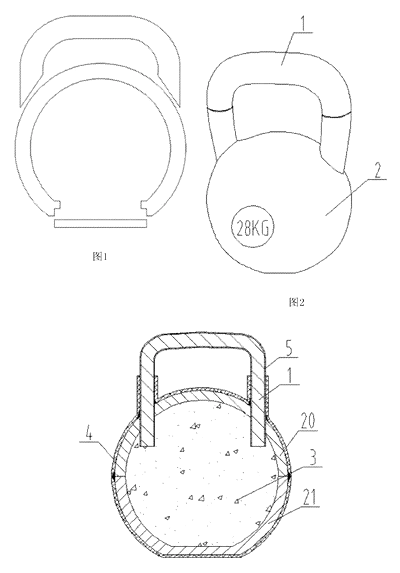
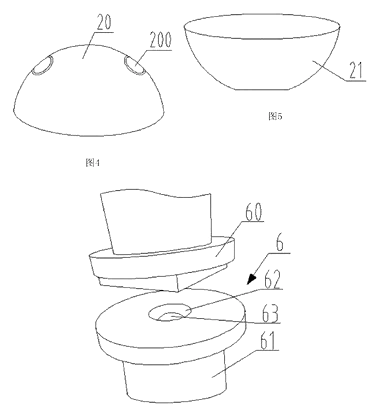
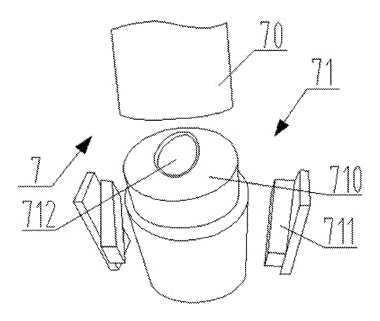
Drawings reproduced from the public patent document for reference.