
Patent CN205730152U
Updated October 26, 2026Foldable Leg Stretching Device for Split Exercises
Practicing splits indoors usually means sliding on a smooth floor with no way to control the stretch or keep balance. This device solves that by guiding the feet along fixed slide bars inside a chute. The base folds into two shapes: a single flat board for standard stretches, or an L-shape where one half stands upright. Each pedal carries an adjustment plate with a shoe-pad-shaped groove and fastening buckles to hold the foot securely. The plates pivot to face forward or upward depending on the exercise. One pedal can be locked to the slide bar using a latch inserted into evenly spaced pin holes, allowing the user to push the other pedal outward gradually. Elastic snubber parts cushion the pedals, while a dual-purpose armrest frame provides hand support and locks the base halves together when folded upright.
- China utility model - withdrawn
- No filings outside China
- Sports & fitness equipment
- Foldable base, sliding pedals, telescoping armrests
Splat! What let you down?
🧘
Guided sliding pedals
Two pedals slide along parallel bars inside a chute, keeping the stretch aligned.
📐
Dual-position base
The hinged base locks completely flat or at a right angle for different postures.
🔒
Pin-and-latch locking
Evenly spaced pin holes let you lock one pedal in place while stretching with the other.
🤲
Adjustable armrests
Telescoping handrails stabilize the body and double as a locking frame when folded.
Bring this product to market
- ✓ Patent vetted China-only family and legal status checked
- 2 Product brief · now How it works, uses and options written up
- 3 Prototype First samples for buyers to review
- 4 Pilot run Small first batch for launch customers
- 5 Volume production Repeat orders at scale
Buyer interest
– of 100 buyers needed to start prototyping
One click, no sign-up. Each vote is one real visitor, and products with the most interest go to prototyping first.
Build team: no members yet. Need a partner, co-funding or skills to build this? Join and we introduce the team once it forms.
The problem
Stretching for splits at home often relies on slippery floors or improvised supports, making it difficult to control how far the legs extend. Without a guided track, the feet can slip sideways, and maintaining balance while leaning forward puts strain on the lower back. Users also lack a reliable way to hold one leg stationary while gradually moving the other, which leads to uneven stretching. Furthermore, dedicated stretching machines tend to be large, single-purpose frames that take up permanent floor space in a room.
The solution
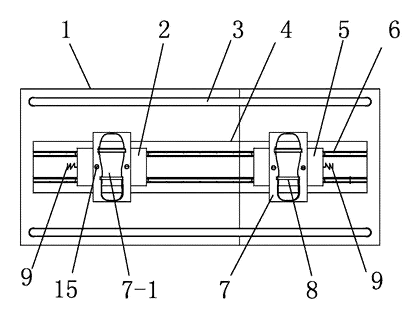
- A base (1) consists of a first half support plate (1-1) and a second half support plate (1-2) joined by a hinge so they lock either perfectly flat or at a right angle.
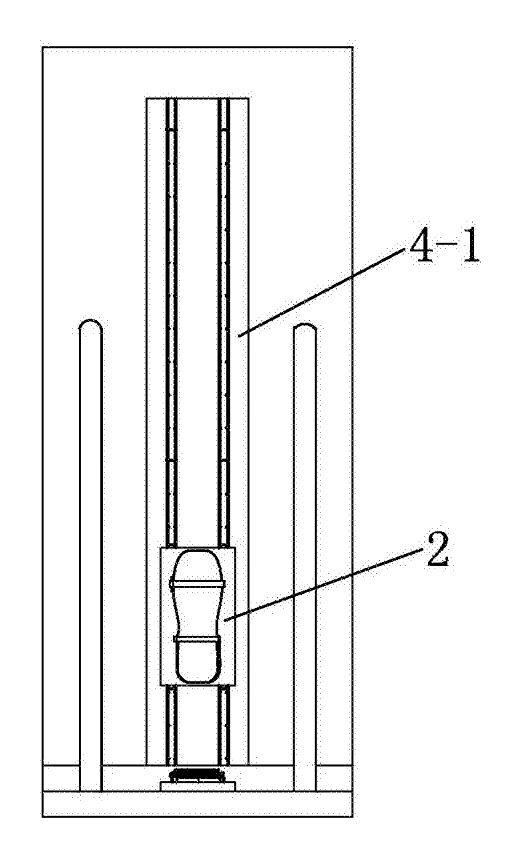
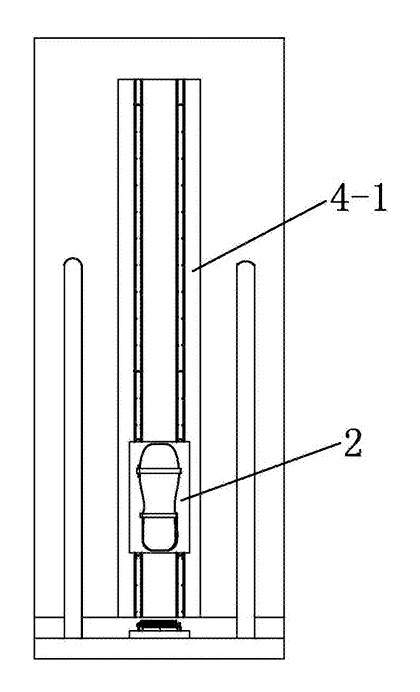
- A rectangular chute (4) is formed in the middle of the base, divided into a first half chute (4-1) and a second half chute (4-2) to match the folding plates.
- Two slide bars (6) run parallel to the length of the chute, also divided into docking halves.
- A first pedal (2) and a second pedal (5) are installed inside the chute, each with a slide opening (10) in the middle or lower part that fits over the slide bars.
- An adjustable plate (7) sits above each pedal, featuring a shoe-pad-shaped groove (7-1) and fastening buckles (8) on both sides to secure the foot. These plates pivot between a position parallel to the chute and a vertical position, held by a locking device (15).
- Multiple pin holes (13) are evenly distributed along each slide bar, accepting a latch (14) to stop a pedal from sliding. Snubber elastic parts (9) are placed between the front end of the first pedal and the rear end of the second pedal.
- Armrest frames (3) mount on both sides of the base, using telescoping handrail bars (11) connected by an arch handrail (12) when flat, or forming an L-shape to connect the upright and flat halves when folded.
Who it is for
- Fitness equipment brands looking to add a compact, guided flexibility tool to their home-gym catalog without requiring heavy steel frames.
- Dance and martial arts suppliers whose customers need a controlled method to practice splits safely between studio sessions.
- Yoga and Pilates studios seeking a stable stretching station that members can use independently during warm-ups or cool-downs.
- Online retail sellers targeting the home-fitness market who need a product that ships flat and occupies minimal storage space.
How it works
The main parts
| No. | Part | What it does |
|---|---|---|
| 1 | Base | Supports the entire assembly; folds via two hinged plates. |
| 1-1, 1-2 | Half support plates | First and second halves of the base that lock flat or upright. |
| 2 | First pedal | Slides along the bars to position the first foot. |
| 3 | Armrest frame | Provides hand support; acts as a lock when the base is folded. |
| 4 | Chute | Rectangular channel guiding the pedals. |
| 5 | Second pedal | Slides along the bars to position the second foot. |
| 6 | Slide bar | Parallel bars inside the chute that guide the pedals. |
| 7 | Adjustable plate | Pivots on the pedal to change foot orientation. |
| 7-1 | Shoe-pad-shaped groove | Contoured recess matching the human foot. |
| 8 | Fastening buckles | Secure the foot inside the groove. |
| 9 | Snubber elastic part | Cushions the space between the two pedals. |
| 10 | Slide opening | Hole in the pedal that fits over the slide bar. |
| 11 | Telescoping handrail bar | Height-adjustable vertical support for the armrest. |
| 12 | Arch handrail | Curved top grip connecting the handrail bars. |
| 13 | Pin hole | Evenly spaced holes on the slide bar for the latch. |
| 14 | Latch | Inserted into a pin hole to lock a pedal in place. |
| 15 | Locking device | Holds the adjustable plate in the chosen direction. |
Operating steps
- Unfold the base - lay the first and second half support plates flat to form a single board, or lock the first half upright at a right angle for standing-supported stretches.
- Secure the feet - place each foot into the shoe-pad-shaped groove on the adjustable plates and fasten them using the buckles on both sides. Adjust the plates to face parallel to the chute or vertically, depending on the desired posture.
- Set the anchor - insert a latch into one of the pin holes on the slide bar to lock the first pedal in a fixed position.
- Stretch - push against the second pedal, letting it slide along the bars away from the anchored pedal. The snubber elastic parts provide resistance and cushioning. Hold the arch handrail for balance.
- Adjust and release - move the latch to different pin holes to change the starting distance, or unlock the pedal to return to the resting position.
Applications
Home flexibility training
Users practicing splits in living rooms or bedrooms need equipment that does not dominate the space. The foldable base allows the device to be stored upright or flat under a bed after use. The guided slide bars prevent feet from slipping on hardwood or carpeted floors.
Dance studio warm-ups
Dancers require consistent, measurable stretching before rehearsals. By using the pin holes and latches, instructors can set specific distances for students to reach gradually. The armrest frames give dancers a stable grip while leaning into the stretch.
Martial arts conditioning
Martial artists working on high kicks benefit from controlled lateral leg extension. The ability to lock the base into an L-shape provides a backrest or support for upright stretching postures. Fastening buckles keep the feet firmly planted during intense holds.
Physical therapy clinics
Therapists guiding patients through lower-body mobility routines need predictable movement paths. The chute restricts the pedals to a straight line, preventing unwanted rotation. The height-adjustable armrests accommodate patients of different sizes.
Yoga and gymnastics centers
Gymnasts and yoga practitioners use split stretches daily to maintain range of motion. The shoe-pad-shaped grooves align the feet naturally, reducing ankle strain. The snubber elastic parts soften the push, allowing for slow, steady extension.
Where it is less suitable
- Heavy commercial gym weight areas - this is a bodyweight flexibility tool, not designed to bear external loaded weights.
- Cardiovascular workouts - the device is strictly for static stretching and holds, not dynamic aerobic exercise.
- Outdoor use - the pin holes, slide bars and hinges are intended for indoor environments where moisture and debris are controlled.
Frequently asked questions
How do the pedals slide?
Two parallel slide bars run inside a rectangular chute in the base. The pedals have openings that fit over these bars, allowing them to glide back and forth. Rolling elements on the sides or bottom of the pedals reduce friction during the movement.
Can I lock one leg in place while stretching the other?
Yes. The slide bars have evenly spaced pin holes. You insert a latch into one of these holes behind a pedal to stop it from moving, then push the other pedal outward along the bars to perform the stretch.
What are the two shapes of the base?
The base is made of two hinged halves. They can lock completely flat to form a single board on the floor, or the first half can lock upright at a right angle to the second half, creating an L-shape for different exercise postures.
How does the foot stay in place?
Each pedal has an adjustable plate with a shoe-pad-shaped groove contoured to the human foot. Fastening buckles on both sides of the groove strap over the foot to hold it securely during the stretch.
Do the foot plates adjust?
The adjustable plates pivot between two directions: parallel to the chute or vertical. A locking device holds the plate in whichever position matches the chosen exercise.
What is the armrest used for?
When the base is flat, the armrest frame uses telescoping bars connected by an arch handrail to give the user something to hold for balance. When the base is folded into an L-shape, the armrest frame connects the upright half to the flat half, acting as a structural lock.
What are the elastic parts for?
Snubber elastic parts are placed between the front of the first pedal and the rear of the second pedal. They provide cushioning and resistance as the pedals move apart.
Can this design be made and sold in the US?
The patent was filed only in China and is withdrawn, meaning the owner abandoned the rights in 2017. It does not restrict the design in the US or anywhere else. However, stretching and fitness equipment may be covered by other active US patents - see Patent & Production - so we recommend a freedom-to-operate check before volume production.
Are you affiliated with the patent owner?
No. IP2M is an independent design and manufacturing service working from the public patent document.
Request a quote
Click Request a Quote below to see our email address - copy it, or open your email app with a ready-made message. Please mention patent CN205730152U in the subject.
Helpful details to include:
- Your company and channel (fitness brand, dance supplier, online retailer, studio buyer)
- Target dimensions and user weight capacity
- Preferred materials for the base, slide bars and pedals
- Color and finish requirements
- Estimated quantity and target price
- Timeline - when you would like samples and the first shipment
You can also reach us at (332) 203-9997.
Explore this product
Interested in building this?
Tell us your target market, quantity and timeline. We reply with options for prototyping, small-batch runs or volume production.
Send your inquiry to
Please put CN205730152U in the subject line and tell us your company, country, estimated quantity and timeline.
Prefer to talk? Call (332) 203-9997.
More product-ready patents
All Sports & Recreation patents →
Sports & Recreation
Compact Torsion-Spring Bike Bell
Mini bike bell with a standard torsion spring and a rubber-floated dome - small size, clear tone, quick strap mount.
Patent CN205819384U
Sports & Recreation
Padded Toe-Box Shield for Sneakers
Ventilated, silicone-lined toe-box insert that supports the front of a sneaker and cushions the toes.
Patent CN209473731U
Sports & Recreation
Reversible Fishing Seat-Box Lid with Backrest
Fishing seat-box lid that flips on removable hinge pins: cushion, backrest and storage on one face.
Patent CN208624426U
Sports & Recreation
Swivel-Pin Skateboard Truck with Rubber Sleeve
Skateboard truck with a turning center pin, a tilting axle clamp and a rubber sleeve that centers it.
Patent CN216777880U
Sports & Recreation
Full-Face Bike Helmet with Magnetic Detachable Chin Bar
Full-face cycling helmet whose chin bar clips on and off with magnetic, latching side connectors.
Patent CN206630067U
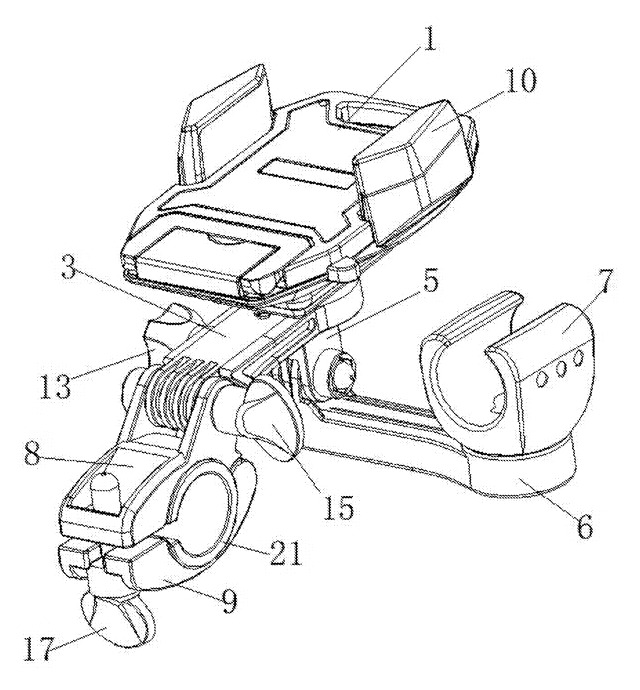
Sports & Recreation
Bike Phone Holder with Built-In Flashlight Clamp
Handlebar mount with a phone cradle on top and a flashlight clamp below, on one arm.
Patent CN206077485U
Browse by category
- Apparel & Accessories (22)
- Baby & Kids (16)
- Bags & Luggage (9)
- Bath & Personal Care (16)
- Car Accessories (10)
- Furniture, Bedding & Storage (12)
- Garden & Outdoor (18)
- Health & Wellness (8)
- Home, Kitchen & Cleaning (24)
- Lighting (12)
- Packaging & Containers (6)
- Pet Products (6)
- Phone & Camera Accessories (4)
- Retail Display (13)
- School, Office & Art (19)
- Sports & Recreation (25)
- Tools & Workshop (27)
- Toys & Games (12)
This page is based on the public patent document CN205730152U, assigned to Xuzhou University of Technology. IP2M is an independent manufacturing service and is not affiliated with, endorsed by or licensed by the patent owner. Images marked as concept renderings are illustrations, not photos of an existing product. Patent status information is provided for reference only and is not legal advice; confirm freedom to operate for your market before production. Full disclaimer.