At a glance
| Patent number | CN205730152U (application CN201620517982) |
| Type | China utility model (实用新型) - protects product shape and structure |
| Original title | Leg stretching fitness equipment for split exercise (用于劈叉练习的腿部拉伸健身器) |
| Patent owner | Xuzhou University of Technology |
| Inventors | Shen Lufei, Jiang Dejing, Liu Lili |
| Filing date | 2016-05-31 |
| Grant date | 2016-11-30 |
| Status (China) | Withdrawn - the owner abandoned the patent right (effective 2017-11-24) |
| Patent family | Chinese filings only - CN205730152U |
| Cited by | 7 later documents |
| Source | Google Patents (search for CN205730152U) |
What the claims cover, in plain language
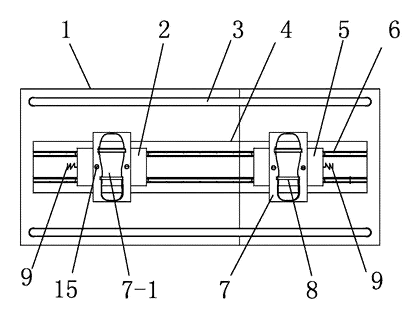
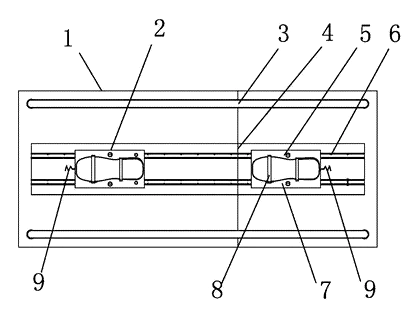
Claim 1 - a leg stretching device comprising a base divided into a first half support plate and a second half support plate that are hinged together and lock either flat or at a right angle. A rectangular chute in the middle of the base holds a first pedal and a second pedal. Both pedals have an adjustable plate that pivots between parallel and vertical positions, secured by a locking device. The adjustable plates include a shoe-pad-shaped groove with fastening buckles on both sides. Two slide bars run parallel to the chute’s length, passing through slide openings in the pedals. The slide bars have evenly spaced pin holes that accept a latch to prevent the pedals from sliding. Snubber elastic parts are located between the front of the first pedal and the rear of the second pedal.
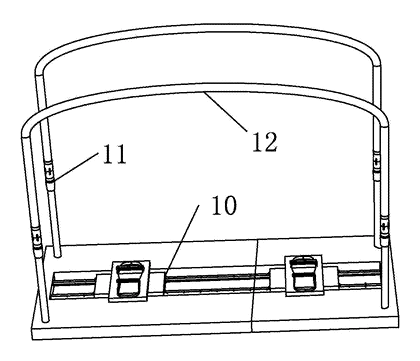
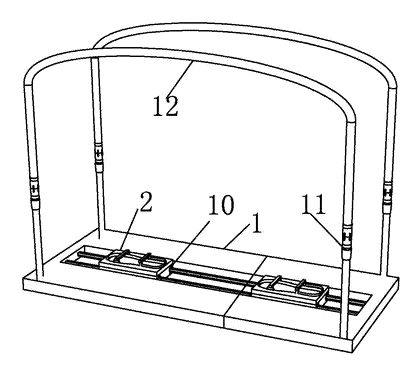
Claim 2 - armrest frames are mounted on the base on both sides of the chute. Claim 3 - when the base is flat, each armrest frame includes telescoping handrail bars at both ends connected by an arch handrail. Claim 4 - when the base is folded at a right angle, the armrest frame is L-shaped and connects the upright half to the flat half. Claim 5 - rolling elements are provided on the sides or bottom of the pedals.
This is a simplified reading for orientation only. The legal scope is defined by the exact claim wording in the official Chinese document.
What this means for US production
This patent was filed only in China and is withdrawn, meaning the owner actively abandoned the rights in 2017. It has no US or other foreign counterpart, and it no longer restricts anyone in China.
Two points to settle early:
- Other patents may exist. Home fitness and stretching equipment is a crowded field with many active US patents covering guided sliders, folding bases and adjustable foot platforms, so a freedom-to-operate (FTO) review of the sliding mechanism and folding hinge is needed before tooling.
- Structural load capacity. The thickness of the slide bars, the material of the chute and the strength of the latches must be confirmed on prototypes to ensure they support the user’s pushing force without bending or failing.
Customization and manufacturing
What can be customized
| Area | Options |
|---|---|
| Base dimensions | Length and width of the support plates to be confirmed in design |
| Materials | Steel, aluminum or reinforced plastics for the base and slide bars |
| Padding | Foam density and cover material for the shoe-pad-shaped grooves |
| Finish | Powder coating colors, anti-slip textures on the base |
| Elastic resistance | Durometer and size of the snubber elastic parts |
| Armrest grips | Rubber or foam covers for the arch handrail |
| Locking mechanism | Spring-loaded pins or manual latches for the pin holes |
Things to plan for (US market)
- CPSC general requirements - fitness equipment sold to consumers must not present unreasonable risks of injury; pinch points at the hinge and sliding pedals must be guarded.
- California Proposition 65 - materials used in the padding, coatings and plastics must be screened for listed chemicals.
- ASTM F2271 - standard specification for safety of certain fitness equipment, which may apply depending on the final product classification.
How a project runs
- Inquiry - target user weight, preferred materials, dimensions and quantity.
- Design - engineering the hinge, chute profile, slide bar diameter and pin hole spacing.
- Prototype - building samples to test the sliding friction, latch security and folding stability.
- Pilot run - verifying assembly tolerances, surface finishes and structural load tests.
- Production - metal stamping or extrusion, welding, powder coating, injection molding for plastic parts, and final assembly.
Quantities & timeline
The base plates require stamping dies or extrusion profiles, the slide bars need precision machining for the pin holes, and the adjustable plates need molds if produced from plastic or dies if stamped from metal. Certification testing for consumer fitness products adds time to the schedule. Send us your target dimensions, material preferences, estimated quantities and timeline and we will reply with options.
Patent drawings
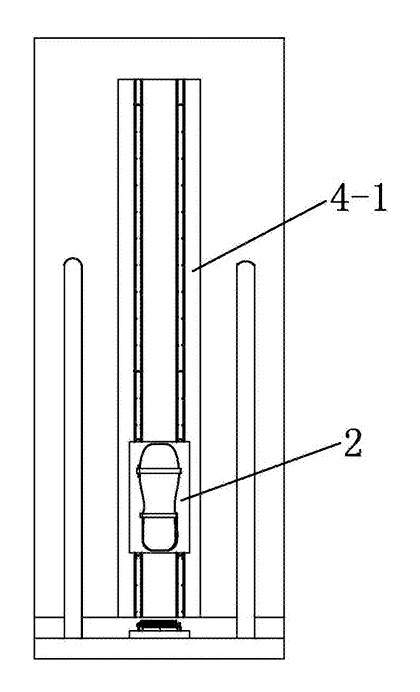
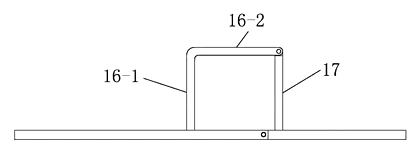
Drawings reproduced from the public patent document for reference.