At a glance
| Patent number | CN205866146U (application CN201620486256) |
| Type | China utility model (实用新型) - protects product shape and structure |
| Original title | Press of bonding interchangeable with formula high-heeled shoes (一种按键型可换跟式高跟鞋) |
| Patent owner | Hangzhou Jiuba Hongtu Technology Co Ltd |
| Inventors | Li Xiangqing, Ma Li, Xu Huijie |
| Filing date | 2016-05-25 |
| Grant date | 2017-01-11 |
| Status (China) | Lapsed - terminated for non-payment of annual fees (recorded 2025-05-16) |
| Patent family | Chinese filings only - no US, European, Japanese, PCT or other filings listed |
| Cited by | 3 later documents |
| Source | Google Patents (search for CN205866146U) |
What the claims cover, in plain language
Claim 1 - a key-type exchangeable heel high-heeled shoe comprising a sole (5) and a heel (1) with a detachable docking device between them. The device includes either an interface arrangement fixed on the heel with an elastic push rod that buckles the sole, plus a push rod structure fixed on the sole to compress and release the elastic push rod; or the reverse, with the interface on the sole and the push rod structure on the heel. The push rod structure includes a push head (7) at one end corresponding to the elastic push rod, a button (10) at the other end, and a push rod (12) connecting them.
Claim 2 - the button (10) is positioned on the outer surface of the high-heeled shoe body. Claim 3 - the push head (7) connects into a positioning structure, which is a concave wall (502) or an up-big-and-down-small hatch frame bore. Claim 4 - the interface arrangement includes a draw-in groove on the heel end face and a fixture block on the sole that joggles into the groove; the elastic push rod includes a movable push rod (3) and a first spring (2). Claim 5 - details the placement of the pusher structure on the fixture block groove and the angled slotted eye. Claim 6 - adds a second spring (9) socketed on the push rod (12), sliding between symmetrical concave walls (502). Claim 7 - a second stator (8) fixed on the concave wall end face (503). Claim 8 - an antifriction metal sheet (6) at the access section and a first stator (4) with a through hole (301) for the movable push rod. Claims 9-11 - alternative arrangements of the pusher structure and elastic push rod between the heel and sole.
This is a simplified reading for orientation only. The legal scope is defined by the exact claim wording in the official Chinese document.
What this means for US production
This patent was filed only in China and is lapsed (terminated for non-payment of annual fees, recorded 2025-05-16), so it no longer restricts anyone in China either. It has no US or other foreign counterpart.
Two points to settle early:
- Other patents may exist. Interchangeable heel footwear is a field with various designs patented globally over the years. Even though this specific Chinese utility model has lapsed and has no foreign family members, a freedom-to-operate (FTO) review of the button-release and spring-lock mechanisms is needed before tooling to ensure no active US patents cover similar docking devices.
- Load bearing and fatigue. The springs, push rods, and fixture blocks must support the wearer’s full body weight dynamically. Material selection for the movable push rod and the antifriction metal sheet must be confirmed on prototypes to prevent failure during walking.
Customization and manufacturing
What can be customized
| Area | Options |
|---|---|
| Heel height | Different heel blocks (to be confirmed in design) mating with the same sole |
| Upper material | Leather, synthetic PU, textile, chosen by the brand |
| Button placement | Side, rear, or medial surface of the shoe body |
| Spring force | Adjusted for heel weight and security requirements |
| Metal finishes | Plating or coating on the stators, push rods, and antifriction sheets |
| Sole construction | Outsole rubber compounds, midsole cushioning layers above the docking block |
Things to plan for (US market)
- CPSC general wearing apparel - while adult shoes are not heavily regulated like children’s items, lead and heavy metal limits in surface coatings (16 CFR 1303) apply to painted buttons or metal hardware.
- California Proposition 65 - brass, plated metals, and certain adhesives used in the docking device and shoe construction must be screened for listed chemicals.
- ASTM F2413 / slip resistance - if marketed for occupational use, the outsole must meet relevant traction standards; otherwise, standard commercial slip testing applies.
How a project runs
- Inquiry - target heel heights, upper materials, sizes, and order volume.
- Design - engineering the fixture block, draw-in groove dimensions, spring rates, and button linkage to fit the last shape.
- Prototype - machining sample docking devices and assembling test shoes for fit, release force, and walking trials.
- Pilot run - molding the soles with the integrated blocks, stamping the metal rods and stators, and conducting fatigue cycling tests.
- Production - lasting the uppers, installing the docking hardware, attaching the outsoles, and final quality inspection.
Quantities & timeline
The sole requires injection molds that incorporate the fixture block or the draw-in groove cavity, depending on the chosen claim configuration. The push rods, stators, and springs need progressive die stamping or precision machining, and the antifriction metal sheets require specific tooling. Cycle testing—repeatedly pressing the button, attaching the heel, and simulating walking impacts—takes the most development time. Send us your target heel heights, size range, upper material preferences, estimated quantity and target price, and we will reply with options.
Patent drawings
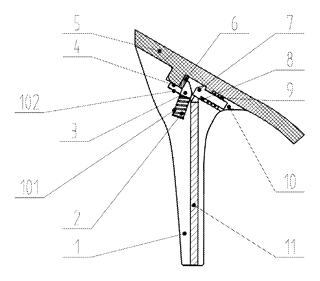
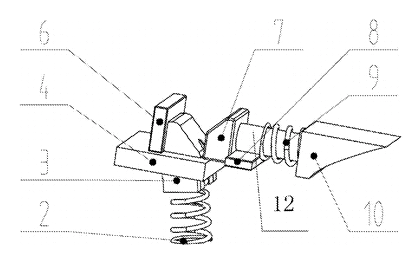
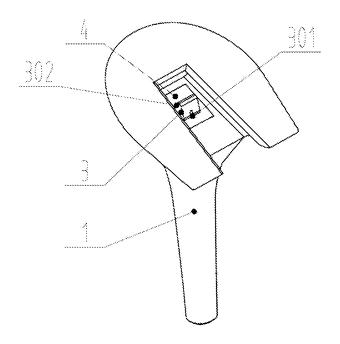
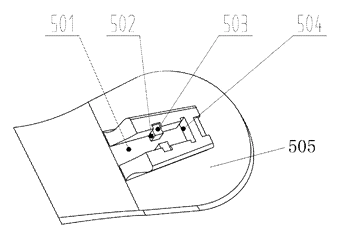
Drawings reproduced from the public patent document for reference.