At a glance
| Patent number | CN205872272U (application CN201620784653) |
| Type | China utility model (实用新型) - protects product shape and structure |
| Original title | Bicycle bottle cage with tool set (一种具工具组的自行车水壶架) |
| Patent owner | Naixing Vehicle Material Shenzhen Co ltd / Zhangzhou Anjiayi Industrial Co ltd / Naixing Enterprise Co ltd |
| Inventors | Shi Heren, Yang Xinhuan, Zhang Zhihong |
| Filing date | 2016-07-25 |
| Grant date | 2017-01-11 |
| Status (China) | Lapsed - terminated for non-payment of annual fees (recorded 2026-07-24) |
| Patent family | Chinese filings only - no US, European, Japanese, PCT or other filings listed |
| Cited by | 2 later documents |
| Source | Google Patents (search for CN205872272U) |
What the claims cover, in plain language
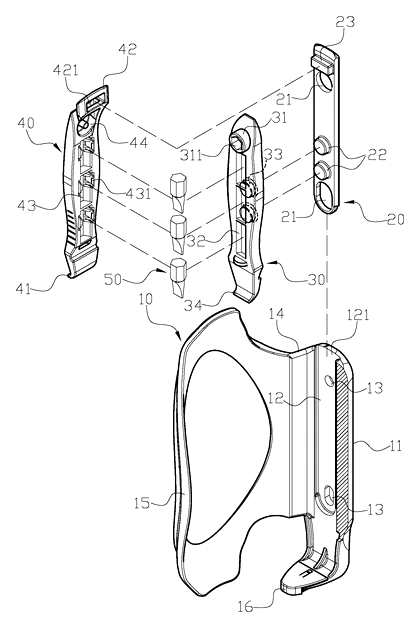
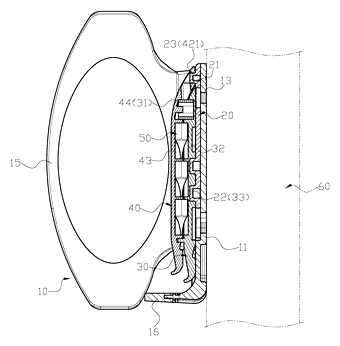
Claim 1 - A bicycle bottle cage comprising a body with a supporting part. The supporting part has a front end chute with an upward opening and internal lock holes. Two sides of the supporting part connect to elastic clamping pieces curved forward via outward-expanded side blocking edges. A bottom support extends below the supporting part. A back plate has lock holes. The front end of the supporting part has first and second clamping convex parts. A first tire digging rod has a front sleeve column with a polygonal clamping hole and containing grooves; its back has a clamping concave part. A second tire digging rod has a working end, fixed end, containing grooves, and a dodging hole. The fixed end has a clamping hole extending backward. The rods slide into the chute, and the back plate’s convex parts snap into the rods’ holes to lock them.
Claim 2 - The lock holes between the bottle cage body and back plate are shaped as long holes (slots), allowing the back plate to be fine-tuned in height relative to the body during installation.
Claim 3 - Reiterates that the two sides of the abutting portion are connected with forwardly curved elastic clips through outwardly expanded side retaining edges.
Claim 4 - The clamping hole and connecting post on the first tire digging rod are formed by embedding and injecting a hexagonal sleeve.
Claim 5 - The second tire digging rod is provided with grippers within its groove.
This is a simplified reading for orientation only. The legal scope is defined by the exact claim wording in the official Chinese document.
What this means for US production
This patent was filed only in China and has lapsed due to non-payment of fees. It currently imposes no restrictions in China, and it has no US or foreign counterpart.
Two points to settle early:
- Other patents may exist. Bicycle accessories, particularly those integrating tools into frames or cages, are a competitive field. Major brands like Topeak, Blackburn, and others hold various patents on tool storage mechanisms and bottle cage geometries. A freedom-to-operate (FTO) review is necessary to ensure your specific lever-locking mechanism does not infringe on active US patents.
- Material Strength. The supporting part and levers undergo high lateral force when prying tires. The patent mentions plastic/metal combinations; ensuring the levers do not snap under load is a critical engineering validation step.
Customization and manufacturing
What can be customized
| Area | Options |
|---|---|
| Material | Aluminum alloy, carbon fiber reinforced polymer, or high-strength nylon. |
| Finish | Anodized colors, matte black, glossy white, or textured grips. |
| Lever Design | Shape of the working end (flat vs. curved) for different tire types. |
| Tool Compatibility | Size of the polygonal hole to accept standard Allen keys or proprietary bits. |
| Mounting | Standard 2-bolt spacing (64mm x 64mm) or adjustable brackets for smaller frames. |
Things to plan for (US market)
- ASTM F963 - Consumer Product Safety Improvement Act requirements apply if marketed to children, but generally, bicycle parts fall under voluntary standards. However, CPSC regulations regarding lead content in paint/coatings still apply.
- Proposition 65 (California) - Warning labels required if materials contain known carcinogens or reproductive toxins (e.g., certain plastics or metal finishes).
- Structural Integrity Tests - While not a federal mandate for all accessories, industry norms require cyclic fatigue testing for any part subjected to repeated insertion/removal and load-bearing (prying).
How a project runs
- Inquiry - Define material preferences, target weight, and compatible tool bit sizes.
- Design - CAD modeling of the chute interface and lever locking mechanism to ensure smooth insertion and secure retention.
- Prototype - 3D printed or CNC machined samples for fit checks against common tire widths and rim profiles.
- Pilot Run - Injection molding or casting trials; testing the snap-fit durability over 100+ cycles.
- Production - Mass manufacturing of cage bodies and levers; assembly and packaging.
Quantities & timeline
Injection molds for the cage body and the two distinct levers are required. Metal inserts (hex sleeves) add a secondary process step (insert molding or assembly). Testing for breakage resistance takes time. Send us your material specs, color options, quantity, and target price and we will reply with options.
Patent drawings
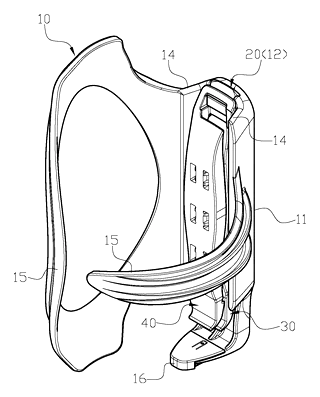
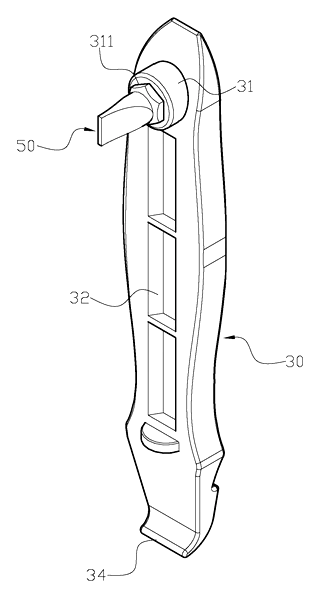
Drawings reproduced from the public patent document for reference.