At a glance
| Patent number | CN205876899U (application CN201620996943) |
| Type | China utility model (实用新型) - protects product shape and structure |
| Original title | Composite furniture stable structure (一种组合家具稳定结构) |
| Patent owner | Zhejiang Malati Intelligent Furniture Technology Co Ltd |
| Inventors | Zhou Jun |
| Filing date | 2016-08-20 |
| Grant date | 2017-01-11 |
| Status (China) | Expired - the 10-year term ended on 2026-08-20 |
| Patent family | Chinese filings only - no US, European, Japanese, PCT or other filings listed |
| Cited by | 17 later documents |
| Source | Google Patents (search for CN205876899U) |
What the claims cover, in plain language
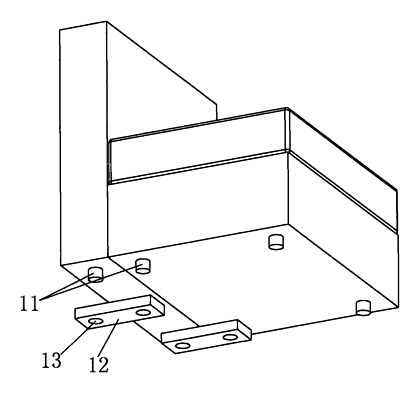
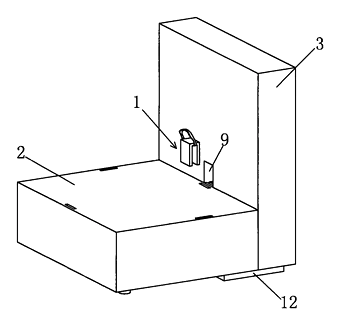
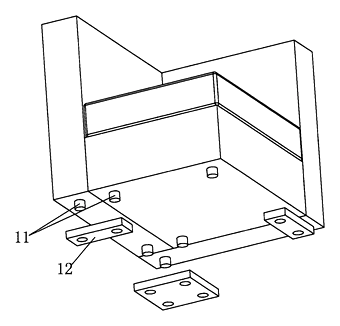
Claim 1 - a composite furniture stable structure including a first support member and a second support member arranged beside it. Both members have legs at the bottom. A connecting plate is provided below the members, spanning their junction. The connecting plate has positioning holes corresponding to the legs, and the legs are inserted into these holes.
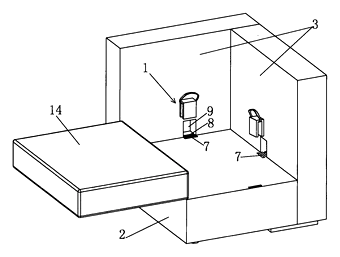
Claim 2 - the upper end of the positioning hole forms a tapered guide mouth. Claim 3 - both sides of the connecting plate are provided with positioning holes; the legs on the first and second support members insert into two corresponding positioning holes. Claim 4 - the height of the connecting plate is identical to the height of the legs. Claim 5 - the tops of the first and second support members are linked together by a connector. Claim 6 - the connector is a U-clamp having a first foot, a second foot, and a substrate connecting the two feet. The first and second support members have corresponding first and second slots into which the feet of the U-clamp are inserted. Claim 7 - the second support member exceeds the upper surface of the first support member; the first slot is on the edge of the first support member’s upper surface, and the second slot is on the side of the second support member. Claim 8 - an escape groove is provided on the side of the second support member, and the second slot is arranged inside this escape groove. Claim 9 - the first support member is a seat portion, and the second support member is a seat portion, backrest, or armrest part. Claim 10 - the U-clamp connection includes a drawn rope.
This is a simplified reading for orientation only. The legal scope is defined by the exact claim wording in the official Chinese document.
What this means for US production
This patent was filed only in China and has expired, so it no longer restricts anyone in China either. It has no US or other foreign counterpart.
Two points to settle early:
- Other patents may exist. Modular furniture connection systems are widely patented. For example, The Lovesac Company holds later US patents in this field (US10806261B2, US12070131B2, USD1074247S1), and Zelong Zhao holds US20230066786A1. A freedom-to-operate (FTO) review is recommended before adopting this specific plate-and-clamp mechanism for the US market.
- Material strength and tolerances. The fit between the legs and the positioning holes, as well as the snap-fit action of the U-clamp, depends on precise material thickness and molding tolerances, which must be set in design and confirmed on prototypes.
Customization and manufacturing
What can be customized
| Area | Options |
|---|---|
| Plate dimensions | Length and width adjusted to match the footprint of the specific furniture modules |
| Hole pattern | Number and spacing of positioning holes to suit three-legged, four-legged, or custom bases |
| Guide mouth angle | Taper depth and angle of the guide mouths tuned for the leg diameter |
| U-clamp size | Substrate length and foot depth adapted to the thickness of the support member frames |
| Materials | Stamped steel, die-cast aluminum, or reinforced polymer for the plate and clamp |
| Finish | Powder coating, plating, or paint color matched to the furniture frame |
Things to plan for (US market)
- 16 CFR 1232 (STURDY Act) - if the composite furniture functions as a clothing storage unit, it must pass the mandatory stability test; the connecting plate alters the center of gravity and base footprint.
- ASTM F2613 - if the modules are designed or marketed for children’s seating, they fall under the safety specification for children’s chairs.
- California Proposition 65 - finishes, coatings, and polymer materials must be screened for listed chemicals.
- TB 117-2013 - smolder resistance requirements for upholstered furniture sold in California, which applies if the support members are padded seats or backrests.
How a project runs
- Inquiry - module sizes, target materials, expected load, and quantity.
- Design - CAD modeling of the connecting plate, hole tapers, and U-clamp geometry to match the specific furniture frames.
- Prototype - machining or 3D printing samples to verify the leg insertion force and U-clamp retention.
- Pilot run - stamping or molding a small batch for stability testing and finish validation.
- Production - volume manufacturing of plates and clamps, surface treatment, and packaging alongside the furniture modules.
Quantities & timeline
The connecting plate requires blanking and punching dies or injection molds depending on the chosen material, while the U-clamp needs forming dies or casting molds. Tooling complexity scales with the number of hole positions and the specific taper geometry. Stability testing and tolerance verification take most of the development phase. Send us your module dimensions, material preferences, expected quantities, and target schedule and we will reply with options.
Patent drawings
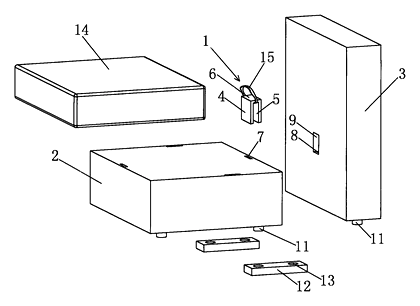
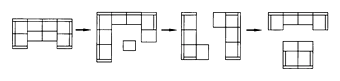


Drawings reproduced from the public patent document for reference.