At a glance
| Patent number | CN206026282U (application CN201620693209) |
| Type | China utility model (实用新型) - protects product shape and structure |
| Original title | Detergent dispenser for a dishwasher (一种用于洗碗机的洗涤剂分配器) |
| Patent owner | Individual |
| Inventors | Xiu Shizhi |
| Filing date | 2016-07-04 |
| Grant date | 2017-03-22 |
| Status (China) | Lapsed - terminated for non-payment of annual fees (recorded 2025-06-27) |
| Patent family | Chinese filings only - no US, European, Japanese, PCT or other filings listed |
| Cited by | 13 later documents |
| Source | Google Patents (search for CN206026282U) |
What the claims cover, in plain language
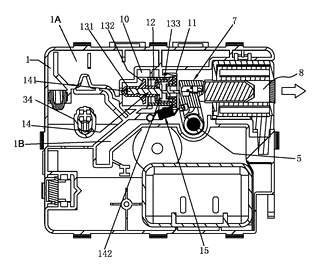
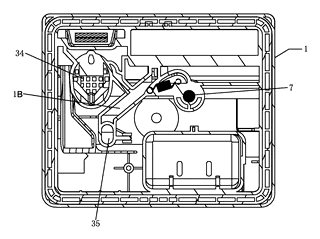
Claim 1 describes the core dispenser structure: a bottom shell and a front cover that snap together, enclosing a sliding cover, a torsion spring, a manual locking assembly and an automatic locking and separation assembly. The torsion spring sits in its own cavity with one end acting on the sliding cover’s upper wall plate and the other on the cavity’s lower wall plate. The manual locking assembly uses a locking part whose pivot section sits in a cavity, a button protruding through a button hole, and a pressure spring pushing the locking part into engagement. The sliding cover travels along a guide groove via a sliding rod.
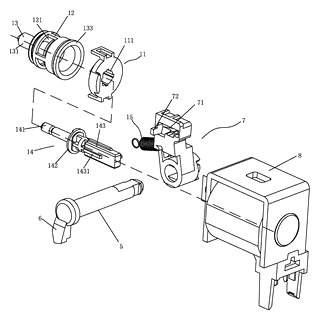
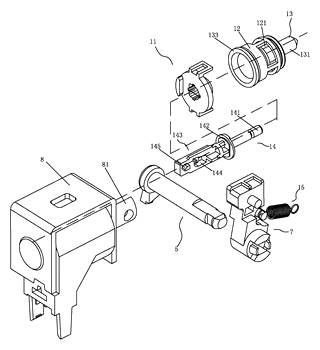
Claim 2 adds the electromagnetic release path: pivot joint holes in the front cover and bottom shell accept a rotating shaft fixed to a crank. The crank is pivotally connected to the armature of a pull-in electromagnet. When the electromagnet activates, the locking part of the manual assembly is separated, allowing the torsion spring to reset and slide the cover away from the washing-liquid chamber opening.
Claim 3 specifies that a driving part cooperates with the crank, and a return spring connects one end to the crank and the other to the bottom shell.
Claim 4 details that the driving part has a guide protrusion along its axis that slides inside a guide groove to maintain alignment.
Claim 5 notes that the armature’s shaft hole matches a fixed shaft on the crank, a guide block extends into a cavity on the crank, and a driving rod extends into a driving cavity.
This is a simplified reading for orientation only. The legal scope is defined by the exact claim wording in the official Chinese document.
What this means for US production
This patent was filed only in China and is now lapsed (terminated for non-payment of annual fees, recorded 2025-06-27), so it no longer restricts anyone in China either. It has no US or other foreign counterpart.
Two points to settle early:
- Other patents may exist. Dishwasher detergent dispensers and their release mechanisms are heavily patented by major appliance manufacturers such as Whirlpool, BSH, and Electrolux, covering wax motors, solenoid latches, and sliding door geometries. A freedom-to-operate (FTO) review of the electromagnetic crank linkage and the dual-lock arrangement is essential before tooling any production run intended for the US market.
- Electrical integration. The pull-in electromagnet requires a specific voltage and current profile. The coil resistance, inrush current, and holding characteristics must be matched to the target machine’s electronics.
Customization and manufacturing
What can be customized
| Area | Options |
|---|---|
| Cavity volume | Adjusted for standard powder, pod, or liquid detergent capacities |
| Electromagnet specs | Coil voltage (e.g., 12V DC or 120V AC rectified), pull force, stroke length |
| Spring rates | Torsion spring torque and pressure spring stiffness tuned for cover weight |
| Materials | Heat-resistant plastics (PP, PBT) for shells; stainless or coated steel for springs and crank |
| Mounting interface | Flange dimensions and screw-hole patterns to fit specific dishwasher door panels |
| Sealing | Gasket profiles around the sliding cover to prevent premature moisture ingress |
| Color and finish | Front cover texture and color matched to the appliance brand’s styling |
Things to plan for (US market)
- UL 749 - Standard for Household Dishwashers, covering electrical safety, fire risk, and mechanical durability of door-mounted components including dispensers.
- NSF/ANSI 3 - Commercial warewashing equipment standard if the dispenser is targeted at commercial machines, requiring specific material and sanitation validations.
- FDA 21 CFR - Materials contacting detergent that subsequently contacts food-contact surfaces must be evaluated for indirect food additive compliance.
- California Prop 65 - Plastics, metal coatings, and lubricants used in the crank pivot must be screened for listed chemicals.
How a project runs
- Inquiry - target dishwasher model dimensions, detergent type, electrical supply available for the coil, and expected cycle life.
- Design - CAD modeling of the shell, sliding cover geometry, spring calculations, and electromagnetic force simulation to ensure reliable tripping.
- Prototype - 3D-printed or soft-tooled shells assembled with wound springs and a sample electromagnet for bench testing of the manual and automatic release sequences.
- Pilot run - Injection-molded parts from single-cavity molds; cycle testing in a simulated dishwasher environment (steam, heat, vibration) to verify the return spring and guide groove wear.
- Production - Multi-cavity injection molds for the shells, progressive stamping for the crank and sliding rod, automated coil winding for the electromagnets, and final assembly with functional testing on every unit.
Quantities & timeline
The plastic shells require injection molds sized to the cavity volume, the crank and guide components need stamping dies, and the electromagnet involves coil-winding tooling. Cycle-life testing under high humidity and temperature takes significant development time to validate the torsion spring fatigue and guide-groove wear. Send us your dimensional requirements, electrical specifications, detergent format, estimated quantity and target price and we will reply with options.
Patent drawings
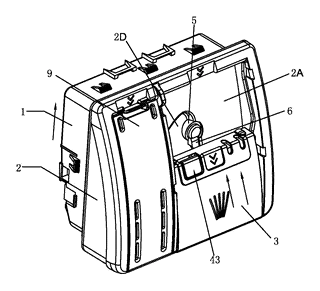
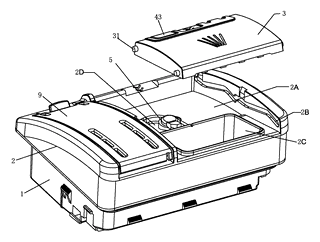
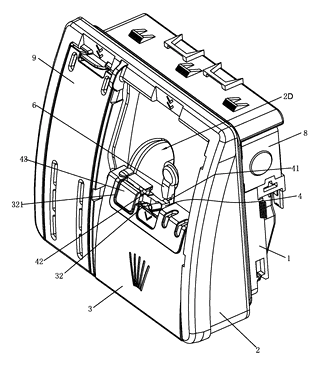
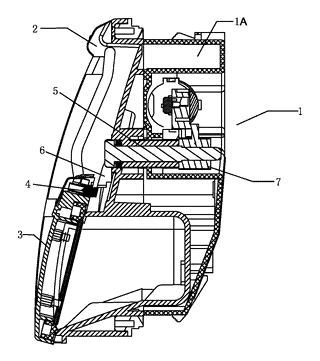
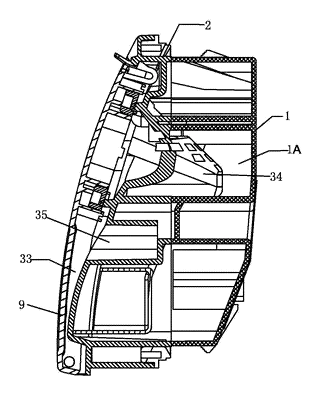
Drawings reproduced from the public patent document for reference.