
Patent CN206078239U
Updated October 28, 2026Globe-Shaped Fish Tank and Flowerpot Device with Auto-Watering
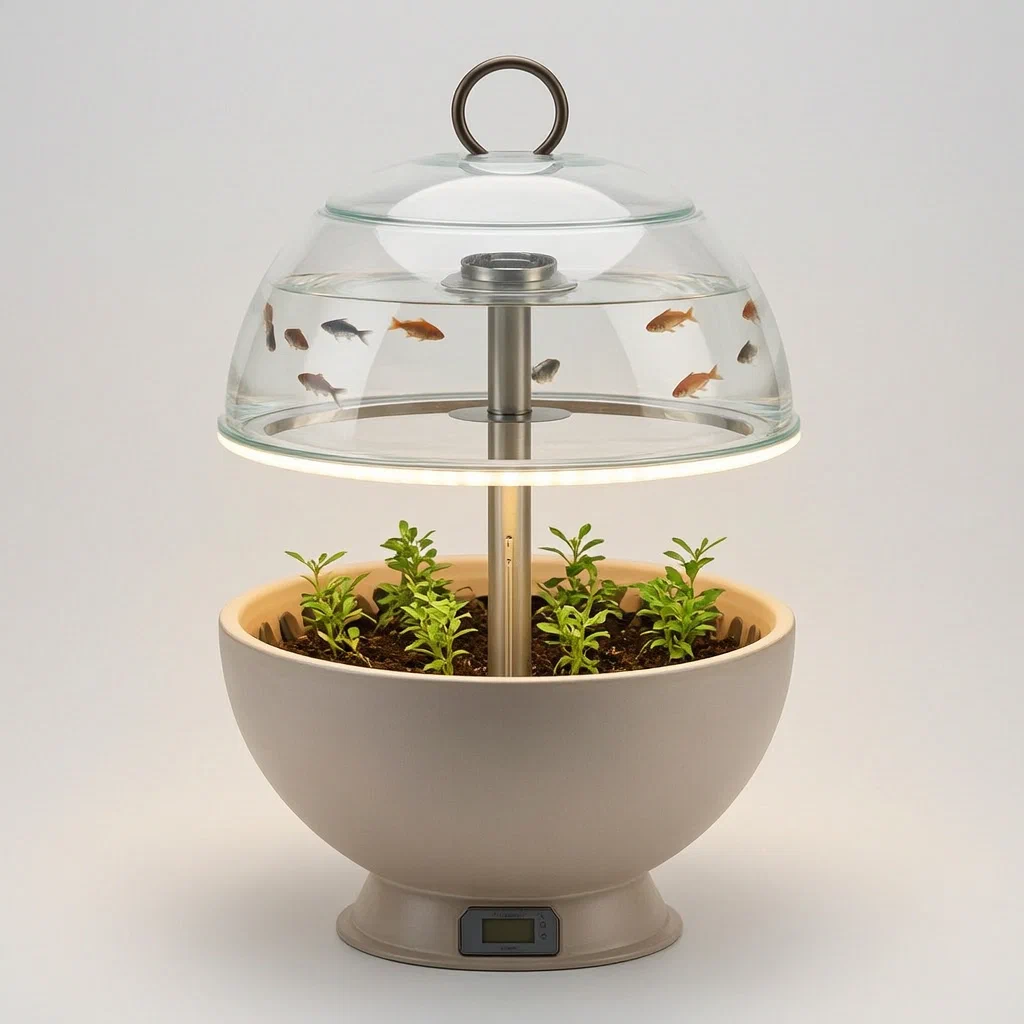
Combining a fish tank and a flowerpot usually means two separate containers taking up space and requiring independent maintenance. This design merges them into a single globe-shaped unit. The upper hemisphere holds the fish, while the lower hemisphere contains the planting groove. A hollow, telescoping support bar connects the two halves and houses a drain pipe linked to a water-drainage solenoid valve. A humidity sensor embedded in the side of the planting groove monitors soil moisture. When the soil dries out, the sensor signals the control panel to open the valve, allowing water from the fish tank to flow down and irrigate the plant. Shortening the support bar lets the upper hemisphere snap directly onto the lower one, forming a complete sphere decorated with a map pattern for display even when the tank is empty.
- China utility model - lapsed
- No filings outside China
- Home decor & indoor gardening
- Plastic or glass hemispheres, electronic controls, LED lighting
Splat! What let you down?
🌍
Globe-shaped design
Two hemispheres form a decorative sphere with a map pattern, functioning as home decor even when empty.
💧
Auto-watering system
A humidity sensor detects dry soil and opens a solenoid valve to let fish tank water irrigate the plant.
🔭
Telescoping support bar
The hollow bar extends to raise the fish tank for watering and shortens to close the globe for display.
💡
LED plant growth lamp
An LED lamp on the dividing plate promotes plant growth and doubles as ambient room lighting.
Bring this product to market
- ✓ Patent vetted China-only family and legal status checked
- 2 Product brief · now How it works, uses and options written up
- 3 Prototype First samples for buyers to review
- 4 Pilot run Small first batch for launch customers
- 5 Volume production Repeat orders at scale
Buyer interest
– of 100 buyers needed to start prototyping
One click, no sign-up. Each vote is one real visitor, and products with the most interest go to prototyping first.
Build team: no members yet. Need a partner, co-funding or skills to build this? Join and we introduce the team once it forms.
The problem
Keeping both a fish tank and houseplants requires separate containers, distinct watering routines, and extra shelf space. Plant owners often forget to water their pots, leading to dry soil and damaged roots, while fish tanks need regular water changes that waste usable water. Combining the two usually results in bulky, unattractive setups that do not fit well in modern living spaces. Furthermore, indoor plants frequently lack sufficient natural light, requiring separate grow lamps that add clutter and cords to the room. Buyers looking for decorative home accents rarely find functional items that merge pet care, plant maintenance, and aesthetics into a single footprint.
The solution
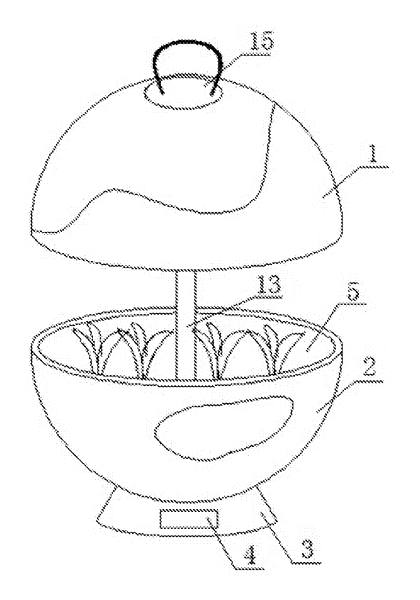
This device solves these issues by integrating a fish tank and a planter into one hollow sphere divided into an upper hemisphere and a lower hemisphere.
- Lower hemisphere - Contains a planting groove for soil and plants. A humidity sensor is embedded in the side of the groove to monitor soil moisture continuously. A bearing at the bottom supports the entire structure.
- Upper hemisphere - Functions as the fish tank. Its lower surface features a dividing plate that forms the breeding space inside the sphere. An opening at the top allows adding water or fish, sealed by a removable cover with a carrying handle.
- Telescoping support bar - Connects the upper hemisphere to the dividing plate via a bearing, allowing the upper half to rotate freely. The bar is hollow and contains an outlet pipe. Its upper end connects to the fish tank space, and its lower end holds a water-drainage solenoid valve.
- Control system - A control panel and power supply sit in the base. The user sets a target humidity value on the control switch. When the sensor detects moisture below this value, it sends a signal to open the solenoid valve, draining water from the fish tank through the pipe into the planting groove.
- LED plant growth lamp - Mounted on the lower surface of the dividing plate, it shines downward into the planting groove to promote growth and provide room illumination.
- Closed position - When the support bar is shortened, the upper hemisphere snaps directly onto the lower hemisphere, creating a closed sphere decorated with a map pattern.
Who it is for
- Home decor brands seeking unique, functional tabletop items that combine living elements like fish and plants into a single visual centerpiece for retail catalogs.
- Indoor gardening suppliers looking for self-watering planter systems that utilize existing water sources, reducing the maintenance burden for consumers who struggle with watering schedules.
- Pet product retailers wanting to offer compact, low-maintenance fish habitats that double as decorative furniture rather than standard rectangular glass boxes.
- Gift wholesalers sourcing novelty items for housewarmings or holidays, where the globe shape and interactive features provide strong unboxing appeal.
How it works
The main parts
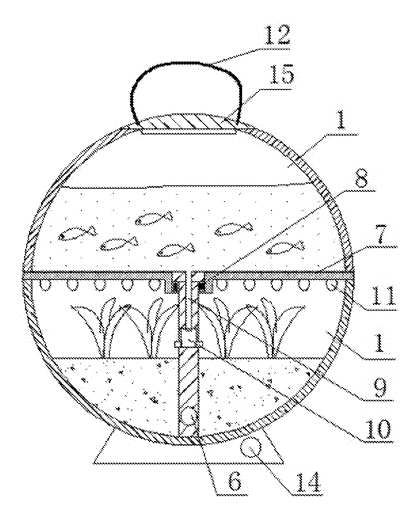
| No. | Part | What it does |
|---|---|---|
| 1 | Upper hemisphere (episphere) | Holds the water and fish; snaps onto the lower half when closed. |
| 2 | Lower hemisphere (lower semisphere) | Houses the planting groove and supports the structure. |
| 3 | Bearing (base) | Fixed at the bottom of the lower hemisphere to support the device. |
| 4 | Control panel | Contains switches to set the target humidity value. |
| 5 | Planting groove | Holds the soil and plants inside the lower hemisphere. |
| 6 | Humidity sensor | Embedded on the side of the planting groove to sense soil moisture. |
| 7 | Dividing plate | Forms the bottom of the fish breeding space; holds the LED lamp. |
| 8 | Bearing (rotary) | Allows the support bar and upper hemisphere to rotate freely. |
| 9 | Outlet pipe | Runs inside the hollow support bar to carry water downward. |
| 10 | Water-drainage solenoid valve | Opens to release water when triggered by the sensor. |
| 11 | LED plant growth lamp | Irradiates the plant to promote growth and provide light. |
| 12 | Handle | Attached to the removable cover for carrying the device. |
| 13 | Support bar | Hollow, telescoping bar connecting the hemispheres. |
| 14 | Power supply | Provides electricity to the control panel, valve, and lamp. |
| 15 | Removable cover | Screws into the top opening to seal the fish tank. |
Operating steps
- Setup - Fill the planting groove with soil and a plant. Add water and fish to the upper hemisphere through the top opening, then screw on the removable cover.
- Set humidity - Use the control panel switch to set the desired soil humidity threshold.
- Extend for use - Pull the telescoping support bar upward so the upper hemisphere rests above the lower one, exposing the plant to the LED lamp.
- Automatic watering - When the humidity sensor detects dry soil, it signals the control panel to open the water-drainage solenoid valve. Water flows from the fish tank, down the outlet pipe inside the support bar, and into the planting groove.
- Close for display - Push the support bar down to shorten it. The upper hemisphere snaps onto the lower hemisphere, forming a complete globe for decoration.
Applications
Living room centerpieces
Homeowners place the globe on coffee tables or shelves where a standard fish tank would be too large. The map pattern on the sphere acts as decor, and the LED lamp provides soft ambient lighting in the evening without needing a separate fixture.
Office desks
Workers who travel for business or forget to water desk plants benefit from the automatic irrigation. The fish tank adds movement to a static workspace, and the closed globe keeps the setup tidy during meetings or after hours.
Classroom teaching aids
Teachers use the device to demonstrate closed-loop ecosystems, soil moisture sensing, and basic electronics to students. The visible solenoid valve operation and sensor feedback make abstract concepts tangible for younger learners.
Retail store displays
Boutiques and garden centers use the illuminated globe to attract foot traffic near checkout counters. The combination of live fish and greenery draws attention more effectively than static merchandise displays.
Where it is less suitable
- Large aquarium hobbyists - the hemisphere volume is designed for small ornamental fish, not large species or complex filtration systems.
- Outdoor gardens - the electronic control panel, power supply, and solenoid valve are intended for indoor use away from rain and direct weather exposure.
- Hydroponic setups - the lower hemisphere uses a planting groove designed for soil, not nutrient film or deep water culture methods.
Frequently asked questions
How does the automatic watering work?
A humidity sensor is embedded in the side of the planting groove in the lower hemisphere. When the soil moisture drops below a value set on the control panel, the sensor sends a signal to open a water-drainage solenoid valve at the bottom of the support bar. Water from the upper fish tank flows down the internal outlet pipe and into the soil.
Can the globe be closed completely?
Yes. The support bar is designed as a telescoping structure. When you push it down to shorten it, the upper hemisphere snaps directly onto the lower hemisphere, forming a complete sphere. This allows the item to serve purely as a decorative globe when the tank and planter are not actively in use.
Does the upper part spin?
The support bar connects to the dividing plate inside the upper hemisphere via a rotary bearing. The patent describes that when stirred by hand, the upper hemisphere can rotate freely on top of the support bar, adding an interactive element to the display.
What powers the device?
The patent specifies a power supply housed in the base bearing alongside the control panel. The exact voltage and whether it relies on batteries, USB, or a mains adapter are set in design and confirmed on prototypes based on the target market’s safety requirements.
Is there a light for the plants?
An LED plant growth lamp is mounted on the lower surface of the dividing plate, which sits just above the planting groove. It connects to the power supply via a controlling switch. It irradiates the plant to promote growth and can also be used for general room illumination.
How do you add water or fish?
The upper surface of the upper hemisphere has an opening. A removable cover screws into this opening via threads. The cover includes a handle, making it easy to lift off for feeding the fish or topping up the water, and simple to carry the unit when needed.
What are the dimensions?
The patent does not list specific sizes or capacities. The overall diameter of the sphere and the depth of the planting groove are to be confirmed in design based on the intended retail application.
Can this design be made and sold in the US?
The patent was filed only in China and has lapsed, so it does not restrict the design in the US or in China. Combined planter-aquarium devices may be covered by other US patents - see Patent & Production - so we recommend a freedom-to-operate check before volume production.
Are you affiliated with the patent owner?
No. IP2M is an independent design and manufacturing service working from the public patent document.
Request a quote
Click Request a Quote below to see our email address - copy it, or open your email app with a ready-made message. Please mention patent CN206078239U in the subject.
Helpful details to include:
- Your company and channel (home decor brand, garden supplier, gift wholesaler, retailer)
- Target dimensions for the globe and preferred hemisphere material (acrylic, glass, etc.)
- Power source preference (battery, USB, or mains plug)
- Custom graphics or surface finishes (map pattern, solid colors, branding)
- Estimated quantity and target price
- Timeline - when you would like samples and the first shipment
You can also reach us at (332) 203-9997.
Explore this product
Interested in building this?
Tell us your target market, quantity and timeline. We reply with options for prototyping, small-batch runs or volume production.
Send your inquiry to
Please put CN206078239U in the subject line and tell us your company, country, estimated quantity and timeline.
Prefer to talk? Call (332) 203-9997.
More product-ready patents
All Garden & Outdoor patents →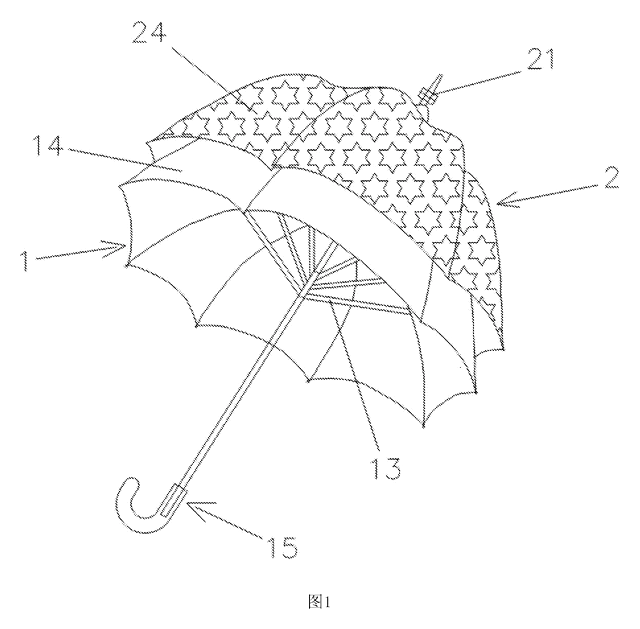
Garden & Outdoor
2-in-1 Parent & Child Umbrella
Full-size umbrella with a nested smaller umbrella on top - a rotating decorative layer that detaches into a kid-size umbrella.
Patent CN205611962U
Garden & Outdoor
Wire-Mesh Tree Root & Trunk Guard Against Rodents
Three-part wire-mesh guard that protects the roots and lower trunk of young trees from burrowing and gnawing animals.
Patent CN206808261U
Garden & Outdoor
Adjustable-Angle Tree Support Prop
Tree prop with a pinned base, angle-locking hinge, twist-adjust tube and a locking trunk ring.
Patent CN208370491U
Garden & Outdoor
Self-Renewing Glue-Roller Mosquito Trap
UV insect trap with a glue roller that re-coats itself and scrapes the catch into a tray - no glue boards.
Patent CN217038569U
Garden & Outdoor
Cam-Lock Telescopic Pole for Garden Power Tools
Telescopic pole for garden power tools with cam-lever locks and a spring-button, tear-drop head socket.
Patent CN205812889U
Garden & Outdoor
Mosquito Fan That Listens for Mosquitoes Before It Sprays
Fan with a scanning microphone dish that mists repellent only when it hears mosquitoes.
Patent CN208708542U
Browse by category
- Apparel & Accessories (22)
- Baby & Kids (16)
- Bags & Luggage (9)
- Bath & Personal Care (16)
- Car Accessories (10)
- Furniture, Bedding & Storage (12)
- Garden & Outdoor (18)
- Health & Wellness (8)
- Home, Kitchen & Cleaning (24)
- Lighting (12)
- Packaging & Containers (6)
- Pet Products (6)
- Phone & Camera Accessories (4)
- Retail Display (13)
- School, Office & Art (19)
- Sports & Recreation (25)
- Tools & Workshop (27)
- Toys & Games (12)
This page is based on the public patent document CN206078239U, assigned to Individual. IP2M is an independent manufacturing service and is not affiliated with, endorsed by or licensed by the patent owner. Images marked as concept renderings are illustrations, not photos of an existing product. Patent status information is provided for reference only and is not legal advice; confirm freedom to operate for your market before production. Full disclaimer.