At a glance
| Patent number | CN206078239U (application CN201620966452) |
| Type | China utility model (实用新型) - protects product shape and structure |
| Original title | Fish bowl flowerpot device (一种鱼缸花盆装置) |
| Patent owner | Individual |
| Inventors | Qiu Ye |
| Filing date | 2016-08-29 |
| Grant date | 2017-04-12 |
| Status (China) | Lapsed - terminated for non-payment of annual fees (recorded 2018-08-14) |
| Patent family | Chinese filings only - no US, European, Japanese, PCT or other filings listed |
| Cited by | 4 later documents |
| Source | Google Patents (search for CN206078239U) |
What the claims cover, in plain language
Claim 1 - A fish jar flower pot arrangement comprising a hollow spheroid separated into an upper hemisphere and a lower hemisphere, and a bearing fixed at the bottom of the lower hemisphere. The bearing houses a control panel and a power supply. The lower hemisphere contains a planting groove and a humidity sensor embedded on the side of the groove. The upper hemisphere is mounted on top of the lower hemisphere via a support bar. A dividing plate is set on the lower surface of the upper hemisphere, forming a fish breeding space between the dividing plate and the sphere. The support bar connects movably to the dividing plate through a bearing, is hollow, and contains an outlet pipe. The upper end of the pipe connects to the breeding space, and the lower end has a water-drainage solenoid valve electrically connected to the humidity sensor and controlled by the control panel.
Claim 2 - The support bar is a scalable (telescoping) structure. When shortened, the upper hemisphere snaps onto the lower hemisphere. Claim 3 - The lower surface of the dividing plate is equipped with an LED plant growth lamp. Claim 4 - The upper surface of the upper hemisphere has an opening fitted with a removable cover.
This is a simplified reading for orientation only. The legal scope is defined by the exact claim wording in the official Chinese document.
What this means for US production
This patent was filed only in China and has lapsed, so it no longer restricts anyone in China either. It has no US or other foreign counterpart.
Two points to settle early:
- Other patents may exist. Self-watering planters and combined aquaponic desktop devices are active fields. One later international publication (WO2020192446A1) citing this document lists Liu Xinjian as the assignee, indicating continued development in related mechanisms. A freedom-to-operate (FTO) review covering the specific sensor-valve logic and telescoping globe structure is needed before tooling.
- Waterproofing the electronics. Integrating a power supply, control panel, and solenoid valve beneath a water-filled hemisphere requires strict sealing designs to prevent leaks and electrical hazards, which must be validated during prototyping.
Customization and manufacturing
What can be customized
| Area | Options |
|---|---|
| Hemisphere material | Clear acrylic, polycarbonate, or glass; size to be confirmed in design |
| Base and bearing | ABS plastic, wood-finish housing, or metal accents |
| Electronics | Battery-operated or USB/mains powered; sensor sensitivity thresholds |
| Lighting | LED color temperature, full-spectrum grow profiles, brightness levels |
| Valve and tubing | Solenoid voltage rating, food-safe silicone tubing diameter |
| Surface graphics | Map patterns, custom prints, frosted finishes, or brand colors |
Things to plan for (US market)
- UL or ETL listing - required if the device plugs into a standard US wall outlet, due to the combination of water and mains electricity.
- FCC Part 15 - applies to the control panel circuitry to ensure it does not cause radio frequency interference.
- California Prop 65 - plastics, solder, and LED components must be screened for listed chemicals.
- FDA 21 CFR - if marketed with any implication of growing edible herbs, materials contacting the water and soil may need food-contact compliance.
How a project runs
- Inquiry - define target dimensions, power source, material preferences, and order volume.
- Design - engineer the telescoping mechanism, seal the bearing against water ingress, and lay out the PCB for the control panel.
- Prototype - 3D print the base, machine or mold the hemispheres, and assemble the plumbing to test the sensor-to-valve response time.
- Pilot run - conduct leak testing, electrical safety checks, and long-term soil moisture cycling to verify durability.
- Production - injection molding for plastic parts, blow molding or glass forming for hemispheres, SMT assembly for electronics, and final waterproof sealing.
Quantities & timeline
The hemispheres require blow molds or glass-forming tools depending on the chosen material, while the base, support bar, and dividing plate need injection molds. The PCB and solenoid valve involve electronic component sourcing and assembly jigs. Safety certification testing for mains-powered units adds significant lead time. Send us your target dimensions, material preferences, power requirements, quantity and target price and we will reply with options.
Patent drawings
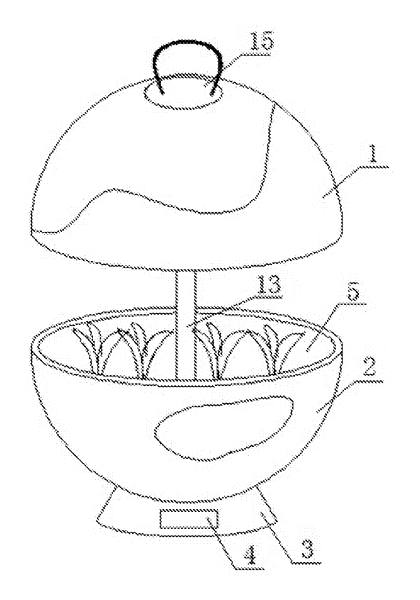
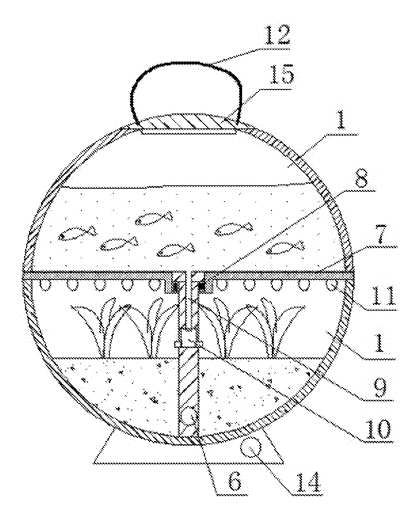
Drawings reproduced from the public patent document for reference.