At a glance
| Patent number | CN206119969U (application CN201620709496) |
| Type | China utility model (实用新型) - protects product shape and structure |
| Original title | Multifunctional pot (一种多功能锅) |
| Patent owner | Zhejiang Shangchu Home Technology Co ltd |
| Inventors | Dong Yuefeng, Hu Jianxin |
| Filing date | 2016-06-30 |
| Grant date | 2017-04-26 |
| Status (China) | Expired - a China utility model lasts at most 10 years from filing; the term ended on 2026-06-30 |
| Patent family | Chinese filings only - no US, European, Japanese, PCT or other filings listed |
| Cited by | 90 later documents |
| Source | Google Patents (search for CN206119969U) |
What the claims cover, in plain language
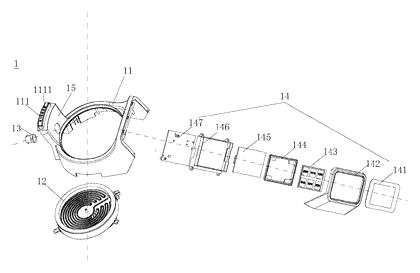
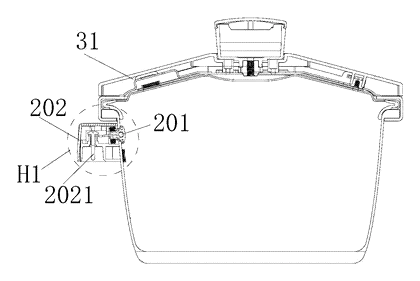
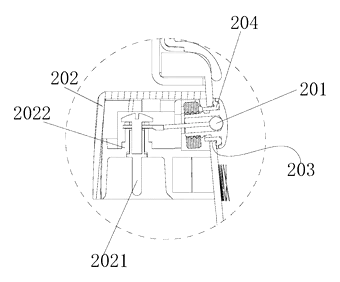
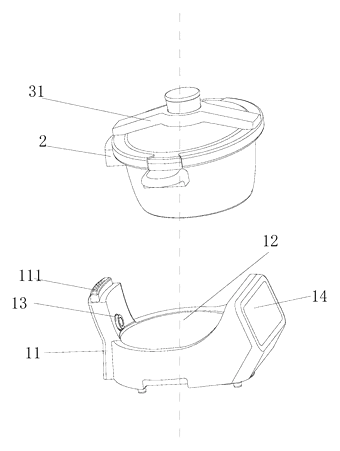
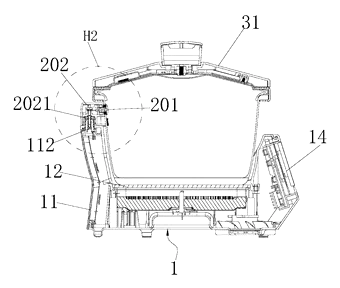
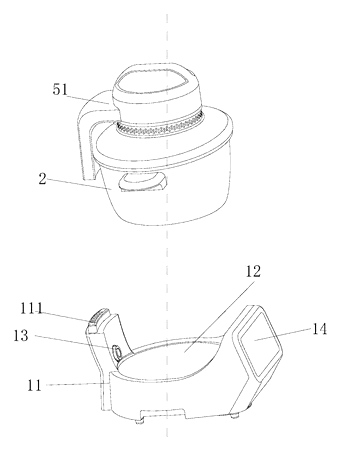
Claim 1 - a multifunctional pot comprising a heating part and an inner pot. The heating part has a main body containing a heating body, a temperature measuring component, and a control board assembly that controls the heating power. The control board is electrically connected to the heating body and the temperature measuring component to receive temperature signals. The inner pot rests on the heating body. An insulated main body connector is provided on the main body, holding a conductive terminal electrically connected to the control board assembly. A temperature measuring device on one side of the inner pot detects its internal temperature and can be electrically connected to the conductive terminal.
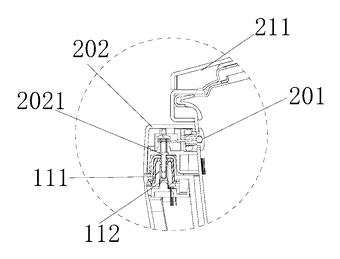
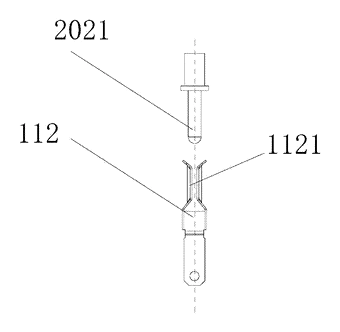
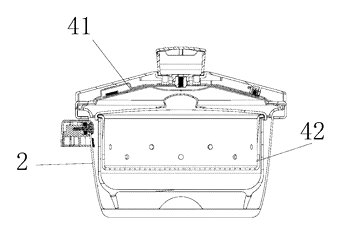
Claims 2-3 - the insulated main body connector is located at the upper edge of an ear part on the main body, featuring a socket corresponding to a terminal post. The upper end of the conductive terminal is a U-shaped elastic contact into which the lower end of the terminal plugs. Claim 4 - the inner pot side wall has a temperature measuring hole fitted with a heat insulating gasket. The temperature measuring device is fixed in this gasket, with its inner end inside the pot and its outer end connected to the terminal. Claim 5 - the temperature measuring component is installed at the ear, protruding from the inner surface to contact the inner pot when placed on the heating body. Claim 6 - adding a pressure cooker lid closed on the inner pot forms an electric pressure cooker. Claim 7 - adding a pressure cooker lid and placing a ceramic pot inside the inner pot forms a health pot. Claim 8 - adding an air fryer lid closed on the inner pot forms an air fryer, where the fan and heat pipe in the lid are electrically connected to the control board assembly through the conductive terminals. Claim 9 - adding a pot cover and placing a ceramic pot inside forms an electric cup pot. Claim 10 - placing a steamer on the inner pot forms a steamer.
This is a simplified reading for orientation only. The legal scope is defined by the exact claim wording in the official Chinese document.
What this means for US production
This patent was filed only in China and has expired, so it no longer restricts anyone in China either. It has no US or other foreign counterpart.
Two points to settle early:
- Other patents may exist. Multi-cooker systems with interchangeable lids and integrated electrical connections are heavily patented. Companies such as Sharkninja Operating Llc hold later US and foreign patents in this field (e.g., US10390656B2, USD873602S1, USD874211S1), citing this design. A freedom-to-operate (FTO) review of the lid-locking mechanisms, terminal designs, and air-fryer integration is essential before tooling.
- Electrical isolation. The insulated main body connector and conductive terminal interface must be engineered to prevent shock hazards when users handle the inner pot or swap lids while the unit is plugged in.
Customization and manufacturing
What can be customized
| Area | Options |
|---|---|
| Capacity | Inner pot volume to be confirmed in design (e.g., about 4 to 8 quarts) |
| Lid selection | Pressure, air fryer, standard cover, steamer tray included or sold separately |
| Terminal design | Shape and spring force of the U-shaped elastic contact to ensure reliable mating |
| Housing material | Outer shell plastics or metals, finish colors, and textures |
| Control board | Pre-set programs, display type, and power ratings adapted for 120V US mains |
| Sensor placement | Position of the temperature measuring hole and insulating gasket on the pot wall |
Things to plan for (US market)
- UL 1026 - Standard for Household Electric Cooking and Warming Appliances, covering the heating base, wiring, and thermal cut-offs.
- UL 1083 - Standard for Household Electric Skillets and Frying-Type Appliances, relevant if the air fryer lid configuration is marketed.
- FDA 21 CFR - Food contact regulations for the inner pot coating, ceramic inserts, and any plastic parts touching food or steam.
- FCC Part 15 - Electromagnetic interference limits for the digital control board assembly.
- California Proposition 65 - Screening of materials used in the housing, cords, and inner pot coatings.
How a project runs
- Inquiry - define target capacity, included lids, voltage, and certification requirements.
- Design - engineer the insulated connector, terminal mating geometry, inner pot sensor placement, and control board logic.
- Prototype - build samples to test electrical continuity through the terminals, heating performance, and lid-swapping mechanics.
- Pilot run - conduct safety testing, thermal cycling, and durability checks on the U-shaped elastic contacts.
- Production - mold housings, stamp or spin the inner pots, assemble the PCB, install the insulated connectors, and perform final electrical safety tests.
Quantities & timeline
Tooling includes injection molds for the main body and various lids, deep-draw dies for the inner pot, and stamping tools for the conductive terminals and insulating gaskets. Certification testing for UL and FDA compliance requires multiple prototype iterations. Send us your target capacity, required lid configurations, voltage, estimated quantity, and timeline and we will reply with options.
Patent drawings
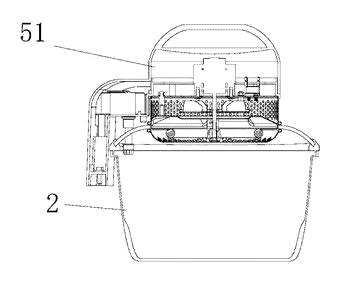
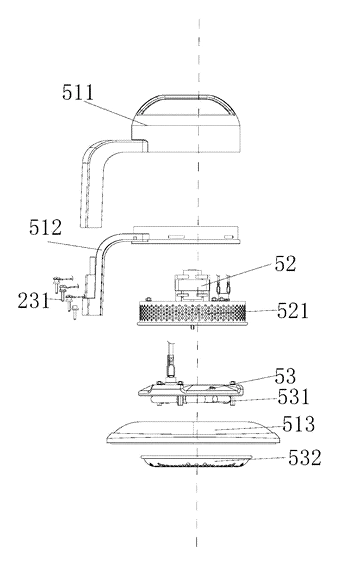
Drawings reproduced from the public patent document for reference.