At a glance
| Patent number | CN206239087U (application CN201620793119) |
| Type | China utility model (实用新型) - protects product shape and structure |
| Original title | Juice extracting and stirring cup (一种榨汁搅拌杯) |
| Patent owner | Jiafan International Co ltd |
| Inventors | Li Baofeng |
| Filing date | 2016-07-26 |
| Grant date | 2017-06-13 |
| Status (China) | Lapsed - terminated for non-payment of annual fees (recorded 2022-07-15) |
| Patent family | Chinese filings only - no US, European, Japanese, PCT or other filings listed |
| Cited by | 7 later documents |
| Source | Google Patents (search for CN206239087U) |
What the claims cover, in plain language
Claim 1 defines the core assembly: a cup body (1) with an internal locking structure (12), a juicing disc (2) featuring a cone (22) and holes (23), a lid (3), a stirring member (4) containing a magnet bar (41), and a rotating device (5) at the base. The rotating device includes a housing (51), motor (52), power supply (53), switch (54), and a connecting rod (55) with magnetic blocks (551) that magnetically couple to the stirring member to rotate it.
Claims 2-3 detail specific variations of the locking structure for the juicing disc: either using convex strips (121) and clamping grooves (211), or a stepped portion (122) with projections (123) and corresponding grooves (212).
Claim 4 onward describe the mechanical interface between the base and the cup, such as threaded connections (513/13) or other attachment methods to secure the motor housing to the cup bottom.
This is a simplified reading for orientation only. The legal scope is defined by the exact claim wording in the official Chinese document.
What this means for US production
This patent was filed only in China and is currently lapsed due to non-payment of fees. Therefore, it does not restrict anyone in China or elsewhere from manufacturing this specific configuration based on this expired right.
Two issues worth resolving before launch:
- Other patents may exist. Kitchen appliances, particularly those involving magnetic coupling and juicing mechanisms, are a crowded field with active patents held by major brands (e.g., Hamilton Beach, Cuisinart, Vitamix) and numerous smaller entities. Before launch, commission a freedom-to-operate (FTO) review to confirm that your implementation of the magnetic drive and juicing disc does not infringe valid US patents.
- Safety and Certification. Electrically powered drinkware involves batteries and motors. Compliance with US safety standards is mandatory regardless of patent status.
Customization and manufacturing
What can be customized
| Area | Options |
|---|---|
| Capacity | 300ml, 400ml, 500ml, etc. (adjust mold cavity) |
| Materials | Tritan, PP, Stainless Steel (inner/outer), Silicone seals |
| Power Source | Rechargeable Lithium-ion (USB-C/Micro-USB) or Disposable AA/AAA |
| Motor Speed | Single speed, dual speed, or variable RPM control |
| Color/Finish | Pantone matching, matte/gloss coatings, metal accents |
| Juicing Disc | Cone height, hole pattern density, material (plastic vs. steel) |
Things to plan for (US market)
- UL 2054 / UL 62368-1: Safety standards for household and information technology equipment, specifically covering battery-powered devices and electrical insulation.
- FDA 21 CFR 177: Regulations for plastic materials intended for food contact. All wetted parts must be FDA-compliant.
- FCC Part 15: If the device includes wireless charging or Bluetooth connectivity, electromagnetic compatibility testing is required.
- California Prop 65: Warning labels may be required if certain chemicals (like lead or phthalates) are present in components above threshold levels.
How a project runs
- Concept & Specs: Define capacity, power method, and target price point.
- Design & Engineering: CAD modeling of the magnetic coupling tolerance and juicing disc ergonomics.
- Tooling: Create injection molds for the cup body, lid, and juicing disc; stamping dies for metal bases if applicable.
- Prototyping: Assemble functional prototypes for leak testing, mixing performance, and drop tests.
- Certification & Mass Production: Send units to UL/FDA labs for approval; begin pilot run and quality control checks.
Quantities & timeline
Lead times typically range from 8-12 weeks for tooling and initial samples, depending on complexity. Minimum Order Quantities (MOQ) usually start at 1,000-3,000 units per color/SKU. Send us your capacity, material preference, power specifications, estimated quantity and target price and we will reply with options.
Patent drawings
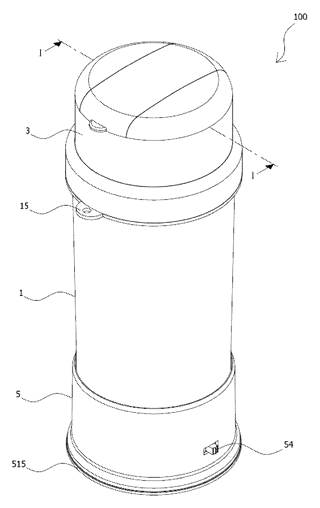
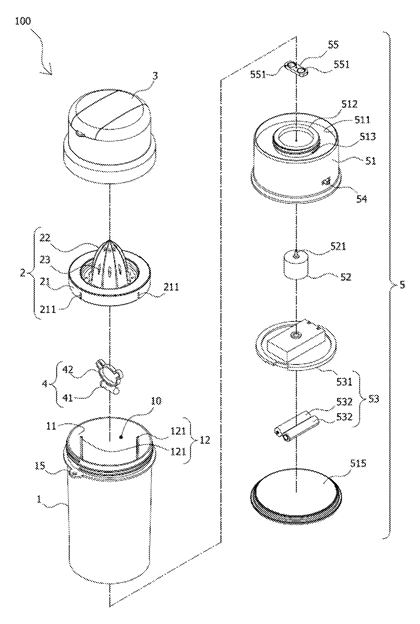
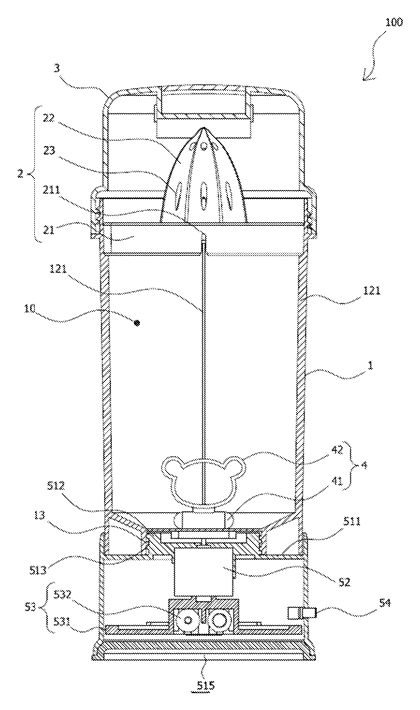
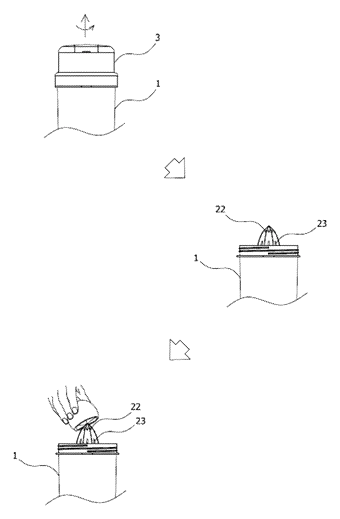
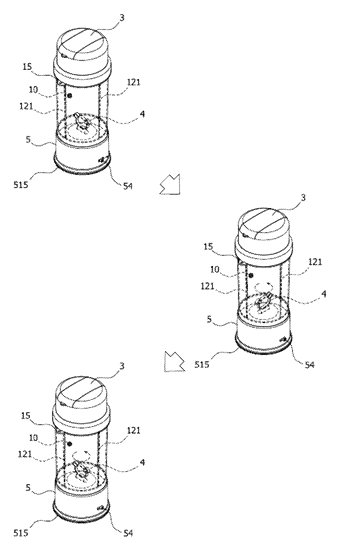
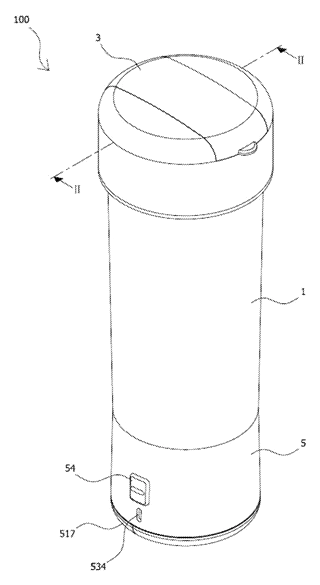
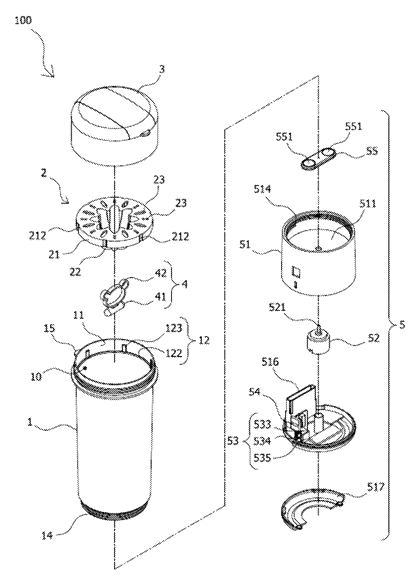
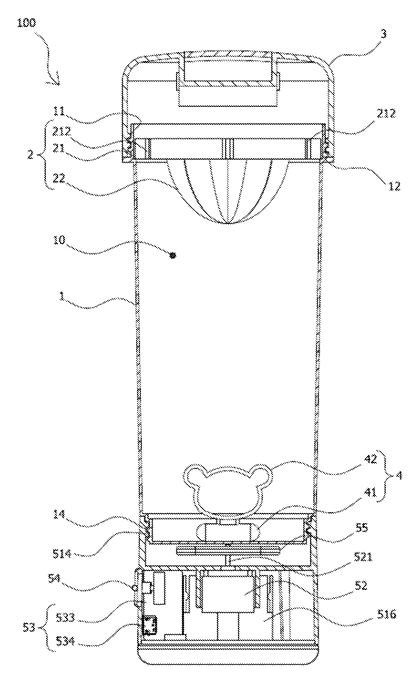
Drawings reproduced from the public patent document for reference.