At a glance
| Patent number | CN206284741U (application CN201620665777) |
| Type | China utility model (实用新型) - protects product shape and structure |
| Original title | Juice-squeezing cup (一种榨汁水杯) |
| Patent owner | Huang Yu (individual) |
| Inventors | Huang Yu |
| Filing date | 2016-06-29 |
| Grant date | 2017-06-30 |
| Status (China) | Lapsed - terminated for non-payment of annual fees (recorded 2021-06-04) |
| Patent family | Chinese filings only - no US, European, Japanese, PCT or other filings listed |
| Cited by | 2 later documents |
| Source | Google Patents (search for CN206284741U) |
What the claims cover, in plain language
Claim 1 - a cup with a body and a screw lid, plus a press and a filter bowl. The top of the press is bottle-shaped with a body, shoulder, neck and screw cap; its bottom is a hollow upside-down cone with a domed squeezing tip, joined to the body by an inner flange and with an opening at its base. The filter bowl, with filter holes, rests on a ledge inside the top of the cup; the press sits on the cup, and the lid, with an opening larger than the press’s cap, screws on over it and holds it in place.
Claims 2-5 - the filter bowl has a handle; it has ribs inside; the squeezing tip has ribs; both sets of ribs are triangular in section. Claims 6-10 - further details described in the patent: the shoulder of the press, seal rings in the lid and on the cup rim, a hang loop and a handle on the cup.
This is a simplified reading for orientation only. The legal scope is defined by the exact claim wording in the official Chinese document.
What this means for US production
This patent was filed only in China and has lapsed, so it no longer restricts anyone in China either. It has no US or other foreign counterpart.
Two points to settle early:
- Check the US patent landscape. Juicer bottles, citrus reamers built into cups and infuser bottles appear in many US design and utility patents, so ask a US patent attorney for a freedom-to-operate (FTO) review of your final design, and give the bottle its own look.
- Food contact. Every part that touches juice or water must be made from food-contact materials and tested.
Customization and manufacturing
What can be customized
| Area | Options |
|---|---|
| Bottle | Capacity and shape - to be confirmed in design; Tritan, PP or glass with a sleeve |
| Press | Cone and rib design for lemons, limes or oranges; stainless-steel tip |
| Filter bowl | Hole size, removable seed screen, dishwasher-safe material |
| Lid | Flip-top, straw lid or sports spout; carry loop |
| Kids’ version | Smaller size, soft-touch grip, spill-proof lid |
| Branding | Colors, printing, gift packaging |
Things to plan for (US market)
- FDA food contact - plastics must meet 21 CFR 174-178 (for example 21 CFR 177.1520 for PP); silicone seals under 21 CFR 177.2600.
- BPA-free claims - only with supporting material documentation.
- California Prop 65 - review colorants, coatings and any printed decoration.
- Children’s version - if marketed for kids 12 and under, CPSIA lead and phthalate limits, third-party testing and a Children’s Product Certificate apply.
- Leak and dishwasher testing - in-house tests of seals and materials.
How a project runs
- Inquiry - capacity, materials, lid style and quantity.
- Design - bottle shape, press cone and filter bowl adapted to your range.
- Prototype - samples tested on lemons, limes and oranges for juice yield and leaks.
- Pilot run - small batch with food-contact testing.
- Production - volume production, packaging and shipping.
Quantities & timeline
The bottle needs a blow or injection mold depending on material, and the press, filter bowl and lid each need injection molds; seals need a silicone mold. Send us your capacity, materials, quantity and target price and we will reply with options.
Patent drawings
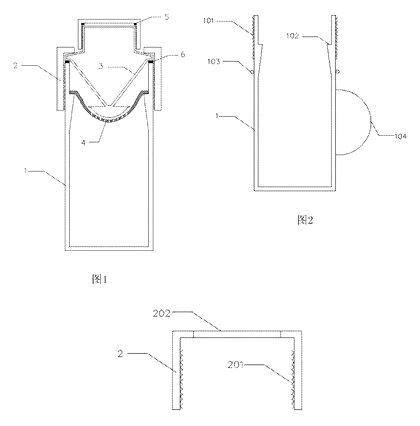
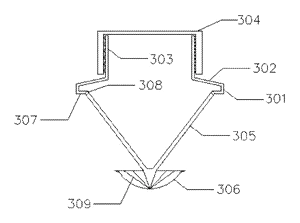
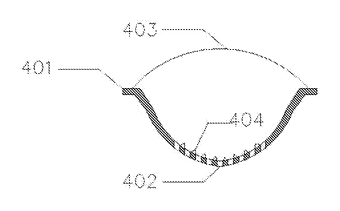
Drawings reproduced from the public patent document for reference.