
Patent CN206285697U
Updated November 3, 2026Modular Plant Curtain Wall with Solidified Matrix Modules and Recirculating Irrigation
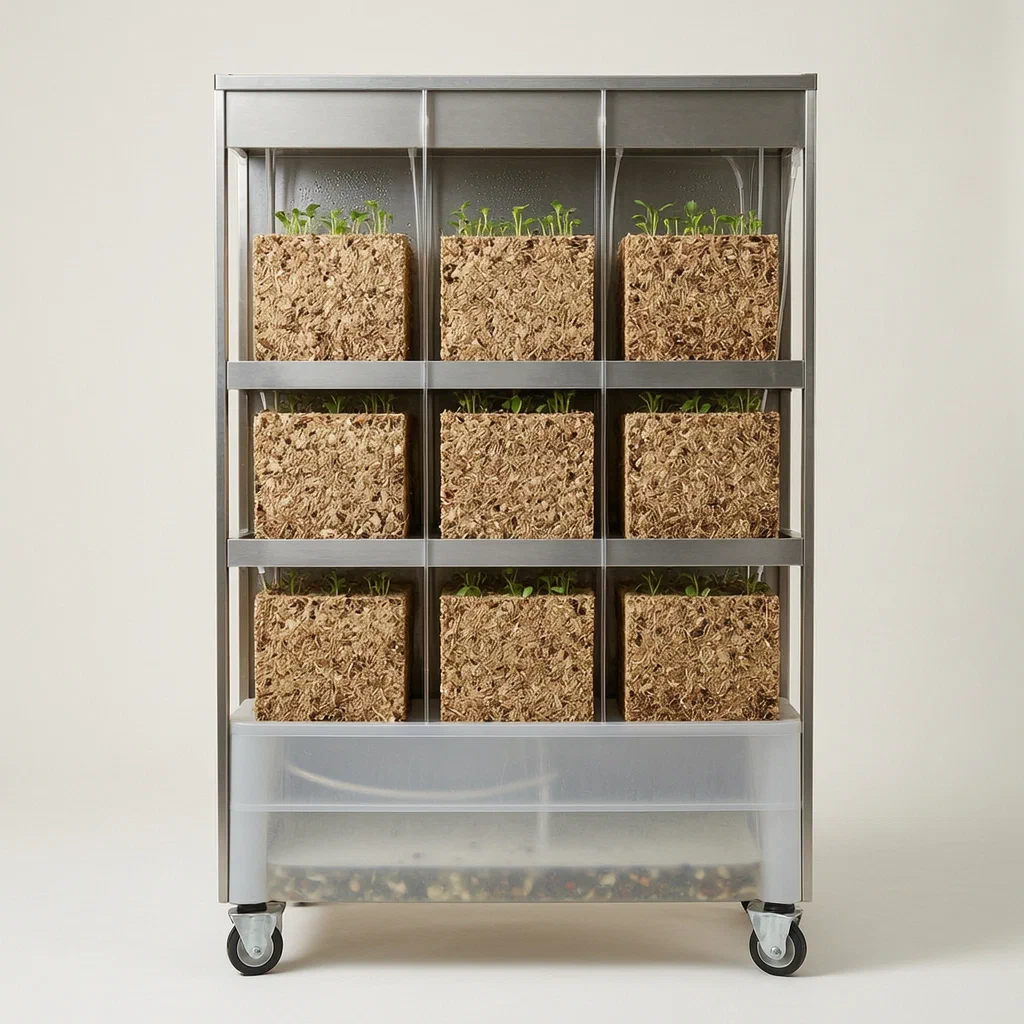
Traditional green walls often suffer from heavy soil loads, poor drainage, and difficult maintenance. This design uses solidified matrix modules—lightweight blocks where peat and perlite are bound by heat-cured polyester fibers—to create a stable, breathable growing medium. These modules snap into a vertical steel frame. Water is delivered via drip tubes at the top of each layer, trickling down through the porous blocks to a filtered base tank for reuse. The system can be moved on casters, lit by overhead LEDs, or integrated with an air purification channel behind the plants.
- China utility model - expired
- No filings outside China
- Vertical gardening & interior landscaping
- Solidified matrix modules, steel frame, drip irrigation
Splat! What let you down?
🧱
Solidified Matrix
Lightweight blocks of peat, perlite, and polyester fiber hold plants securely without loose soil.
💧
Recirculating Irrigation
Drip tubes feed each layer; water drains into a filtered base tank for reuse.
🏗️
Modular Steel Frame
Modules snap into a vertical steel frame, allowing easy replacement of plant varieties.
🌬️
Optional Air Purification
An internal channel with photocatalytic coating can draw air through the plant gaps.
Bring this product to market
- ✓ Patent vetted China-only family and legal status checked
- 2 Product brief · now How it works, uses and options written up
- 3 Prototype First samples for buyers to review
- 4 Pilot run Small first batch for launch customers
- 5 Volume production Repeat orders at scale
Buyer interest
– of 100 buyers needed to start prototyping
One click, no sign-up. Each vote is one real visitor, and products with the most interest go to prototyping first.
Build team: no members yet. Need a partner, co-funding or skills to build this? Join and we introduce the team once it forms.
The problem
Conventional vertical gardens often rely on heavy soil pockets or hydroponic pads that are difficult to maintain, prone to clogging, and structurally unstable when wet. Transporting and installing these systems requires significant labor because the growing medium is loose or fluid-based. Furthermore, standard green walls typically lack integrated solutions for lighting in low-sun areas or for improving indoor air quality beyond simple photosynthesis. There is a need for a modular system that is light enough to move easily, durable enough to hold its shape under watering cycles, and capable of integrating auxiliary functions like filtration and air treatment.
The solution
The patent describes a plant curtain wall constructed from discrete units rather than a continuous surface.
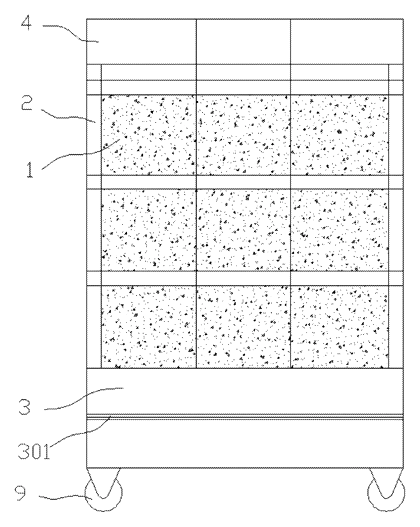
- Solidified Matrix Modules (1) serve as the growing medium. These are formed by mixing peat, perlite, and vermiculite with semi-melted polyester fibers (typically in a weight ratio of 1:6 to 1:8). The mixture is placed in molds and heated to set, creating a rigid, three-dimensional network structure. This results in a block that is lightweight, porous, and retains its shape even when saturated.
- A Module Frame (2), typically rectangular, contains multiple cavities. The solidified matrix modules are embedded directly into these cavities. The frame uses a hanging buckle design for easy assembly and disassembly.
- The entire assembly is held in a vertical orientation by a Support Steel Frame (5). This ensures the wall stands upright and supports the load of the modules.
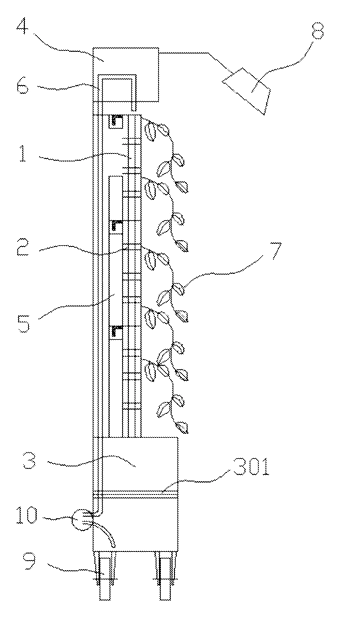
- Irrigation is handled by Dropper Tubes (6) laid along the back of the support frame. Water is pumped to the top of each layer of modules. As the water saturates the upper module, it trickles down through the porous material to the next layer below, eventually reaching a Water Tank (3) at the base.
- The base tank includes a Filter (301) to separate debris, allowing clean water to be recirculated by a Pump (10).
Who it is for
- Interior Landscapers: Companies designing living walls for offices, hotels, or lobbies who need a system that is lighter than traditional soil beds and easier to service.
- Commercial Building Managers: Facilities seeking to improve indoor aesthetics and potentially air quality with a self-contained unit that can be moved if needed.
- Retail Display Designers: Brands looking for flexible, modular greenery displays that allow for quick changes in plant types or layout configurations.
- Residential Homeowners: Individuals wanting a manageable vertical garden for patios or indoor spaces without the complexity of large-scale hydroponic setups.
How it works
The main parts
| No. | Part | What it does |
|---|---|---|
| 1 | Solidified Matrix Module | The growing block containing plants; made of cured substrate and fiber. |
| 2 | Module Frame | Holds the matrix modules in vertical alignment via cavities. |
| 3 | Water Tank | Base reservoir collecting drained water; divided into dirty and clean sections. |
| 301 | Filter | Separates solids from water in the tank before recirculation. |
| 4 | Top Cover | Houses supplemental lighting components. |
| 5 | Support Steel Frame | Provides structural rigidity and mounts the droppers. |
| 6 | Dropper Tubes | Deliver water to the top of each module layer. |
| 7 | Plants | Vegetation grown within the matrix modules. |
| 8 | Fill Light | Supplemental lamps illuminating the plants from above. |
| 9 | Casters | Wheels attached to the tank base for mobility. |
| 10 | Pump | Circulates water from the clean section of the tank to the droppers. |
| 11 | Air Purification Channel | Optional duct behind the plants for airflow treatment. |
| 12 | Fan | Draws air through the purification channel. |
Operating steps
- Assembly: Insert solidified matrix modules (1) into the cavities of the module frame (2). Attach the frame to the support steel frame (5).
- Planting: Plants (7) are already established in the modules or inserted during assembly.
- Irrigation Cycle: The pump (10) sends water from the clean portion of the tank (3) up through the dropper tubes (6). Water exits at the top of each module layer.
- Percolation: Water soaks into the porous matrix of the top module, then drips down to the module below it, continuing until it reaches the bottom.
- Collection & Filtration: Excess water collects in the return portion of the tank (3), passes through the filter (301), and enters the clean portion for reuse.
- Lighting: If installed, fill lights (8) activate to provide additional illumination to the plant canopy.
- Air Flow (Optional): If equipped with the purification channel (11), the fan (12) draws air through gaps in the plant roots or across the photocatalytic coated surfaces.
Applications
Office Lobby Green Walls
Large open spaces in corporate buildings are a possible setting for this modular system. Check the frame, anchoring and loaded weight for the actual location. Maintenance teams can plan replacement of individual plant modules without replacing the entire installation.
Retail Store Displays
Fashion and lifestyle brands use living walls to enhance store ambiance. The ability to add casters (9) allows these displays to be moved between sales floors or repositioned for seasonal events. The solidified matrix prevents soil spillage onto retail flooring, maintaining cleanliness in high-traffic areas.
Hotel and Hospitality Areas
Lobbies and waiting areas in hotels often have limited natural light. Fill lights (8) are an option described in the patent, but illumination and watering must be matched to the selected plants. Assess pump noise and servicing access on prototypes before specifying a quiet hospitality installation.
Indoor Air Quality Zones
In enclosed spaces with poor ventilation, the optional air purification channel (11) adds value. By routing room air through the plant root zones and photocatalytic surfaces, the system acts as a hybrid bio-filter, supplementing standard HVAC systems without requiring external chemical treatments.
Residential Patios and Balconies
Homeowners could consider a compact version for a patio or balcony. Plan tank refilling and drainage, then verify loaded weight, anchoring and outdoor exposure for the chosen location. The patent does not establish a comparative wind-load rating.
Where it is less suitable
- Outdoor High-Wind Areas: While the steel frame is strong, the exposed plant modules may dry out too quickly in direct sun and wind without additional shielding.
- Very Large Scale Installations: For massive exterior facades spanning multiple stories, structural engineering for the steel frame becomes complex; this design is optimized for freestanding or wall-mounted interior/semi-interior units.
- Hydroponic-Only Crops: The solidified matrix is designed for soil-like retention; plants requiring pure nutrient film technique (NFT) or deep water culture may not perform optimally in the fiber-bound substrate.
Frequently asked questions
What is a “solidified matrix”?
It is a pre-formed block of growing medium. Unlike loose soil, this block is made by mixing peat, perlite, and vermiculite with polyester fibers, then heating them to fuse the structure. This creates a lightweight, rigid cube that holds water and nutrients while allowing roots to penetrate. It prevents mess and makes replacing dead plants as easy as swapping a brick.
How does the watering system work?
Water is pumped from a base tank up to tubes running behind the steel frame. These tubes drip water onto the top of each row of plant modules. The water naturally trickles down through the porous matrix blocks, irrigating the lower layers. Excess water collects in the bottom tank, passes through a filter to remove debris, and is pumped back up for reuse.
Can I move the plant wall around?
Yes. The patent describes adding casters (wheels) to the base of the water tank. This turns the entire unit into a mobile display piece, which is useful for retail stores or event spaces that need to rearrange their layout frequently.
Does it help with air quality?
The patent includes an optional version with an air purification channel behind the plants. A fan draws air through this closed passage, which can be coated with photocatalytic materials. This setup aims to filter air as it passes near the plant roots and leaves, though specific performance metrics would depend on the final engineering design.
Is it hard to maintain?
Maintenance is simpler than traditional green walls. You don’t need to dig out soil to replace a plant; you just pull out the solidified matrix module and insert a new one. The recirculating water system reduces the frequency of manual refills compared to drip-only systems without recovery tanks.
What power sources are needed?
If you choose the version with pumps, fans, or supplemental lights, the unit requires an electrical connection. Basic gravity-fed or manual-refill versions might not need power, but the patented design specifically mentions a pump for circulation and optional electric lights/fans.
Can this design be made and sold in the US?
The patent was filed only in China and has expired, so it does not restrict the design in the US or in China. However, vertical gardening is a competitive field with many active US patents. We recommend a freedom-to-operate check to ensure your specific implementation doesn’t conflict with newer US intellectual property.
Are you affiliated with the patent owner?
No. IP2M is an independent design and manufacturing service working from the public patent document.
Request a quote
Click Request a Quote below to see our email address - copy it, or open your email app with a ready-made message. Please mention patent CN206285697U in the subject.
Helpful details to include:
- Your company and application (interiorscape, retail display, residential builder)
- Dimensions of the desired wall (height, width, number of module rows)
- Features required (casters, fill lights, air purification channel, automatic pump)
- Material preferences for the frame (powder-coated steel, stainless, etc.)
- Estimated quantity and target price
- Timeline - when you would like prototypes and the first shipment
You can also reach us at (332) 203-9997.
Explore this product
Interested in building this?
Tell us your target market, quantity and timeline. We reply with options for prototyping, small-batch runs or volume production.
Send your inquiry to
Please put CN206285697U in the subject line and tell us your company, country, estimated quantity and timeline.
Prefer to talk? Call (332) 203-9997.
More product-ready patents
All Garden & Outdoor patents →
Garden & Outdoor
2-in-1 Parent & Child Umbrella
Full-size umbrella with a nested smaller umbrella on top - a rotating decorative layer that detaches into a kid-size umbrella.
Patent CN205611962U
Garden & Outdoor
Wire-Mesh Tree Root & Trunk Guard Against Rodents
Three-part wire-mesh guard that protects the roots and lower trunk of young trees from burrowing and gnawing animals.
Patent CN206808261U
Garden & Outdoor
Adjustable-Angle Tree Support Prop
Tree prop with a pinned base, angle-locking hinge, twist-adjust tube and a locking trunk ring.
Patent CN208370491U
Garden & Outdoor
Self-Renewing Glue-Roller Mosquito Trap
UV insect trap with a glue roller that re-coats itself and scrapes the catch into a tray - no glue boards.
Patent CN217038569U
Garden & Outdoor
Cam-Lock Telescopic Pole for Garden Power Tools
Telescopic pole for garden power tools with cam-lever locks and a spring-button, tear-drop head socket.
Patent CN205812889U
Garden & Outdoor
Mosquito Fan That Listens for Mosquitoes Before It Sprays
Fan with a scanning microphone dish that mists repellent only when it hears mosquitoes.
Patent CN208708542U
Browse by category
- Apparel & Accessories (33)
- Baby & Kids (24)
- Bags & Luggage (14)
- Bath & Personal Care (24)
- Car Accessories (19)
- Furniture, Bedding & Storage (18)
- Garden & Outdoor (26)
- Health & Wellness (11)
- Home, Kitchen & Cleaning (39)
- Lighting (18)
- Packaging & Containers (9)
- Pet Products (8)
- Phone & Camera Accessories (7)
- Retail Display (19)
- School, Office & Art (27)
- Sports & Recreation (33)
- Tools & Workshop (42)
- Toys & Games (18)
This page is based on the public patent document CN206285697U, assigned to Anhui Xi Mei Environmental Protection Technology Co Ltd. IP2M is an independent manufacturing service and is not affiliated with, endorsed by or licensed by the patent owner. Images marked as concept renderings are illustrations, not photos of an existing product. Patent status information is provided for reference only and is not legal advice; confirm freedom to operate for your market before production. Full disclaimer.