At a glance
| Patent number | CN206285697U (application CN201620901041) |
| Type | China utility model (实用新型) - protects product shape and structure |
| Original title | Plant curtain wall (一种植物幕墙) |
| Patent owner | Anhui Xi Mei Environmental Protection Technology Co Ltd |
| Inventors | Cheng Yang |
| Filing date | 2016-08-18 |
| Grant date | 2017-06-30 |
| Status (China) | Expired - a China utility model lasts at most 10 years from filing; the term ended on 2026-08-18 |
| Patent family | Chinese filings only - no US, European, Japanese, PCT or other filings listed |
| Cited by | 5 later documents |
| Source | Google Patents (search for CN206285697U) |
What the claims cover, in plain language
Claim 1 - defines the core structure: a plant curtain wall comprising solidified matrix modules, a module frame with cavities to hold these modules, a support frame holding the module frame vertically, a tank at the bottom, and droppers running along the back of the support frame to deliver water to the top of each module layer. The modules are stacked vertically.
Claim 2 - adds fill lights fixed to the top of the module frame to illuminate the plants. Claim 3 - specifies casters attached to the bottom of the tank to allow the entire unit to be moved. Claim 4 - identifies the support frame as a steel frame. Claim 5 - details the tank’s dual function: divided into a return water portion and a purified water portion connected by a filter. The return portion catches dripping water; the purified portion feeds the pump and droppers. Claims 6-9 - describe an optional air purification channel located behind the support frame. This closed passage has inlet/outlet ports, inner surfaces coated with photocatalytic material, and connects to a blower/fan. Air flows either through the gaps in the plant modules or is discharged after passing through the channel. Baffle plates may be included inside the channel. Claim 10 - reiterates the tank/filter/pump configuration in the context of the air purification embodiment.
This is a simplified reading for orientation only. The legal scope is defined by the exact claim wording in the official Chinese document.
What this means for US production
This patent was filed only in China and has expired, so it no longer restricts anyone in China either. It has no US or other foreign counterpart.
Two points to settle early:
- Other patents may exist. Vertical gardening and modular green wall technologies are active fields with numerous US patents covering various mounting systems, irrigation methods, and structural frames. One specific citation noted in the data is US20260053099A1 by Daniel S. Spiro. A freedom-to-operate (FTO) review is recommended to ensure your specific implementation of the solidified matrix and recirculation loop does not infringe on current US intellectual property.
- Material Certification. The “solidified matrix” involves specific chemical curing processes (polyester fibers mixed with peat/perlite). In the US market, you must verify that these materials meet safety standards for indoor use, particularly regarding off-gassing and fire retardancy.
Customization and manufacturing
What can be customized
| Area | Options |
|---|---|
| Module Size | Standard 30x30x5 cm blocks or custom dimensions per cavity design. |
| Frame Material | Powder-coated steel, stainless steel, or aluminum profiles for weight reduction. |
| Irrigation Logic | Manual refill vs. automated timer-controlled pumps; sensor-based moisture feedback. |
| Lighting | LED strip integration in top cover; adjustable color temperature for plant growth stages. |
| Mobility | Fixed feet vs. locking casters for mobile display units. |
| Air Treatment | Optional inclusion of photocatalytic coatings or activated carbon filters in the rear channel. |
Things to plan for (US market)
- UL Listing / Electrical Safety: Any component involving mains electricity (pumps, fans, LED drivers) must comply with UL standards (e.g., UL 1595 for commercial-grade electrical equipment or similar applicable categories).
- Fire Ratings: Interior materials, especially plastics and foams used in the matrix or housing, may need to meet ASTM E84 Class A or B flame spread ratings depending on local building codes.
- Proposition 65 (California): Ensure that any coatings, adhesives, or electronic components do not contain restricted chemicals requiring warning labels.
- Structural Stability: If the unit exceeds certain heights, anchoring requirements may apply under local seismic or building codes.
How a project runs
- Inquiry - Define target market (office, retail, residential), desired height/width, and feature set (irrigation, lights, air purification).
- Design - Create CAD models for the steel frame, injection mold designs for the module holders, and hydraulic schematics for the recirculation loop.
- Prototype - Build functional samples. Test the solidified matrix composition for durability and water retention. Verify pump flow rates and leak-proof connections.
- Pilot Run - Small batch production. Conduct drop tests for mobility versions and long-term watering cycles to check for algae buildup or filter clogging.
- Production - Mass manufacture steel frames, mold plastic components, assemble electronics, and pack finished units.
Quantities & timeline
Tooling for the module frames and tank housings will require injection molds. The steel support frames are fabricated via laser cutting and welding. Lead times depend heavily on the availability of specialized solidified matrix materials and certified electrical components. Send us your target dimensions, feature list, estimated annual volume and we will reply with options.
Patent drawings
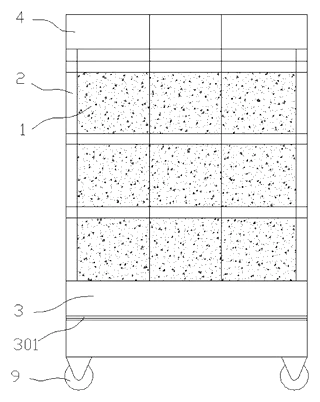
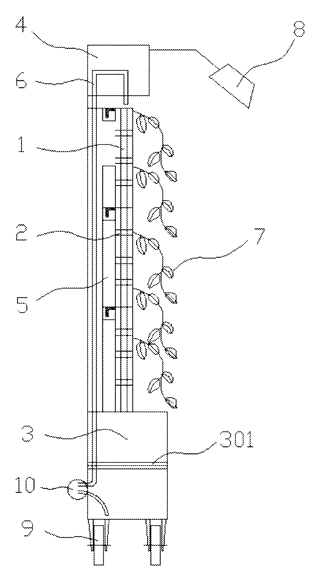
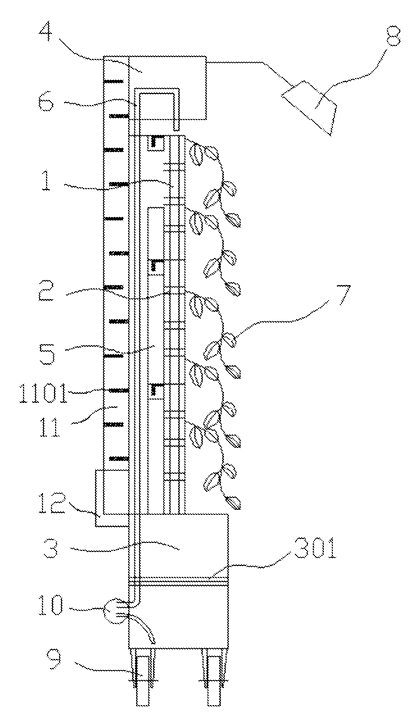
Drawings reproduced from the public patent document for reference.