At a glance
| Patent number | CN206287174U (application CN201621243950) |
| Type | China utility model (实用新型) - protects product shape and structure |
| Original title | A kind of razor head and shaver (一种剃须刀头以及剃须刀) |
| Patent owner | NINGBO BANGSHOU ELECTRICAL APPLIANCE CO Ltd |
| Inventors | Wang Xiaoming |
| Filing date | 2016-11-17 |
| Grant date | 2017-06-30 |
| Status (China) | In force in China until at most 2026-11-17 (if annual fees are paid) |
| Patent family | Chinese filings only - no US, European, Japanese, PCT or other filings listed |
| Cited by | 77 later documents |
| Source | Google Patents (search for CN206287174U) |
What the claims cover, in plain language
Claim 1 defines a razor head comprising a stationary knife, a moving knife, and two stage clips (springs). The ends of the stationary knife extend vertically downward to form stationary knife supports, and the stage clips are welded to these supports to press the moving knife against the stationary knife. The stationary knife has evenly spaced teeth forming V-shaped grooves, an arc-shaped upper surface extending to both sides to form a working position about 0.05-0.1 mm thick, and a smooth raised projection about 0.46 mm high at the front end. The moving knife also has evenly spaced teeth forming V-shaped grooves, and a fork slot is located in the center of its lower surface.
Claim 2 specifies that the length of the stationary knife teeth is greater than the length of the moving knife teeth. Claim 3 describes a downwardly projecting Access Division on the lower surface of the stationary knife, which engages with a concave coordination Access Division on the upper surface of the moving knife. Claim 4 states the fork slot dimensions are about 3.2 mm in length and 1.6 mm in width. Claim 5 notes that the stationary knife support includes a circular block button hole. Claim 6 covers the complete shaver, including the razor head and a fuselage containing a buckle, spring, motor, and eccentric shaft. The head attaches via the button hole snapping onto the buckle, and the moving knife connects to the eccentric shaft via the fork slot. Claim 7 limits the eccentric throw of the shaft to about 0.8-1.2 mm.
This is a simplified reading for orientation only. The legal scope is defined by the exact claim wording in the official Chinese document.
What this means for US production
This patent was filed only in China and is currently in force there (until at most 2026-11-17, provided annual fees are maintained). Making or selling this exact razor head design in China needs the owner’s permission. It has no US or other foreign counterpart, so the Chinese registration alone does not restrict manufacturing or sales in the United States.
Two points to settle early:
- Other patents may exist. Electric shaver mechanisms are heavily patented globally. Braun GmbH holds multiple later European patents citing this document (EP3854544A1, EP3854542A1, EP3854539A1), indicating active development in foil and cutter geometries by major industry players. A freedom-to-operate (FTO) review focusing on foil profiles, spring-clip arrangements, and fork-slot drives is necessary before tooling up for the US market.
- Blade metallurgy and tolerances. The working edge thickness (0.05-0.1 mm) and the smooth projection height (0.46 mm) dictate the stamping precision and material grade required for the stationary knife to function safely against skin.
Customization and manufacturing
What can be customized
| Area | Options |
|---|---|
| Head width | Set in design / confirmed on prototypes to match target fuselage dimensions |
| Foil material | Stainless steel or nickel-plated alloys; thickness to be confirmed in design |
| Spring clip force | Wire gauge and weld position adjusted to set moving-knife pressure |
| Tooth geometry | V-groove pitch and depth tailored for specific hair types |
| Fork slot size | Modified to match the chosen motor’s eccentric shaft diameter and throw |
| Housing plastics | ABS, PC, or PP for the fuselage and internal brackets |
| Finish | Plating, PVD coating, or painted accents on the outer body |
Things to plan for (US market)
- FDA regulations - electric shavers are generally consumer electronics, but materials contacting the skin must comply with applicable biocompatibility expectations if marketed with specific skin-safety claims.
- FCC Part 15 - the shaver contains a motor and potentially electronic control circuitry; it must not cause harmful radio frequency interference.
- UL or ETL listing - mains-powered shavers or those with lithium-ion batteries require safety certification (e.g., UL 859 for household electric personal care appliances).
- UN 38.3 - if the shaver includes a rechargeable lithium battery, the cells must pass transport testing for shipping.
- California Proposition 65 - metals and plastics must be screened for restricted substances like lead or phthalates.
How a project runs
- Inquiry - define target price point, power source (corded/cordless), and desired head width.
- Design - engineer the stationary knife profile, spring clip geometry, fork slot, and fuselage mold based on the patent layout.
- Prototype - stamp sample foils, wire-form the clips, and 3D-print or machine the housing for initial fit and motor-drive tests.
- Pilot run - produce a small batch to validate welding consistency, cutting performance, and electrical safety.
- Production - scale up progressive die stamping for the knives, automated clip welding, injection molding for the body, and final assembly.
Quantities & timeline
Progressive stamping dies are required for the stationary and moving knives to achieve the specified edge thicknesses and tooth patterns. Injection molds are needed for the fuselage and any plastic internal brackets. Welding fixtures must be built to attach the spring clips consistently. Certification testing (UL/ETL, FCC, UN 38.3) runs parallel to pilot production and dictates the final launch schedule. Send us your target specifications, power requirements, estimated order quantities, and timeline, and we will reply with options.
Patent drawings
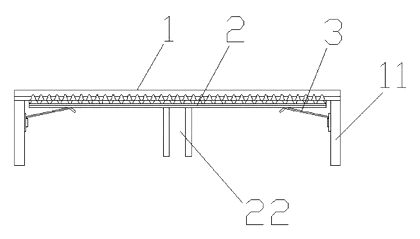
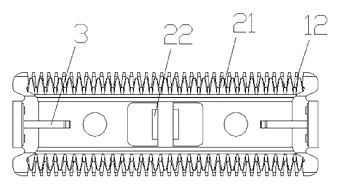
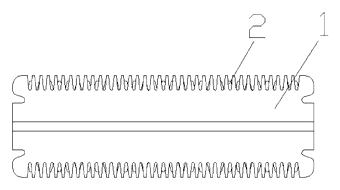
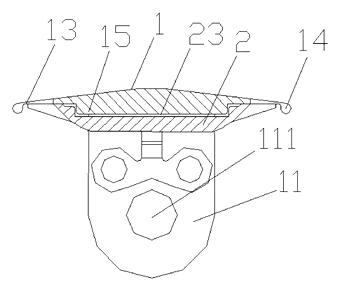
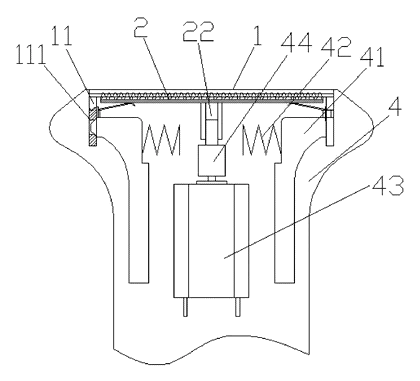
Drawings reproduced from the public patent document for reference.