
Patent CN206290197U
Updated October 23, 2026Rolling Tool Box with Telescoping Step Ladder
A telescoping A-frame ladder and a tool box in one. Collapsed, the ladder sits behind the tool box and the whole unit rolls on casters like a carry-on. Extended, the tool box clamps to the ladder rails at whatever height you work at - tools at hand, without climbing down or calling for help.
- China utility model - lapsed
- No filings outside China
- Tools & ladders
- Aluminum tube + molded case
Splat! What let you down?
🧳
Rolls like luggage
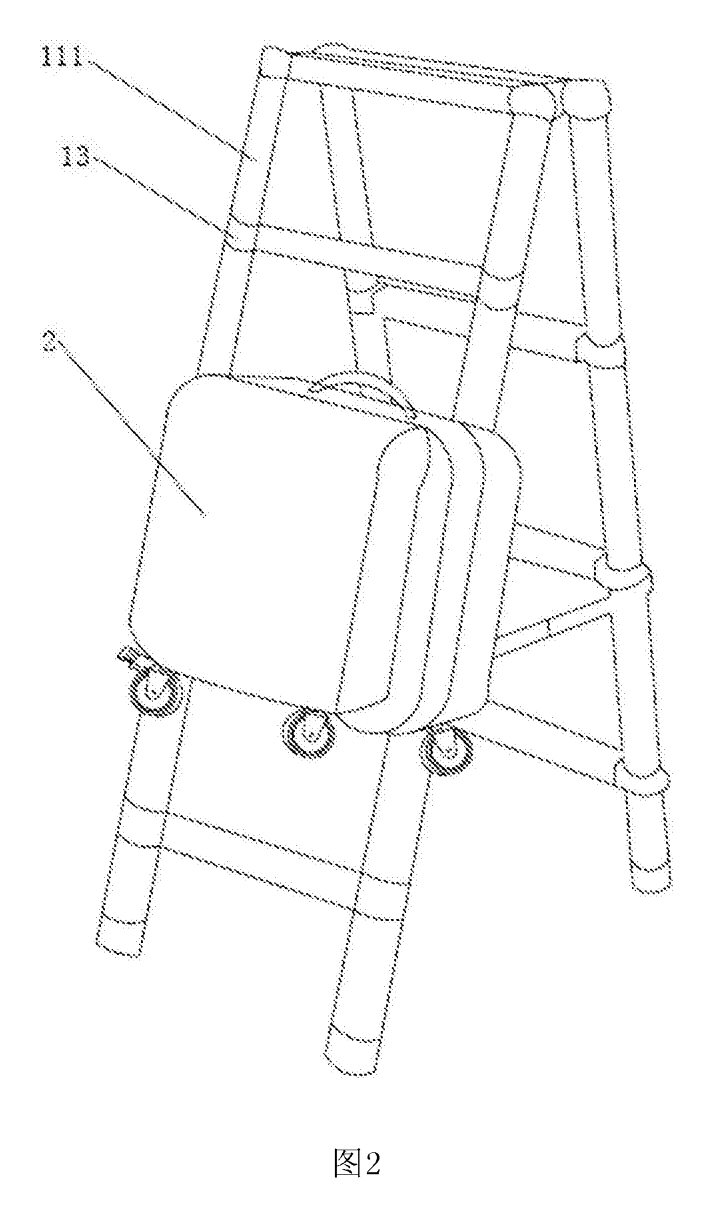
Collapsed, the ladder tucks behind the tool box and the whole unit rolls on four swivel casters.
🪜
Ladder + tool box in one
Two telescoping ladder sections hinge into an A-frame; one side carries the tool box.
↕️
Tools at working height
Sliding sleeves let the tool box move up or down the rails and lock with bolts where you need it.
⚖️
Balanced load
The box hangs between the two rails of one ladder side, not off one edge, so it does not pull the ladder sideways.
Bring this product to market
- ✓ Patent vetted China-only family and legal status checked
- 2 Product brief · now How it works, uses and options written up
- 3 Prototype First samples for buyers to review
- 4 Pilot run Small first batch for launch customers
- 5 Volume production Repeat orders at scale
Buyer interest
– of 100 buyers needed to start prototyping
One click, no sign-up. Each vote is one real visitor, and products with the most interest go to prototyping first.
Build team: no members yet. Need a partner, co-funding or skills to build this? Join and we introduce the team once it forms.
The problem
Electricians, maintenance staff and installers often work from a ladder - and their tools are on the ground. Every missing screwdriver means climbing down or asking a colleague to pass it up, which is slow and, when people lean or reach on a ladder, dangerous.
Existing combinations have drawbacks: a tool tray on top of the ladder gets in the way where the worker needs to stand or brace; a box hung on one side makes the ladder lean and is hard to move. And carrying a ladder plus a full tool box across a building or campus is hard work.
The solution
This design merges a telescoping ladder and a rolling tool box:
- Two telescoping ladders - rails made of nested aluminum tubes that collapse like a fishing rod - are hinged together into an A-frame.
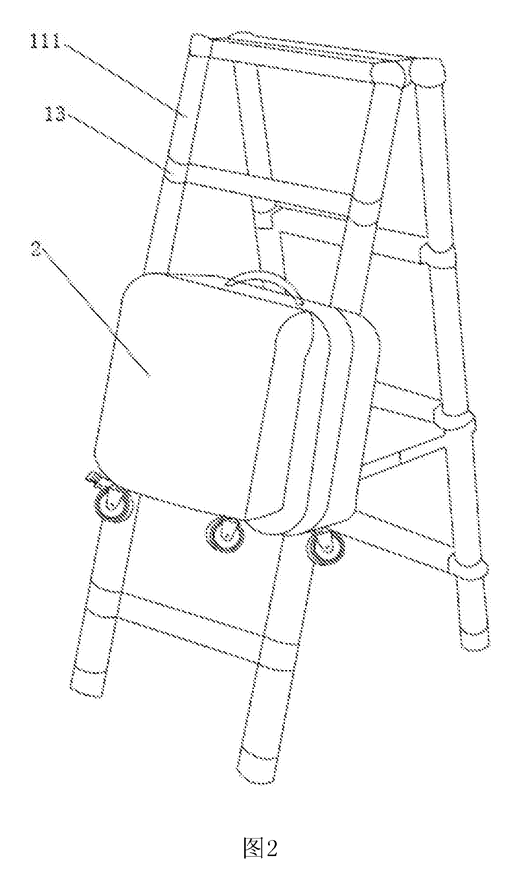
- One ladder side carries a tool box. On its back are two sliding sleeves with a concave inner face that half-wrap the left and right rails.
- Bolts through the sleeves press a pad against the rails to lock the box in place. Loosen them and the box slides up or down to the working height.
- The tool box has swivel casters at the bottom and a carry handle on top. With the ladder collapsed, the unit can be pushed like a suitcase.
- The lid is held open by a stay sliding in a slot, so the box can be used as a tray.
Who it is for
- Tool and ladder brands looking for a differentiated product for trades, facility maintenance and home DIY.
- Facility-maintenance and electrical contractors who move between rooms and buildings all day.
- Amazon and hardware-store sellers in the ladders and tool-storage categories.
How it works
The main parts
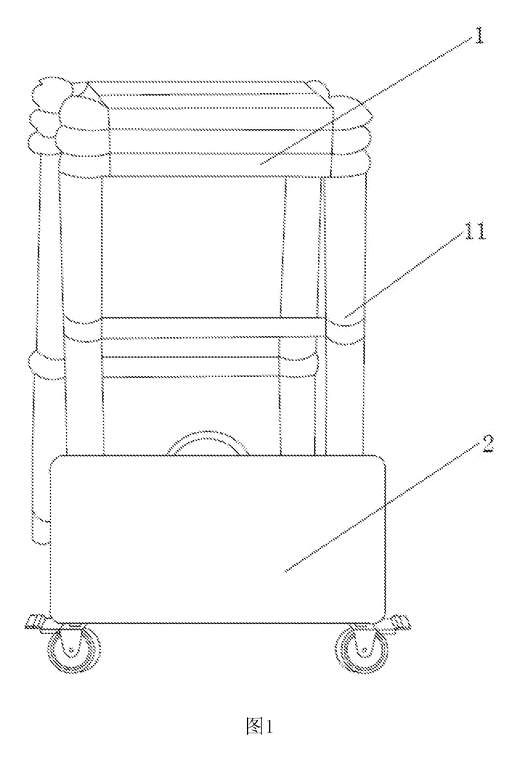
| No. | Part | What it does |
|---|---|---|
| 1 | Telescoping ladder | Two ladders hinged together into an A-frame. |
| 11 | Rail units | Left and right rails of each ladder. |
| 111 | Hollow rail tubes | Nested tubes, each one smaller than the one below, that slide into each other to collapse. |
| 12 | Steps | Horizontal steps between the rails. |
| 13 | Locating sleeves | Joints at the top of each tube that carry the steps and lock the extended tubes. |
| 2 | Tool box | Box body (21) and lid (22) with a carry handle (23). |
| 24 | Lid stay | Slot (241), stay bar (242) and stop block (243) that hold the lid open. |
| 3 | Sliding sleeves | Concave guides on the back of the tool box that half-wrap the rails. |
| 4 / 41 | Bolt / thread | Clamps the sleeve to the rail. |
| 5 | Pad | On the end of the bolt; presses on the rail without damaging it. |
| 6 | Swivel casters | Under the tool box, for rolling the folded unit. |
From cart to ladder
- Roll. Collapsed, the unit stands on the tool box casters (6). Tilt and push it by the handle (23) like a carry-on suitcase.
- Open. Spread the two ladder sides into an A-frame.
- Extend. Pull the rail tubes (111) out section by section; each locating sleeve (13) locks at its step, as on any telescoping ladder.
- Set the box height. Loosen the bolts (4), slide the tool box along the rails on its sleeves (3) to the height where you will work, and tighten the bolts again.
- Work. Open the lid (22); the stay (24) holds it so the lid and box work as a tray within reach.
How the box clamps to the rails
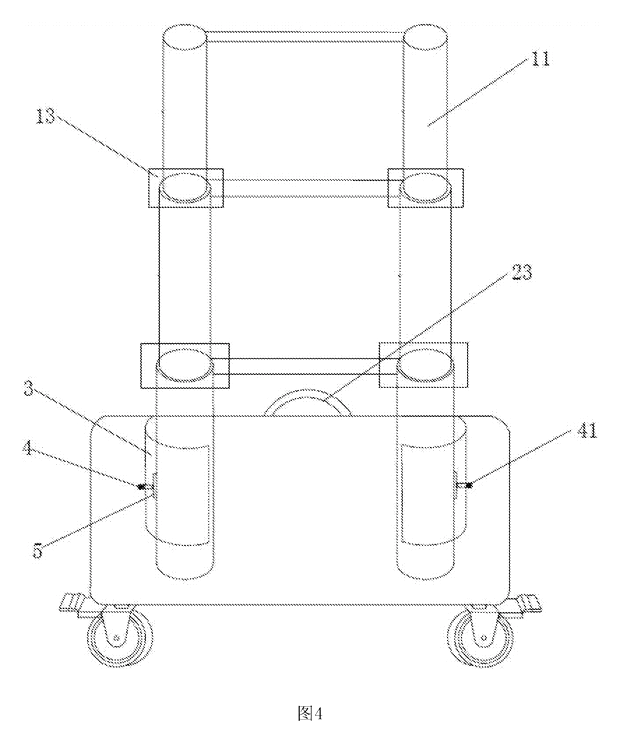
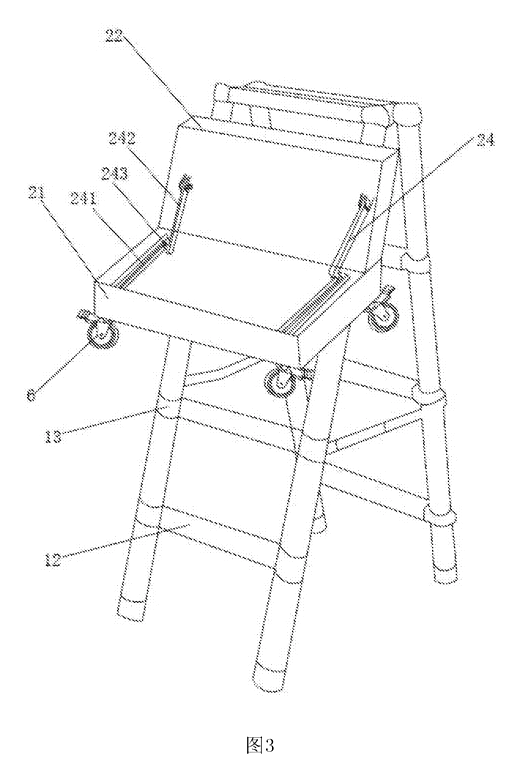
Each sleeve has a round hole with an internal thread that matches the bolt (41). Turning the bolt in presses the pad (5) against the rail and fixes the box; turning it out lets the box slide. Because the box spans both rails of one ladder side, its weight stays centered on that side.
Applications
Electricians and lighting installers
Changing fixtures, pulling cable and working at ceiling height means many trips up and down. With the tool box at shoulder height on the ladder, tools and parts stay within reach.
Facility maintenance teams
Schools, hospitals, hotels and offices send technicians from room to room. Rolling one unit through corridors and elevators is easier than carrying a ladder and a tool bag separately.
IT, security and AV technicians
Installing access points, cameras, speakers and projectors is ceiling work with small parts and specialist tools - ideal for a tray at working height.
Retail and warehouse staff
Changing signage, price displays and lights in stores, where staff need a compact ladder they can wheel between aisles.
Home DIY
Painting, hanging curtains and changing light fittings at home - a ladder that stores compactly in a closet with its tools inside.
Where it is less suitable
- Heavy-duty or very tall work - choose a ladder with the right duty rating and height; a telescoping ladder is not a replacement for scaffolding.
- Rough outdoor terrain - casters are made for floors and paved surfaces.
Frequently asked questions
Does the tool box make the ladder unstable?
The box spans both rails of one ladder side and is clamped to them, so its weight stays centered on that side rather than pulling the ladder sideways. Load limits for the box are set and tested during design.
How high can it go?
That depends on the ladder model. Household step-ladder heights and taller A-frame versions are both possible, each with its own duty rating.
Can I adjust the tool box height without tools?
In the patent the box is clamped with bolts. A production version can use hand knobs so it can be moved without tools.
Can I use the ladder without the tool box?
The box is bolted to the rails; a version with quick-release clamps can let users take it off.
Is it safe for electrical work?
Standard aluminum ladders conduct electricity. For electricians, non-conductive rail covers or a fiberglass version should be considered and clearly labeled.
What standards does it need in the US?
Ladders sold in the US are generally expected to meet ANSI-ASC A14 standards with duty-rating labels. We plan testing as part of the project.
Can this design be made and sold in the US?
The patent was filed only in China and lapsed in 2019, so it does not restrict anyone. Other ladder and tool-case designs may be patented - see Patent & Production - so we recommend a freedom-to-operate check before volume production.
Are you affiliated with the patent owner?
No. IP2M is an independent design and manufacturing service working from the public patent document.
Request a quote
Click Request a Quote below to see our email address - copy it, or open your email app with a ready-made message. Please mention patent CN206290197U in the subject.
Helpful details to include:
- Your company and target market (trade, facility maintenance, retail, DIY…)
- Ladder height and duty rating you need
- Tool box - size, internal layout, lock
- Materials - aluminum, non-conductive options
- Estimated quantity and target price
- Timeline - when you would like samples and the first shipment
You can also reach us at (332) 203-9997.
Explore this product
Interested in building this?
Tell us your target market, quantity and timeline. We reply with options for prototyping, small-batch runs or volume production.
Send your inquiry to
Please put CN206290197U in the subject line and tell us your company, country, estimated quantity and timeline.
Prefer to talk? Call (332) 203-9997.
More product-ready patents
All Tools & Workshop patents →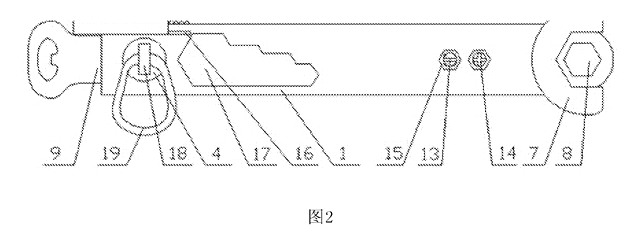
Tools & Workshop
Folding 3-Handle Wrench Multi-Tool
Folding three-handle wrench multi-tool with magnetic screwdriver bits, saw, file and bottle opener.
Patent CN205290875U
Tools & Workshop
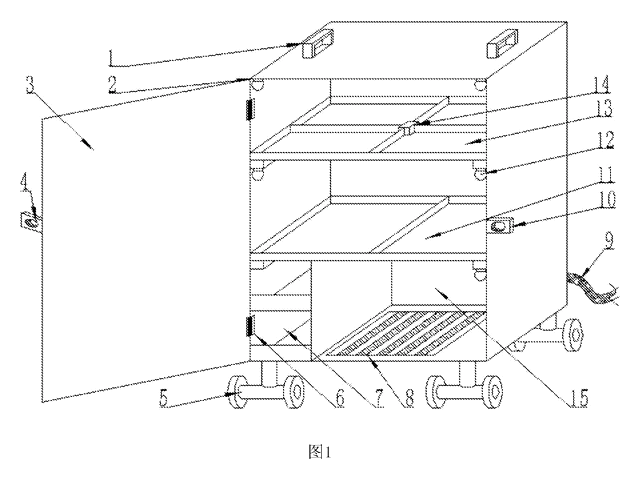
Rolling Auto-Repair Tool Cabinet with Built-In Lights
Lockable rolling tool cabinet for car repair with interior lights, a lubricant tray, parts drawers and a tool bay.
Patent CN205989314U
Tools & Workshop
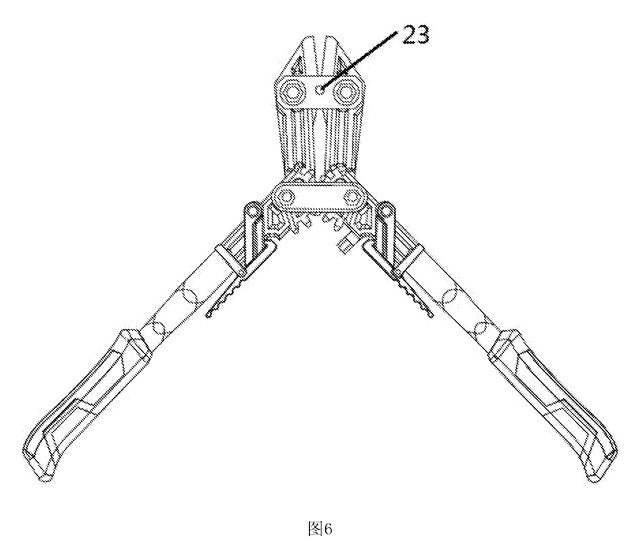
Wide-Opening Folding Bolt Cutter
Bolt cutter with linked, gear-meshing handles that open up to 190° and fold in half for storage.
Patent CN207206226U
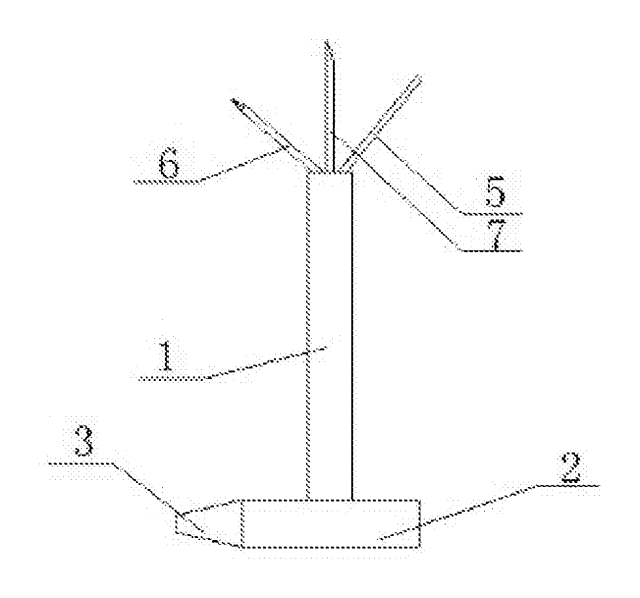
Tools & Workshop
Nail-Holding Hammer with Fold-Out Drivers
Hammer with a nail-holding T-slot in the head and fold-out drivers stored in the handle.
Patent CN205254927U
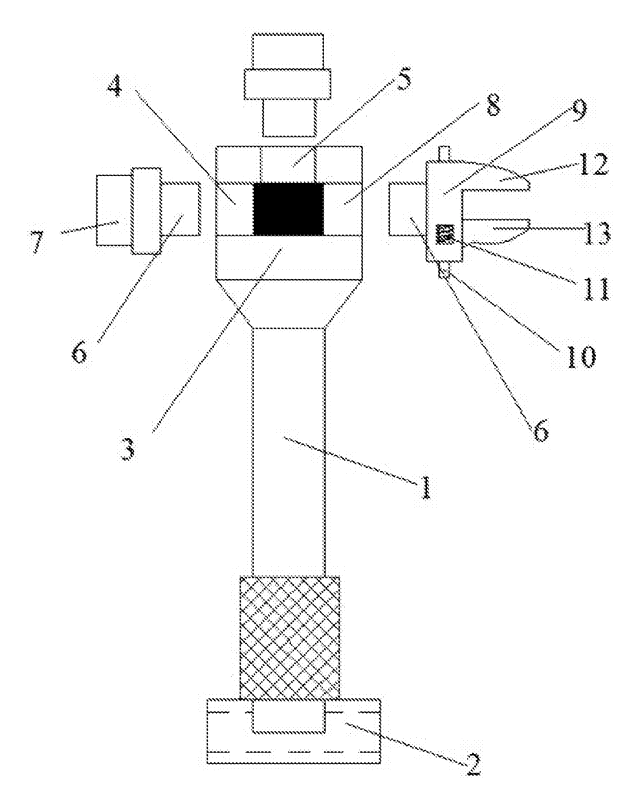
Tools & Workshop
Modular Wrench with Screw-On Heads
Wrench handle with a three-way threaded hub for screw-on adjustable and hex heads, plus a pipe sleeve.
Patent CN206216564U
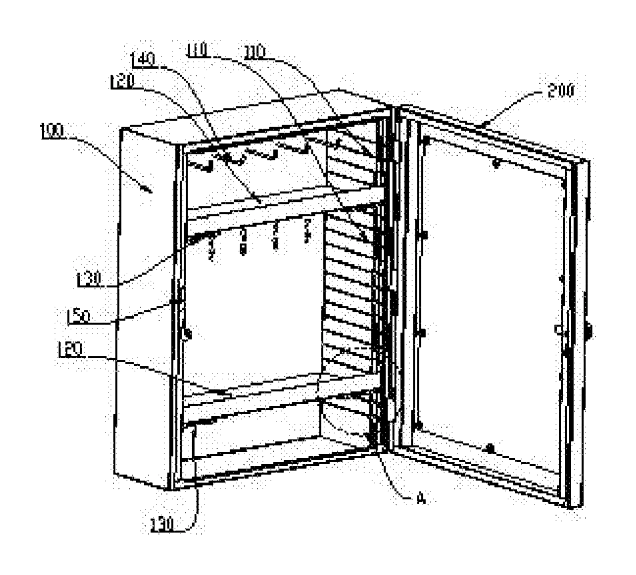
Tools & Workshop
Adjustable-Shelf Tool Cabinet with Window Door
Tool cabinet with slot-in shelves at any height, spring-pin locks, hooks and a window door.
Patent CN206263916U
Browse by category
- Apparel & Accessories (22)
- Baby & Kids (16)
- Bags & Luggage (9)
- Bath & Personal Care (16)
- Car Accessories (10)
- Furniture, Bedding & Storage (12)
- Garden & Outdoor (18)
- Health & Wellness (8)
- Home, Kitchen & Cleaning (24)
- Lighting (12)
- Packaging & Containers (6)
- Pet Products (6)
- Phone & Camera Accessories (4)
- Retail Display (13)
- School, Office & Art (19)
- Sports & Recreation (25)
- Tools & Workshop (27)
- Toys & Games (12)
This page is based on the public patent document CN206290197U, assigned to Fujian Huian Jiangu Electrical Machinery Co., Ltd.. IP2M is an independent manufacturing service and is not affiliated with, endorsed by or licensed by the patent owner. Images marked as concept renderings are illustrations, not photos of an existing product. Patent status information is provided for reference only and is not legal advice; confirm freedom to operate for your market before production. Full disclaimer.