At a glance
| Patent number | CN206324044U (application CN201720340818) |
| Type | China utility model (实用新型) - protects product shape and structure |
| Original title | A kind of wireless power aquarium (一种无线供电水族箱) |
| Patent owner | Guangzhou Cloud Nest Industrial Design Co Ltd |
| Inventors | Zhao Bi, Fu Fuchu |
| Filing date | 2017-03-31 |
| Grant date | 2017-07-14 |
| Status (China) | Lapsed - terminated for non-payment of annual fees (recorded 2024-04-09) |
| Patent family | Chinese filings only - no US, European, Japanese, PCT or other filings listed |
| Cited by | 10 later documents |
| Source | Google Patents (search for CN206324044U) |
What the claims cover, in plain language
Claim 1 - a wireless-powered aquarium comprising an aquarium body, an electromagnetic induction transmitter module outside the tank, and an electromagnetic induction receiver module inside the tank. The two modules face each other. The transmitter contains a transmitting coil, a circuit board and a power line. The receiver contains a receiving coil and a circuit board. Inside the tank there are also a lighting module, an oxygen processing module and a detection module, all connected to the receiver module, which supplies them with power.
Claim 2 - the transmitter module is located at the bottom outside of the aquarium. Claim 3 - the aquarium bottom has a surrounding support; the transmitter is detachably fixed anywhere on the bottom, and the support height is greater than the transmitter thickness. Claim 4 - the transmitter is flat/plate-shaped; the transmitting coil is at the center of the front face, the circuit board is at the edge, and they connect to each other and to the power line. Claim 5 - the receiving coil is arranged opposite the transmitting coil. Claim 6 - the receiver module is a surrounding-sealed flat plate, with the receiving coil and circuit board integrated inside it. Claim 7 - the lighting, oxygen processing and detection modules connect to the receiver circuit board. Claims 8-10 - specific mounting locations: lighting on the inner wall or bottom, detection on the inner wall/middle/bottom, oxygen processing at the inner bottom.
This is a simplified reading for orientation only. The legal scope is defined by the exact claim wording in the official Chinese document.
What this means for US production
This patent was filed only in China and is lapsed (terminated for non-payment of annual fees in 2024), so it no longer restricts anyone in China either. It has no US or other foreign counterpart.
Two points to settle early:
- Other patents may exist. Wireless charging and inductive power transfer for consumer devices are heavily patented globally, including specific implementations for underwater or aquarium use by major electronics and pet brands. A freedom-to-operate (FTO) review covering the coil geometry, operating frequency, and sealed receiver packaging is essential before tooling.
- Electrical isolation. Even though the patent has lapsed, the physical product must meet stringent US safety standards for devices combining mains-connected electronics with water containment.
Customization and manufacturing
What can be customized
| Area | Options |
|---|---|
| Tank dimensions | Length, width, height and glass/acrylic thickness to be confirmed in design |
| Power rating | Output wattage set by coil turns, wire gauge and driver IC selection |
| Operating frequency | Tuned to balance transfer efficiency against heat generation in the glass |
| Internal modules | LED color temperature, aeration flow rate, sensor types (temperature, pH, level) |
| Receiver housing | Potting compound type, enclosure material (acrylic, polycarbonate) and mounting method |
| Transmitter form factor | Pad size, cable length, adapter type and cosmetic finish |
| Support base | Height and profile of the bottom rim to accommodate the transmitter |
Things to plan for (US market)
- UL 60730 / UL 1018 - safety standards for automatic electrical controls and electric aquarium equipment; the entire system (adapter, transmitter, receiver, loads) requires evaluation.
- FCC Part 15 - the oscillating magnetic field generated by the induction coils constitutes an intentional or unintentional radiator; emissions testing is mandatory to ensure it does not interfere with radio communications.
- FDA 21 CFR (if applicable) - if the tank is marketed for housing animals used in food production or if any internal plastic component leaches substances into water intended for human contact, though standard ornamental aquariums generally fall outside this scope.
- California Prop 65 - potting compounds, PVC wire insulation and solder alloys must be screened for listed chemicals.
How a project runs
- Inquiry - target tank size, total internal load wattage, module list and quantity.
- Design - coil simulation, resonant frequency selection, receiver PCB layout, potting specification and mechanical fit within the support rim.
- Prototype - 3D-printed housings, hand-wound coils and bench tests measuring transfer efficiency across the intended glass thickness.
- Pilot run - injection-molded receiver shells, potted assemblies, thermal cycling tests in water, and preliminary FCC/UL pre-compliance scans.
- Production - coil winding, SMT assembly for both boards, ultrasonic welding or potting of the receiver, tank fabrication, final pairing and burn-in.
Quantities & timeline
The transmitter and receiver require custom coil winding fixtures and PCB assembly, while the receiver housing needs injection molds and a reliable potting process for long-term waterproofing. Tank fabrication follows standard glass cutting or acrylic bonding lines. Safety certification testing (UL and FCC) adds significant lead time before volume shipments. Send us your tank dimensions, required internal wattage, module list, quantity and target price and we will reply with options.
Patent drawings
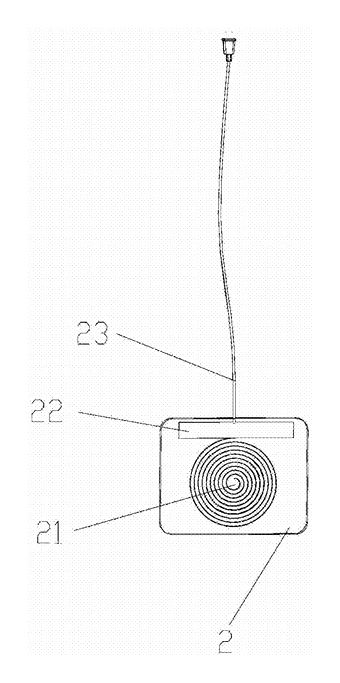
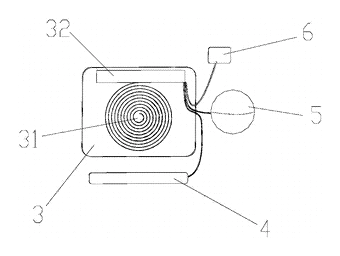
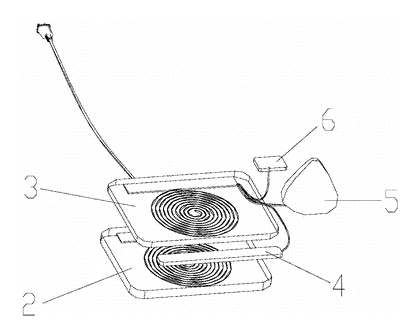
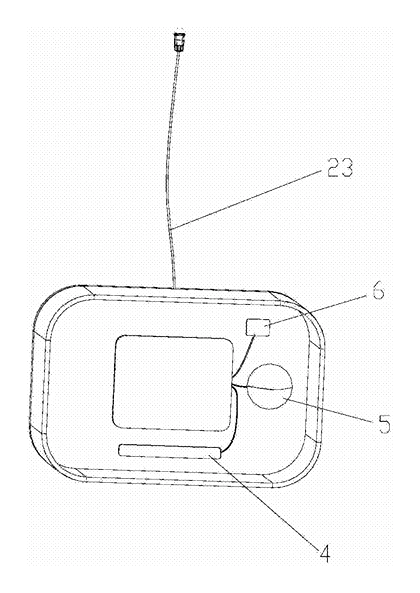
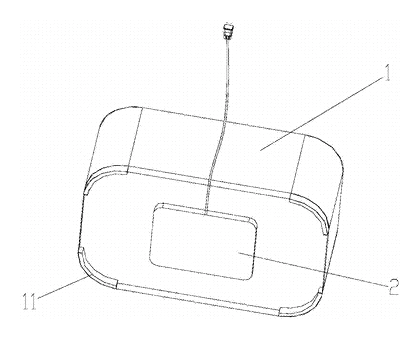
Drawings reproduced from the public patent document for reference.