At a glance
| Patent number | CN206354662U (application CN201621440001) |
| Type | China utility model (实用新型) - protects product shape and structure |
| Original title | A kind of portable water intaking water purifying cup (一种便携式取水净水杯) |
| Patent owner | Individual |
| Inventors | Fang Xuehui |
| Filing date | 2016-12-23 |
| Grant date | 2017-07-28 |
| Status (China) | Lapsed - terminated for non-payment of annual fees (recorded 2026-01-02) |
| Patent family | Chinese filings only - no US, European, Japanese, PCT or other filings listed |
| Cited by | 1 later document |
| Source | Google Patents (search for CN206354662U) |
What the claims cover, in plain language
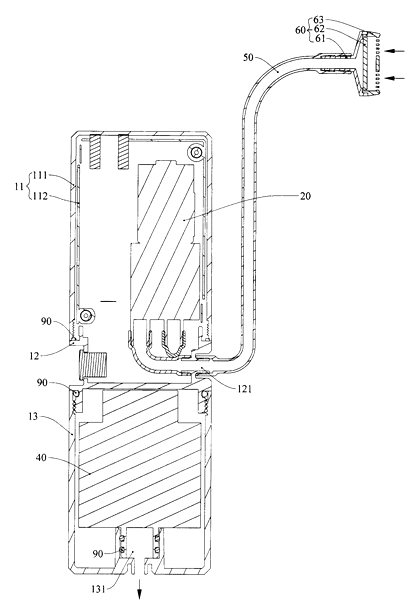
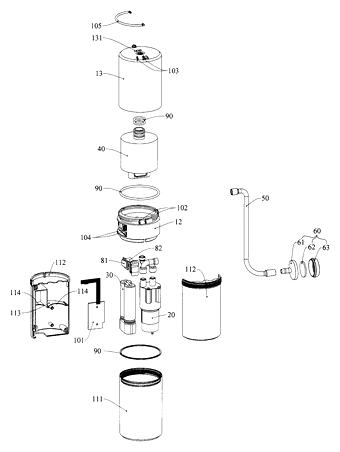
Claim 1 - a portable water-taking and purifying cup comprising a cylindrical housing, a booster pump, a filter element, a storage battery and a water inlet pipe, all arranged inside the housing. The water inlet end of the pipe has a detachable dirt blocker for preliminary filtering. The pipe connects to the pump inlet, the pump outlet connects to the filter element inlet, and the filter element outlet leads outside the casing. A real-time water quality detector with an indicating function is inside the housing, and the battery is electrically connected to the pump.
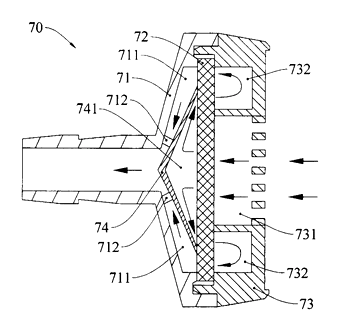
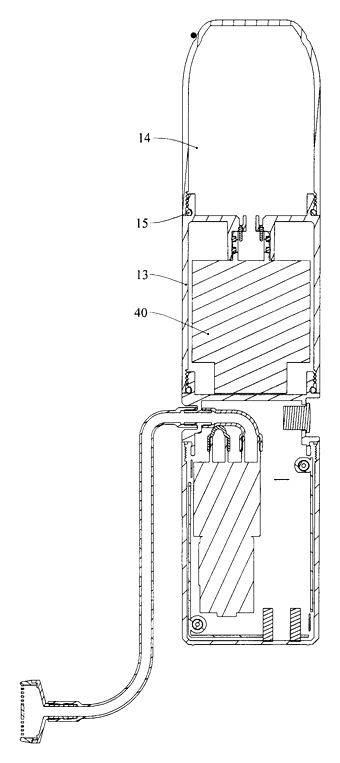
Claim 2 - the housing has a lower, middle and upper section fixed together. The pump and battery are parallel in the lower shell; the filter element is in the upper shell. Claim 3 - a water outlet at the bottom of the upper shell communicates with the filter element outlet. Claim 4 - the middle shell has a water inlet tube connected to the inlet pipe, feeding the pump via a hose. Claim 5 - a switch for the pump and a plug-in charging interface are on the middle shell. Claim 6 - the lower shell has an outer cylindrical shell and an inner shell with a partition containing through holes to position the battery and pump. Claim 7 - the booster pump is a DC pump. Claim 8 - the detector includes a circuit board, a water inlet detection electrode at the filter inlet and a water outlet detection electrode at the filter outlet. Claim 9 - a detection indicator light is connected to the circuit board. Claim 10 - the dirt blocker comprises a funnel-shaped base, an outer cover with a grid and a filter screen between them.
This is a simplified reading for orientation only. The legal scope is defined by the exact claim wording in the official Chinese document.
What this means for US production
This patent was filed only in China and is lapsed (terminated for non-payment of annual fees), so it no longer restricts anyone in China either. It has no US or other foreign counterpart.
Two points to settle early:
- Other patents may exist. Portable water filters, pump-driven purifiers and TDS-sensing bottles are active fields with many US and international patents held by outdoor and appliance companies, so a freedom-to-operate (FTO) review covering the pump-filter-detector combination and the dirt-blocker structure is needed before tooling.
- Filter media selection. The patent names a “filter element” without specifying the material; the choice of carbon block, hollow fiber or ceramic determines what the unit removes and which US regulations apply.
Customization and manufacturing
What can be customized
| Area | Options |
|---|---|
| Shell dimensions | Diameter and height to be confirmed in design based on target capacity |
| Filter element | Carbon block, hollow-fiber membrane, ceramic or composite; pore size set in design |
| Pump specification | DC pump voltage and flow rate matched to the filter’s resistance |
| Battery | Capacity and cell type (e.g., lithium-ion) confirmed on prototypes |
| Detector | Electrode type and indicator light color or display logic |
| Dirt blocker | Mesh size of the screen and grid cover geometry |
| Exterior finish | Color, texture, grip sleeves or branding area on the middle shell |
| Charging port | USB-C, micro-USB or proprietary plug-in interface |
Things to plan for (US market)
- FDA 21 CFR - any part contacting drinking water (shell interior, hoses, filter housing, dirt blocker) must use materials compliant with FDA food-contact regulations.
- NSF/ANSI 42 and 53 - buyers and retailers expect portable filters to be tested against these standards for aesthetic and health-related contaminant reduction claims.
- EPA establishment registration - if the filter makes pesticidal claims (e.g., killing bacteria or viruses), the device may fall under EPA regulation as a water treatment unit.
- UN 38.3 - the storage battery must pass transport testing for shipping lithium cells to and within the US.
- FCC Part 15 - the detector circuit board and DC pump electronics need FCC compliance for unintentional radiators.
- California Prop 65 - plastics, metals and battery components must be screened for listed substances.
How a project runs
- Inquiry - target water volume, source types, filtration goals and quantity.
- Design - shell sizing, pump and battery matching, filter selection, detector circuit layout and dirt blocker mesh.
- Prototype - 3D-printed or soft-tooled shells assembled with selected components for flow-rate and detector tests.
- Pilot run - injection molds opened; units undergo cycle testing, leak checks and NSF/FDA material verification.
- Production - plastic injection molding, PCB assembly, battery pack integration, filter potting and final assembly.
Quantities & timeline
The cylindrical shell requires injection molds for the lower, middle and upper housings plus the inner shell and partition. The dirt blocker needs its own mold for the base, cover and screen retainer. The detector circuit board requires PCB fabrication and electrode assembly. Battery certification (UN 38.3) and NSF testing run in parallel with pilot builds. Send us your target capacity, filter type, required certifications, estimated quantity and timeline and we will reply with options.
Patent drawings
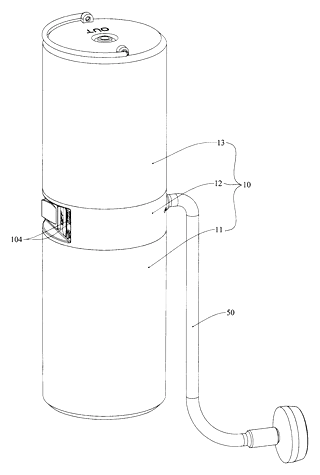
Drawings reproduced from the public patent document for reference.