At a glance
| Patent number | CN206383856U (application CN201621313943) |
| Type | China utility model (实用新型) - protects product shape and structure |
| Original title | Child carrier safety seat (儿童提篮安全座椅) |
| Patent owner | Goodbaby Child Products Co., Ltd. |
| Inventors | Zhang Xiaoguang, Chen Jianyang |
| Filing date | 2016-12-02 |
| Grant date | 2017-08-08 |
| Status (China) | In force - no termination recorded; a China utility model lasts at most 10 years from filing (to 2026-12-02) |
| Patent family | Chinese filings only - no US, European, Japanese, PCT or other filings listed |
| Cited by | 6 later documents |
| Source | Google Patents (search for CN206383856U) |
What the claims cover, in plain language
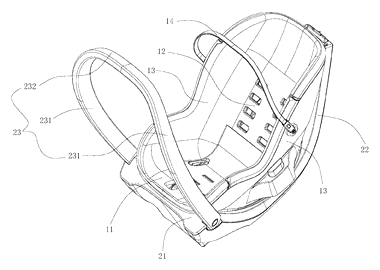
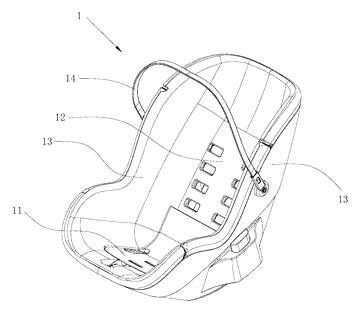
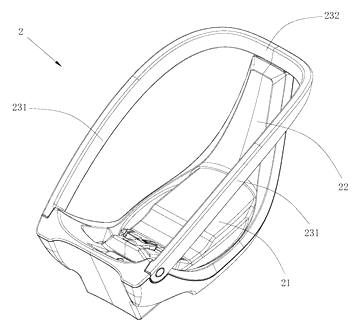
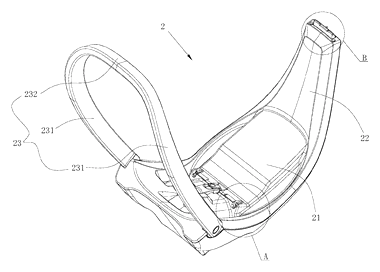
Claim 1 - a child carrier safety seat with a base assembly, a carrier removably set on it and a locking mechanism between them. The carrier has a first base, a first backrest and side panels. The base assembly has a second base, a second backrest and a guardrail assembly with side rails on both sides. With the carrier in place, the second base supports the first base, the first backrest rests against the second backrest, and the side rails lie against the outside of the side panels.
Claim 2 - each side rail is hinged at the front of the second base and swings between an open position (away from the backrest, for fitting or removing the carrier) and a closed position (in use). Claims 3-4 - a fixing mechanism holds the rails closed, released by an unlock button sliding on the second backrest. Claim 5 - a cross rail joins the side rails and is fixed to the second backrest when closed.
This is a simplified reading for orientation only. The legal scope is defined by the exact claim wording in the official Chinese document.
What this means for US production
This patent was filed only in China. It is still in force in China, so making or selling this design in China would need the owner’s permission while it lasts (at most until 2026-12-02). It has no US or other foreign counterpart and does not restrict the design outside China.
Two points to settle early:
- Other patents may exist. Infant car seat bases, load legs, side impact features and carrier latches are heavily patented by the major car seat brands, so a freedom-to-operate (FTO) review of the base, rails and lock is essential before tooling.
- Safety engineering. A car seat is a regulated safety product; the side rail concept must be proven by a qualified engineering team through sled testing before any sale.
Customization and manufacturing
What can be customized
| Area | Options |
|---|---|
| Carrier | Shell weight target, canopy, handle positions, travel-system adapters |
| Base | Belt-path or LATCH installation, load leg, recline indicator |
| Side rails | Rail height and padding, energy-absorbing foam, release button position |
| Fabrics | Flame-resistant covers, removable and washable, colorways |
| Fit | Weight and height range of the carrier, infant insert |
| Bundles | Second base, stroller adapters, travel-system packaging |
Things to plan for (US market)
- FMVSS 213 (49 CFR 571.213) - dynamic sled testing of the child restraint, including the carrier with and without the base as sold.
- FMVSS 302 - flammability of fabrics and foams.
- Registration card (49 CFR 588) - every child restraint ships with a NHTSA owner registration card.
- Labeling - NHTSA-required labels, warnings and instructions on the seat and in the manual.
- Aircraft use - if certified for aircraft, the FAA statement and inversion test apply.
How a project runs
- Inquiry - target weight range, carrier weight goal, installation type and market.
- Design - shell and base structure, rail hinge and latch, foam and fabrics.
- Prototype - engineering samples for fit trials and internal sled tests.
- Pilot run - certification testing at an accredited lab, labeling and manual.
- Production - molding, assembly, end-of-line checks and lot traceability.
Quantities & timeline
The carrier shell, base and side rails need large injection molds, the rail hinges and lock pin need metal stamping or die-cast parts, and foam parts need EPS or EPP molds. Engineering and certification testing take the most time. Send us your target market, weight range, installation type, quantity and target price and we will reply with options.
Patent drawings
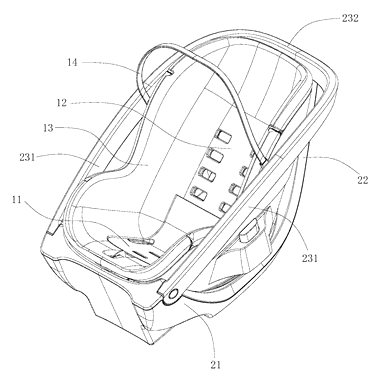
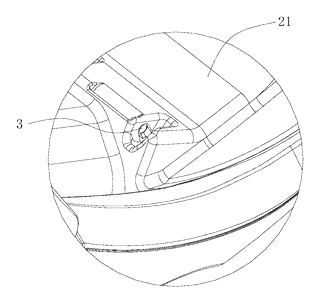
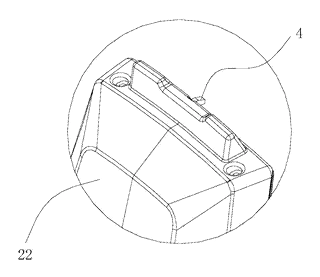
Drawings reproduced from the public patent document for reference.