At a glance
| Patent number | CN206652176U (application CN201720311862) |
| Type | China utility model (实用新型) - protects product shape and structure |
| Original title | Complete record training running shoes with guiding function (带引导功能的全纪录训练用跑鞋) |
| Patent owner | Hunan Vocational College of Mordern Logistics |
| Inventors | Tang Biao, Zhu Bin, Chen Di |
| Filing date | 2017-03-28 |
| Grant date | 2017-11-21 |
| Status (China) | Lapsed - terminated for non-payment of annual fees (recorded 2019-03-15) |
| Patent family | Chinese filings only - no US, European, Japanese, PCT or other filings listed |
| Cited by | 6 later documents |
| Source | Google Patents (search for CN206652176U) |
What the claims cover, in plain language
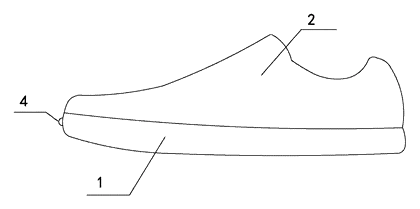
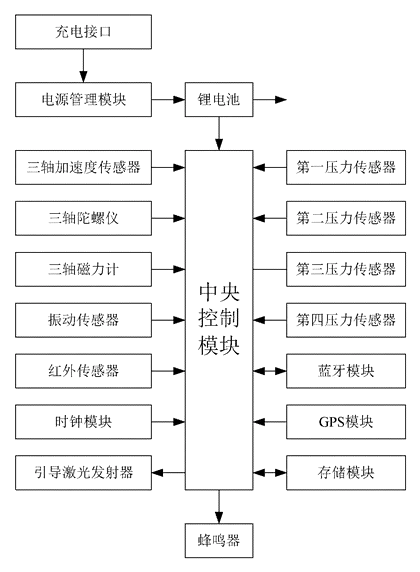
Claim 1 - a training running shoe comprising a sole and a vamp fixed on the sole. Inside the sole are more than two pressure sensors. A guiding laser emitter is provided at the front end of the shoe. A control circuit inside the shoe includes a central control module, a three-axis acceleration sensor, a three-axis gyroscope, a three-axis magnetometer, a vibrating sensor, a clock module, the pressure sensors, a memory module and a power module. All sensors and the laser emitter are connected to the central control module, and the power module supplies electricity.
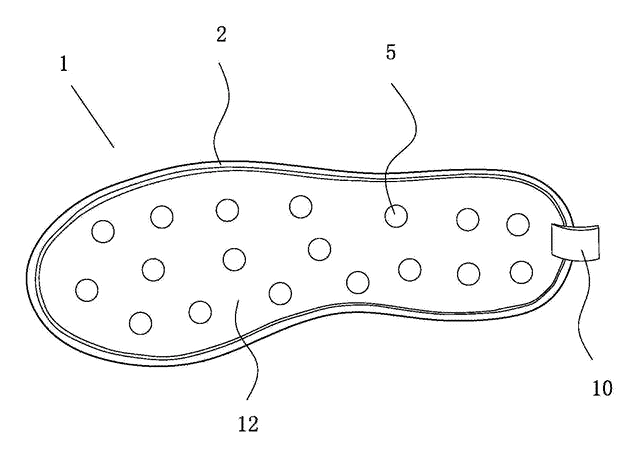
Claim 2 - specifies four pressure sensors located at the left-front corner, right-front corner, left-rear corner and right-rear corner inside the sole. Claim 3 - the guiding laser emitter uses a spherical universal adjuster at the front of the sole, consisting of a hollow ball cover and a ball center that rotates within it, held by damping friction. Claim 4 - the power module uses a lithium battery with a power management module and a charging inlet. Claim 5 - a GPS module is connected to the central control module. Claim 6 - a Bluetooth module is connected to the central control module. Claim 7 - a buzzer is connected to the central control module. Claim 8 - an infrared sensor is connected to the central control module.
This is a simplified reading for orientation only. The legal scope is defined by the exact claim wording in the official Chinese document.
What this means for US production
This patent was filed only in China and has lapsed (terminated for non-payment of annual fees, recorded 2019-03-15), so it no longer restricts anyone in China either. It has no US or other foreign counterpart.
Two points to settle early:
- Other patents may exist. Smart footwear integrating sensors, laser projection and IMU-based gait tracking is actively patented by major athletic brands and electronics companies in the US. A thorough freedom-to-operate (FTO) review covering sensor placement in shoe soles, optical stride guides and wearable motion capture algorithms is essential before investing in molds or PCB layouts.
- Electronic component sourcing. The bill of materials includes lasers, lithium batteries, Bluetooth radios and microcontrollers, all of which must meet US import and safety standards. Component selection drives both compliance testing and supply chain planning.
Customization and manufacturing
What can be customized
| Area | Options |
|---|---|
| Shoe size range | Adult US sizes to be confirmed in design; youth sizing requires scaled-down sole molds |
| Upper material | Mesh, knit, synthetic leather or TPU overlays depending on breathability needs |
| Sole compound | EVA foam, PU or rubber outsole with custom cavities for the sensor array and battery |
| Sensor count | Four pressure sensors as described, or additional zones for higher-resolution mapping |
| Laser color and class | Red or green diode; output power selected to meet eye-safety regulations |
| Connectivity | Bluetooth version, optional ANT+ for existing sports watch ecosystems |
| Battery capacity | Sized for target runtime per charge cycle, affecting sole thickness |
| App integration | Custom mobile application development for data visualization and firmware updates |
Things to plan for (US market)
- FCC Part 15 - the Bluetooth module and any intentional radiators must be tested and certified for sale in the United States.
- FDA / CDRH laser regulations (21 CFR 1040.10) - the guiding laser emitter is subject to federal performance standards for laser products. The shoe will likely need to be classified as a Class 1 or Class 2 laser product, with appropriate labeling and reporting to the FDA.
- UL / IEC 62133 - the embedded lithium battery must comply with safety standards for portable secondary cells to prevent thermal runaway risks in footwear subjected to repeated impact.
- UN 38.3 - required for shipping lithium batteries internationally, including prototypes sent for testing.
- California Proposition 65 - materials used in the upper, sole and electronics must be screened for listed chemicals.
- CPSC general wearing apparel rules - while adult athletic shoes are largely exempt from flammability standards applying to clothing, lead and phthalate limits apply if the shoe is sized and marketed for children under 12 (CPSIA).
How a project runs
- Inquiry - define the target user, feature set, size range and regulatory markets.
- Design - mechanical engineering for the sole cavities, PCB layout for the control circuit, optical alignment for the laser adjuster, and software architecture for the central module.
- Prototype - 3D-printed or CNC-machined sole inserts assembled with off-the-shelf sensors to validate fit, signal quality and laser projection geometry.
- Pilot run - injection molds opened for the sole; small batch produced for FCC pre-scans, laser safety testing, battery cycle tests and wear trials.
- Production - full-scale molding, SMT assembly for the PCBs, final shoe lasting and assembly, followed by functional testing of every unit before packing.
Quantities & timeline
Manufacturing this product requires injection molds for the sole (with precise pockets for sensors, battery and wiring), standard shoemaking lasts for the upper, and SMT stencils for the custom PCB. Certification testing for FCC, laser safety and battery transport adds significant lead time before mass production can begin. Send us your target sizes, feature requirements, estimated quantity and launch timeline and we will reply with options.
Patent drawings
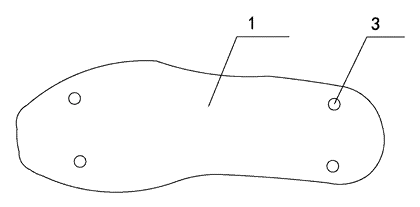
Drawings reproduced from the public patent document for reference.