
Patent CN206730500U
Updated November 1, 2026Toy Car with Integrated Game Mission System and Motion Sensors
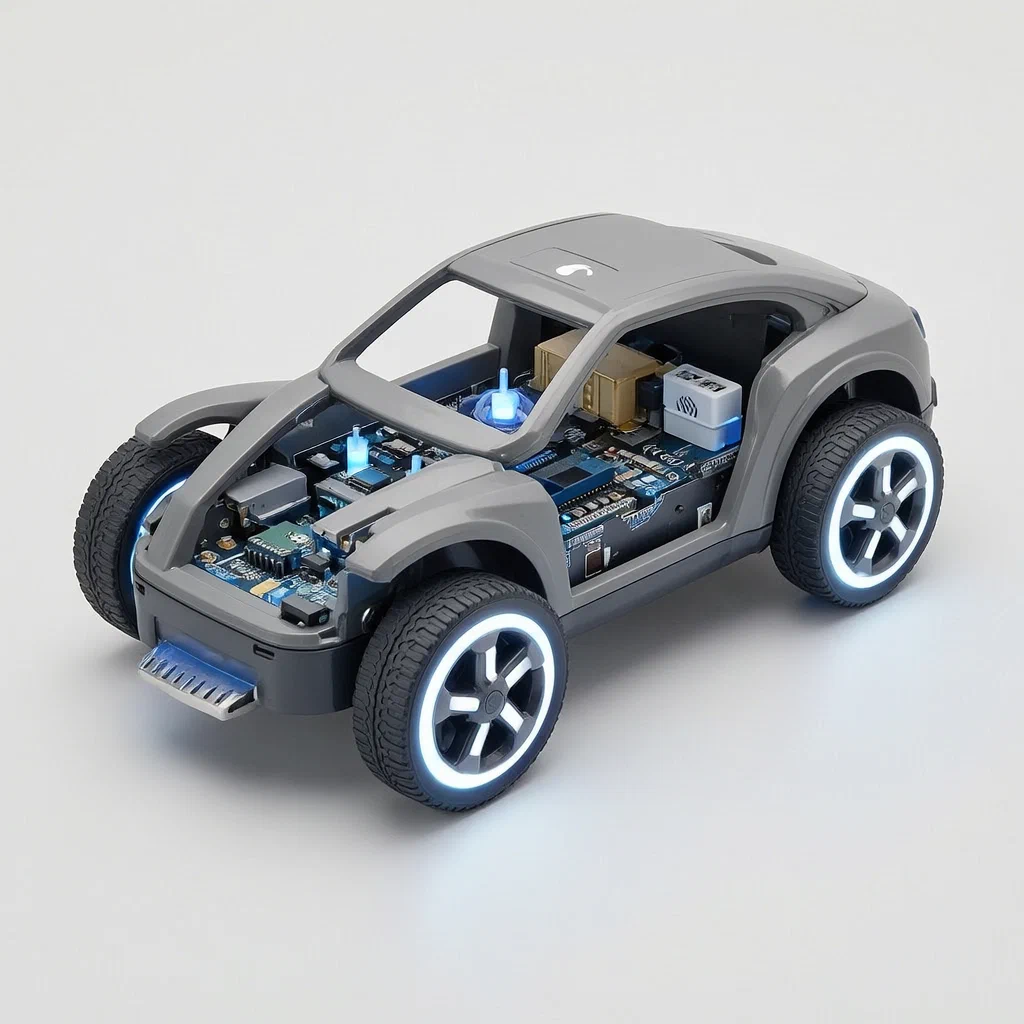
Traditional remote-controlled cars often limit play to simple forward-backward motion, leading to quick boredom and sedentary habits. This design transforms the toy into an interactive platform by embedding a 'Mission Objective System' directly into the chassis. By using onboard sensors to track real-world movement, the car can complete digital game tasks offline or sync with online apps. This bridges the gap between screen-based gaming and physical outdoor activity, encouraging children to move while playing. The integrated hardware also addresses common pain points like battery overcharging and static wheel lighting, offering a more robust and engaging user experience.
- China utility model - lapsed
- No filings outside China
- Interactive Toys & Electronics
- Sensor-based gameplay, LED wheel integration
Splat! What let you down?
🎮
Onboard Mission System
Control chip and memory store game objectives; sensors detect movement to trigger progress.
📡
Connectivity Ready
Supports Wi-Fi, Bluetooth, or wired interfaces to sync with smartphones or servers.
🔊
Voice Feedback
Integrated voice module provides audio cues during gameplay without needing a phone.
💡
Active LED Wheels
Mechanical contact switches light up LEDs only when wheels turn, saving energy.
Bring this product to market
- ✓ Patent vetted China-only family and legal status checked
- 2 Product brief · now How it works, uses and options written up
- 3 Prototype First samples for buyers to review
- 4 Pilot run Small first batch for launch customers
- 5 Volume production Repeat orders at scale
Buyer interest
– of 100 buyers needed to start prototyping
One click, no sign-up. Each vote is one real visitor, and products with the most interest go to prototyping first.
Build team: no members yet. Need a partner, co-funding or skills to build this? Join and we introduce the team once it forms.
The problem
Many modern toys are either purely electronic screens or basic mechanical vehicles. Children often sit indoors staring at tablets, missing out on physical activity. Conversely, traditional RC cars offer limited engagement once the novelty of driving fades. Manufacturers struggle to integrate digital gameplay with physical toys reliably without complex external hardware. There is a need for a vehicle that can track its own movement to validate game progress, ensuring that play happens outdoors, while maintaining battery safety and visual appeal.
The solution
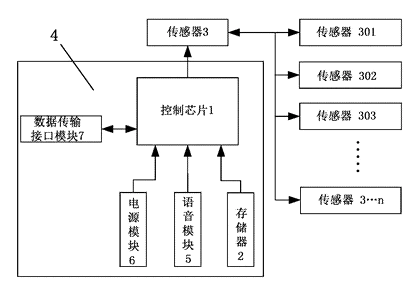
The patent describes a toy car body fitted with a Mission Objective System. This system is not just a controller but a self-contained unit on the car’s circuit board.
- Core Processing: A control chip acts as the brain, connected to a memory module where specific game missions are pre-stored.
- Sensing Movement: Multiple sensors are positioned on the car body. These detect movement data such as turns or swaying. For example, an inertial sensor near the headstock perceives swaying directions.
- Audio Interaction: A voice module provides immediate feedback, announcing mission status or success without requiring a paired device.
- Power Management: A dedicated power module supplies energy. Crucially, it includes a charging detection automatic power-off circuit to prevent overcharging issues.
- Visual Engagement: The wheels contain LEDs activated by a mechanical switch mechanism involving copper sheets and springs, ensuring lights only flash when the car is moving.
Who it is for
- Educational Toy Brands: Companies looking to promote physical activity through gamified learning tools.
- RC Hobbyists & Retailers: Sellers seeking differentiated products with “smart” features beyond basic radio control.
- App Developers: Studios wanting hardware peripherals that can act as input devices for mobile games.
- Private Label Importers: Buyers who want a customizable electronic chassis for branded toy lines.
How it works
The main parts
The hardware architecture is centralized around the car’s internal circuit board.
| No. | Part | Function |
|---|---|---|
| Body | Toy Car Chassis | Houses all electronics; provides structural support for sensors. |
| Chip | Control Chip | Processes sensor inputs and compares them against stored missions. |
| Mem | Memory Module | Stores pre-loaded game objectives and logic. |
| Sen | Multiple Sensors | Detects physical movement (e.g., inertial sensors for swaying). |
| Voice | Voice Module | Outputs audio prompts related to game progress. |
| Comm | Data Transmission | Wi-Fi/Bluetooth modules connect to external terminals/servers. |
| Pwr | Power & Charge | Battery management with auto-cutoff circuit for safety. |
| Wheel | LED Wheel Unit | Mechanical switches trigger LEDs based on wheel rotation. |
Operating steps
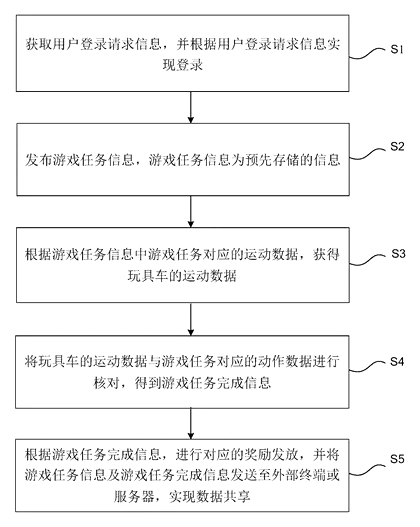
- Initialization: The user powers on the car. The control chip loads mission data from memory.
- Detection: As the child drives the car, sensors collect real-time movement data (distance, turns, speed).
- Processing: The chip analyzes this data. If the movement matches a pre-stored mission requirement, such as a set number of turns or a travel pattern defined in the game data, the system registers completion.
- Feedback: The voice module announces success. If connected via Wi-Fi/Bluetooth, the external terminal or server can record the result.
- Visuals: When wheels rotate, the internal contact switches close circuits, flashing the LEDs to indicate active motion.
Applications
Outdoor Active Play
Children use the car in parks or backyards. The sensors track their running and driving paths, turning physical exertion into game points, which encourages longer periods of outdoor activity compared to stationary video games.
Educational STEM Kits
The modular nature of the control chip and sensors makes this suitable for teaching robotics basics. Students can observe how input (movement) translates to output (voice/app data), bridging software and hardware concepts.
Connected Gaming Experiences
With Wi-Fi or Bluetooth enabled, the car acts as a peripheral for mobile games. Players navigate virtual maps using the physical car, creating a hybrid reality experience where real-world obstacles affect the game state.
Interactive Retail Displays
In stores, these cars can be set to demo modes where they respond to customer handling. The voice module attracts attention, while the LED wheels provide visual flair, increasing dwell time and product engagement.
Where it is less suitable
- High-Precision Racing: The patent focuses on general movement detection rather than high-speed telemetry needed for competitive RC racing.
- Waterproof Environments: The patent does not describe sealing or waterproofing for the circuit board or charging circuit, so wet or muddy conditions would require additional protection that is not part of this design.
- Complex AI Navigation: The system relies on pre-stored missions and sensor data; it does not describe autonomous pathfinding or obstacle avoidance algorithms.
Frequently asked questions
How do the “missions” actually work?
The car has a control chip and memory that store specific tasks, such as completing a set sequence of turns. Onboard sensors detect the car’s real-world movement. When the sensor data matches the stored mission criteria, the system marks the task as complete and can trigger voice feedback or send data to an app.
Does it require a smartphone to play?
No. The patent describes a standalone system where the memory and voice module are inside the car. However, Claims 2-4 specify optional Wi-Fi, Bluetooth, or USB connections, so it can pair with a phone or server for extended gameplay if desired.
How does the wheel lighting work?
It uses a mechanical switch. Inside the wheel, there are copper sheets or springs on the inner sleeve and rotating parts. When the wheel turns, these parts touch periodically, closing the circuit to flash the LEDs. This ensures lights only turn on when the car is moving, saving battery life.
Is the charging safe?
The patent includes a specific “charging detection automatic power-off circuit” (Claim 6) using a triode and diode. This design aims to cut off power automatically when the battery is full, reducing the risk of overcharging. In production, this must still pass standard UL and CPSC safety tests.
Can I change the game content?
Yes. Since the missions are stored in a memory module connected to a control chip, the firmware can be updated. You can define new movement patterns or voice responses during the development phase.
What sensors are used?
The primary sensor mentioned is an inertial sensor (like an accelerometer or gyroscope) placed on the headstock to detect swaying and direction. Other general “multiple sensors” are described, allowing for flexibility in adding speed or distance sensors.
Can this design be made and sold in the US?
The patent was filed only in China and has lapsed, so it does not restrict the design in the US or in China. However, interactive toys are heavily patented globally. We strongly recommend a freedom-to-operate (FTO) review to ensure your specific implementation doesn’t infringe on active US patents held by major toy companies.
Are you affiliated with the patent owner?
No. IP2M is an independent design and manufacturing service working from the public patent document.
Request a quote
Click Request a Quote below to see our email address - copy it, or open your email app with a ready-made message. Please mention patent CN206730500U in the subject.
Helpful details to include:
- Your company and channel (toy brand, educational kit maker, app developer)
- Connectivity preference (Wi-Fi, Bluetooth, or standalone)
- Sensor requirements (basic movement vs. precise navigation)
- Lighting style (single color, multi-color, pattern)
- Estimated quantity and target price
- Timeline - when you would like prototypes and first shipment
You can also reach us at (332) 203-9997.
Explore this product
Interested in building this?
Tell us your target market, quantity and timeline. We reply with options for prototyping, small-batch runs or volume production.
Send your inquiry to
Please put CN206730500U in the subject line and tell us your company, country, estimated quantity and timeline.
Prefer to talk? Call (332) 203-9997.
More product-ready patents
All Toys & Games patents →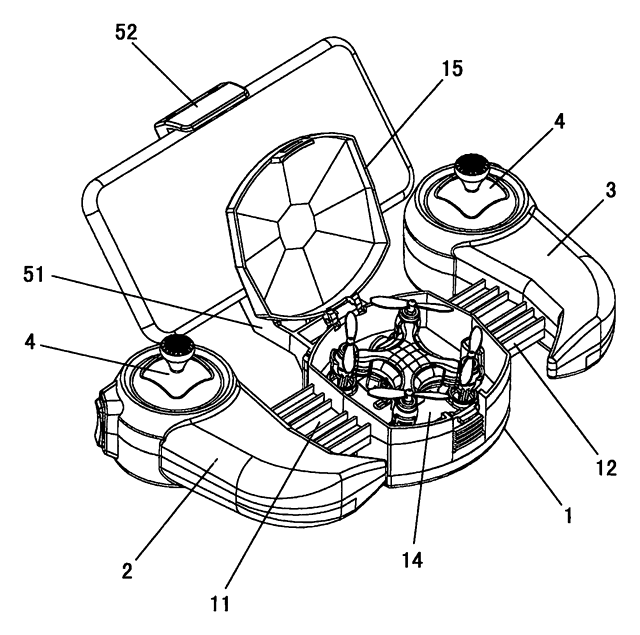
Toys & Games
Stretch-to-Fit Toy Remote with Drone Storage
Toy drone remote with slide-out handles for any hand size, a phone clamp and built-in drone storage.
Patent CN205412243U
Toys & Games
Magnetic Tile Racks for Ultra-Thin Travel Mahjong
Magnetic rack frames that hold ultra-thin mahjong tiles upright and fold into the set's carrying box.
Patent CN207169017U
Toys & Games
X-Braced Square Magnetic Building Tile with Locating-Post Shell
Square magnetic building tile: open X-brace frame, corner-lug magnets, two shells aligned by posts.
Patent CN105963988B
Toys & Games
Card-Thin Magnetic Travel Mahjong and Chess Sets with Magnet Racks
Pocket mahjong and chess sets: thin magnetic-powder tiles, finger magnet picker and fold-out magnetic racks.
Patent CN206896783U
Toys & Games
Inflatable Baby Climbing Mat with a Bumpy Hump and a Ramp Obstacle
Inflatable crawling mat: a bumpy rounded hump and a sloped ramp on a stiffened air base.
Patent CN108905229B
Toys, Games & Puzzles
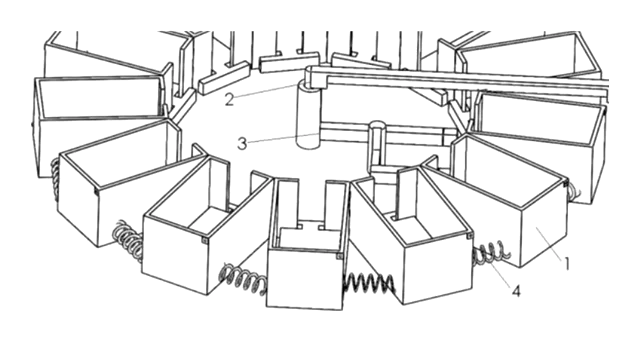
Ring-Layout Automatic Card Shuffler with Electromagnetic Box Coupling
Ring-layout card shuffler that sweeps stacks between boxes via electromagnetic coupling.
Patent CN209564602U
Browse by category
- Apparel & Accessories (25)
- Baby & Kids (19)
- Bags & Luggage (12)
- Bath & Personal Care (19)
- Car Accessories (14)
- Furniture, Bedding & Storage (14)
- Garden & Outdoor (21)
- Health & Wellness (9)
- Home, Kitchen & Cleaning (31)
- Lighting (14)
- Packaging & Containers (7)
- Pet Products (7)
- Phone & Camera Accessories (5)
- Retail Display (15)
- School, Office & Art (21)
- Sports & Recreation (28)
- Tools & Workshop (33)
- Toys & Games (15)
This page is based on the public patent document CN206730500U, assigned to Individual. IP2M is an independent manufacturing service and is not affiliated with, endorsed by or licensed by the patent owner. Images marked as concept renderings are illustrations, not photos of an existing product. Patent status information is provided for reference only and is not legal advice; confirm freedom to operate for your market before production. Full disclaimer.