At a glance
| Patent number | CN206776782U (application CN201720312241) |
| Type | China utility model (实用新型) - protects product shape and structure |
| Original title | Self-heating thermal multi-functional riding suit (可自主发热保暖的多功能骑行服) |
| Patent owner | Individual (Song Jianhui) |
| Inventors | Song Jianhui |
| Filing date | 2017-03-28 |
| Grant date | 2017-12-22 |
| Status (China) | In force in China until at most 2027-03-28 (if annual fees are paid) |
| Patent family | Chinese filings only - no US, European, Japanese, PCT or other filings listed |
| Cited by | 4 later documents |
| Source | Google Patents (search for CN206776782U) |
What the claims cover, in plain language
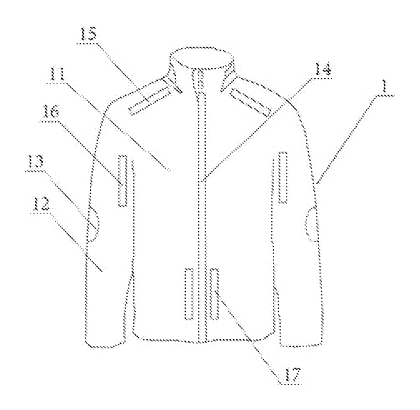
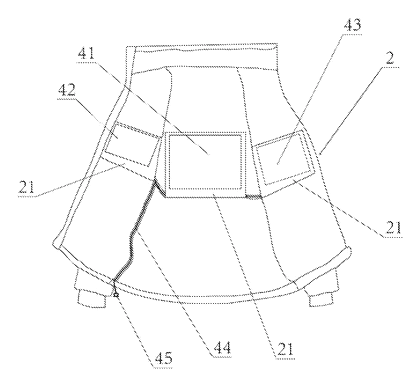
Claim 1 – a two-piece riding suit comprising an upper garment and lower trousers that are split apart. The upper garment has a double-layer structure: an outer shell and an inner liner, also separable. On the inner surface of the liner, a first carbon fiber heating pad corresponds to the upper back, a second pad to the left chest, and a third pad to the right chest. All three pads connect via conductive wires to a power source and to a control and adjustment device.
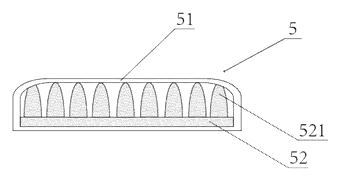
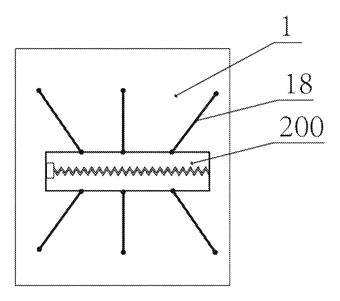
Claim 2 – the lower trousers include an outer waterproof layer and an inner breathable sweat-wicking layer. A fourth carbon fiber heating pad sits at the left knee and a fifth pad at the right knee, wired to the same power and control system. Claim 3 – the outer surface of the trouser legs carries left and right knee pads corresponding to the knee positions. Claim 4 – the knee pads fit into external cloth pockets on the trouser legs. Claim 5 – the knee pads are detachably connected to the trousers. Claim 6 – the outer shell includes an outer waterproof layer and an inner breathable layer; first vents are located at the left and right shoulders, connecting to the interior through mesh air ducts, with additional exhaust outlets on the jacket. Claim 7 – the exhaust outlets include two first outlets on the sleeves near the armpits and two second outlets at the lower hem. Claim 8 onward – details of the power connector placement, protector mounting structures and wiring grooves.
This is a simplified reading for orientation only. The legal scope is defined by the exact claim wording in the official Chinese document.
What this means for US production
This patent was filed only in China and is currently in force there. Manufacturing or selling this exact design in China requires the patent owner’s permission while the patent remains active. It has no US or other foreign counterpart, so the design itself is not restricted in the United States by this specific document.
Before starting tooling or fabric sourcing, buyers should address the following:
- Freedom to operate (FTO). Even though this Chinese utility model does not apply in the US, heated motorcycle apparel involves overlapping intellectual property around flexible heating elements, wiring routing in garments and vented armor integration. An FTO search covering US patents for wearable heating systems is strongly recommended.
- Other patents may exist. Heated clothing and motorcycle armor systems are actively patented by major riding gear brands and textile technology firms in the US and Europe. Elements such as the specific placement of carbon fiber pads or the mesh-duct venting arrangement may overlap with existing US registrations.
Customization and manufacturing
What can be customized
| Area | Options |
|---|---|
| Heating element material | Carbon fiber pads, metallic wire traces or printed conductive ink depending on flexibility and cost targets |
| Voltage and power source | 12V motorcycle battery direct, 5V USB power bank, or 7.4V dedicated rechargeable pack |
| Controller interface | Analog dial, push-button LED indicator, or Bluetooth-connected smartphone app module |
| Outer shell fabric | Cordura nylon, polyester Oxford, waxed cotton or laminated softshell with varying denier counts |
| Waterproof membrane | TPU laminate, PTFE membrane or PU coating, selected by breathability and hydrostatic head requirements |
| Armor type | CE Level 1 or Level 2 foam, viscoelastic inserts or hard-shell plastic buffers |
| Sizing and fit | Men’s, women’s and unisex patterns; pre-curved sleeves and articulated knees for riding posture |
| Branding | Private-label logos, custom zipper pulls, reflective print placements and hang tags |
Things to plan for (US market)
- UL 964 or equivalent – standards for electrically heated bedding and clothing are often referenced by US retailers for wearable heating products to ensure safe temperature limits and wiring insulation.
- FCC Part 15 – if the control device includes any wireless module (such as Bluetooth for app connectivity), it must comply with FCC regulations for unintentional or intentional radiators.
- CPSC general wearing apparel rules – flammability standards under 16 CFR 1610 apply to the textile portions of the suit.
- California Proposition 65 – fabrics, waterproof coatings, plastic armor components and solder used in wiring must be screened for listed chemicals.
- CE EN 17092 – while a European standard, many US motorcycle apparel buyers expect abrasion resistance testing to this motorcycle clothing standard for marketing purposes.
How a project runs
- Inquiry – confirm target market, sizing range, preferred heating voltage, fabric choices and estimated order volume.
- Design and pattern making – develop graded patterns integrating the wiring grooves, pad pockets and vent ducts; select component suppliers for the carbon fiber pads and controller.
- Prototyping – sew sample units to verify heating distribution, vent airflow, armor fit and overall comfort in riding posture.
- Testing and certification – submit prototypes for electrical safety, flammability and abrasion tests required by the destination market.
- Production – cut fabric, laminate membranes, install wiring harnesses, sew assemblies, attach hardware, perform inline electrical checks and final quality inspection.
Quantities & timeline
Manufacturing a heated garment requires specialized sewing operations for routing conductive wires through insulated grooves without piercing them, alongside standard textile cutting and assembly. Molds are needed for custom plastic armor inserts and potentially for silicone-coated connectors. Electrical testing equipment must be integrated into the assembly line to verify every unit before packing. Send us your sizing breakdown, fabric preferences, heating specifications, quantity and target price and we will reply with options.
Patent drawings
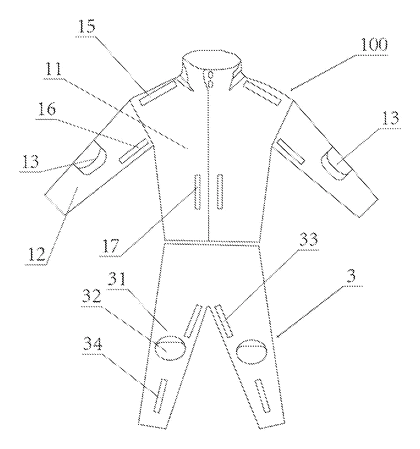
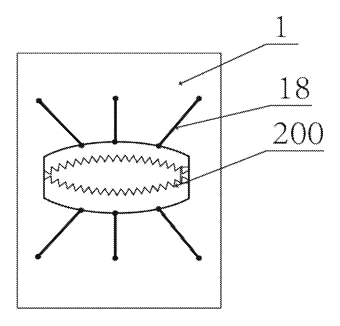
Drawings reproduced from the public patent document for reference.