At a glance
| Patent number | CN206792231U (application CN201621366318) |
| Type | China utility model (实用新型) - protects product shape and structure |
| Original title | A kind of vegetables and fruits juice extractor (一种蔬果榨汁机) |
| Patent owner | Foshan Nanhai Mei Yue Electric Co Ltd |
| Inventors | Cheng Baolin |
| Filing date | 2016-12-13 |
| Grant date | 2017-12-26 |
| Status (China) | Lapsed - terminated for non-payment of annual fees (recorded 2020-11-27) |
| Patent family | Chinese filings only - no US, European, Japanese, PCT or other filings listed |
| Cited by | 3 later documents |
| Source | Google Patents (search for CN206792231U) |
What the claims cover, in plain language
Claim 1 - a vegetable and fruit juicer comprising a fuselage (1), a squeezing cylinder (2) mounted on top of the fuselage, a charging aperture (3) at the top of the cylinder, and a juice opening (7) at the bottom. A ceramic agitating screw (11) inside the cylinder connects to a second stirring motor (10) inside the fuselage. An interface of slagging tap (4) connects to the cylinder, featuring a slag notch (5) and three annular convex ribs (12) inside. A juice receiving cup (6) sits below the juice opening. An agitating device (8) with a shaft and vanes is placed in the cup, connecting through a rotation connection block (13) on the fuselage to a first stirring motor (9). A control button (14) is on top of the fuselage.
Claim 2 - the first and second stirring motors are direct current generators. Claim 3 - the feed pipe at the top of the squeezing cylinder has an up-narrow and down-wide trapezoidal structure. Claim 4 - the interface of slagging tap and the squeezing cylinder are threadedly coupled. Claim 5 - a filter screen is provided at the juice opening at the bottom of the squeezing cylinder.
This is a simplified reading for orientation only. The legal scope is defined by the exact claim wording in the official Chinese document.
What this means for US production
This patent was filed only in China and is lapsed (terminated for non-payment of annual fees, recorded 2020-11-27), so it no longer restricts anyone in China either. It has no US or other foreign counterpart.
Two points to settle early:
- Other patents may exist. Slow masticating juicers and auger-style extractors are a heavily patented field globally, covering auger geometries, pulp ejection mechanisms, and motor arrangements. A freedom-to-operate (FTO) review of the ceramic screw profile, the ribbed discharge interface, and the dual-motor layout is needed before tooling.
- Food contact materials. The ceramic auger, plastic housing, filter screen, and juice cup must all meet US food-contact regulations. Material grades and suppliers are selected early to ensure compliance.
Customization and manufacturing
What can be customized
| Area | Options |
|---|---|
| Housing and cup | Colors, surface finish, plastic resin grade |
| Ceramic screw | Profile pitch and diameter to be confirmed in design |
| Motors | DC motor voltage and torque ratings set in design |
| Discharge interface | Rib geometry and threading size |
| Feed chute | Trapezoidal dimensions adjusted for target produce sizes |
| Controls | Button style, switch placement, optional speed settings |
| Packaging | Retail box graphics, molded pulp or foam inserts |
Things to plan for (US market)
- FDA 21 CFR - food contact substances; the ceramic auger, juice cup, filter screen, and any plastic touching the juice must comply with FDA food-contact regulations.
- UL or ETL listing - mains-powered kitchen appliances sold in the US typically require safety certification by a Nationally Recognized Testing Laboratory (NRTL) covering electrical and mechanical hazards.
- California Proposition 65 - plastics, ceramics, and motor components must be screened for listed chemicals.
How a project runs
- Inquiry - target market, desired features, materials, and estimated volume.
- Design - 3D modeling of the fuselage, cylinder, ceramic screw, and cup; electrical layout for the two DC motors and control button.
- Prototype - CNC or printed parts for fit checks; functional samples to test the extraction and stirring mechanisms.
- Pilot run - small batch using soft tooling to verify the threaded interface seal, the rib pressing action, and motor noise levels.
- Production - injection molding for plastic parts, ceramic forming and sintering for the screw, motor assembly, wiring, and final testing.
Quantities & timeline
The project requires injection molds for the fuselage, squeezing cylinder, discharge interface, and juice cup. The ceramic agitating screw needs specific forming and firing tooling. The two DC motors and the rotation connection block require precise assembly jigs. Certification testing for electrical safety and food contact takes a significant portion of the schedule. Send us your target specifications, material preferences, estimated quantity, and timeline and we will reply with options.
Patent drawings
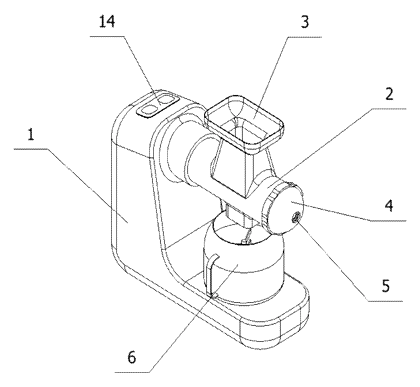
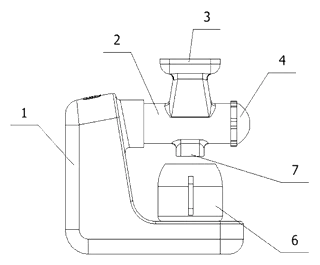
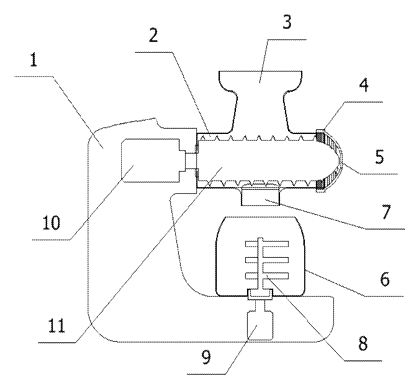
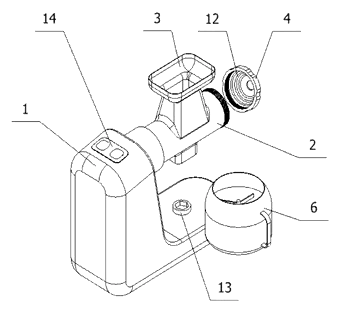
Drawings reproduced from the public patent document for reference.