At a glance
| Patent number | CN206831443U (application CN201720675006) |
| Type | China utility model (实用新型) - protects product shape and structure |
| Original title | Music lantern with mosquito killer lamp (一种带有灭蚊灯的音乐彩灯) |
| Patent owner | Chen Xuemei (individual) |
| Inventors | Chen Xuemei |
| Filing date | 2017-06-12 |
| Grant date | 2018-01-02 |
| Status (China) | Lapsed - terminated for non-payment of annual fees (recorded 2023-07-07) |
| Patent family | Chinese filings only - no US, European, Japanese, PCT or other filings listed |
| Cited by | 2 later documents |
| Source | Google Patents (search for CN206831443U) |
What the claims cover, in plain language
Claim 1 - a music lantern with a lamp cap and a lamp body with through holes; a high-voltage grid inside the body; a circuit board with ultraviolet LEDs and LEDs; a shade over the board with a music player wired to it; and control switches for the mosquito killer, the light and the player.
Claim 2 - a mosquito-luring sound wave device on the shade. Claim 3 - the body has a top and a bottom plate joined by crossed ribs forming a guard spaced 3-5 mm. Claim 4 - two layers of guard, with the grid on the inner one. Claims 5-6 - optional UV sterilizing LEDs and a miniature negative-ion emitter on the board.
This is a simplified reading for orientation only. The legal scope is defined by the exact claim wording in the official Chinese document.
What this means for US production
This patent was filed only in China and has lapsed, so it no longer restricts anyone in China either. It has no US or other foreign counterpart.
Two points to settle early:
- Other patents may exist. Bug zapper bulbs, speaker light bulbs and combination patio lights are sold by many US brands and covered by a number of design and utility patents, so a freedom-to-operate (FTO) review of the cage, grid and combined functions is needed before tooling.
- Claims and options. The patent’s air-purifying ion emitter and sterilizing claims are not needed for the core product; dropping them keeps the marketing within what US rules allow.
Customization and manufacturing
What can be customized
| Area | Options |
|---|---|
| Base | E26 screw base, plug-in cord, or rechargeable battery version |
| Cage | Round bulb, lantern or tube shape; rib spacing within the finger-safe range |
| Light | Warm white plus RGB color modes, brightness levels, remote or app |
| Audio | Bluetooth speaker, speaker size, volume limits |
| Zapper | UV LED count and wavelength, grid voltage, removable cleaning tray |
| Options | Ion emitter and UV sterilizing LEDs left out or included per market |
Things to plan for (US market)
- UL 1559 - safety standard for electrocution-type insect-control equipment; retailers ask for it.
- UL 1993 - self-ballasted LED lamps with a screw base; applies if the product is a screw-in bulb.
- EPA device rules (FIFRA) - insect zappers are pesticide devices: no registration, but the producing establishment must be EPA-registered and claims must be truthful and not exaggerated.
- FCC Part 15 - the LED driver and any Bluetooth audio module need FCC authorization.
- California air cleaner rules (CARB) - if an ion emitter is kept and air cleaning is claimed, CARB ozone certification applies; otherwise make no air-cleaning claims.
How a project runs
- Inquiry - base type, functions, audio features and quantity.
- Design - cage and grid geometry, LED board, speaker chamber, switches.
- Prototype - samples for catch tests, light and sound tests, heat checks.
- Pilot run - UL, FCC and EPA labeling review; drop and moisture tests.
- Production - cage molding, grid assembly, board and speaker assembly, burn-in.
Quantities & timeline
The cage, top, bottom plate and shade need injection molds; the high-voltage grid needs a wire or stamped mesh and a step-up circuit; and the LED and audio board is a standard SMT assembly. Safety testing of the grid takes the most time. Send us your base type, functions, audio choice, quantity and target price and we will reply with options.
Patent drawings
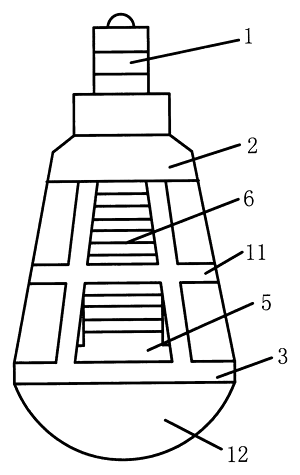
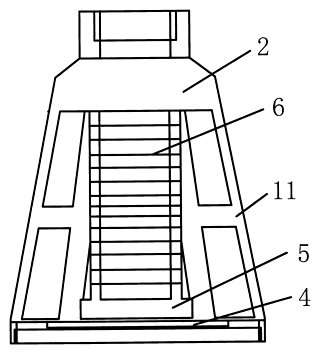
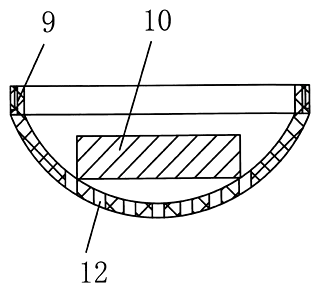
Drawings reproduced from the public patent document for reference.