At a glance
| Patent number | CN206964482U (application CN201621344625) |
| Type | China utility model (实用新型) - protects product shape and structure |
| Original title | Disposable soup spoon (一次性汤匙) |
| Patent owners | Xin Yang (辛阳) and Shen Guan (沈关), individuals |
| Inventors | Xin Yang, Shen Guan |
| Filing date | 2016-12-08 |
| Grant date | 2018-02-06 |
| Status (China) | Lapsed - terminated for non-payment of annual fees (recorded 2021-11-19) |
| Patent family | Chinese filings only - no US, European, Japanese, PCT or other filings listed |
| Cited by | 4 later documents |
| Source | Google Patents (search for CN206964482U) |
What the claims cover, in plain language
Claim 1 - a disposable soup spoon with a bowl and a handle, where a reinforcing rib on the side wall of the handle extends into the side wall of the bowl, and the bottom of the bowl has a rib raised from the outside inward.
Claim 2 - a first reinforced edge on the bowl rim, and second and third reinforced edges on the handle, joined to each other and both extending to the bowl rim, where they connect to the first edge. Claim 3 - the second edge consists of a first support, a first buffer part and a second support, connected to the third edge by a second buffer part; both buffer parts are arched. Claim 4 - the bottom rib is ring-shaped, and its wall meets the bowl bottom as a sloped supporting wall.
This is a simplified reading for orientation only. The legal scope is defined by the exact claim wording in the official Chinese document.
What this means for US production
This patent was filed only in China, and it lapsed for non-payment of annual fees (recorded in 2021). It no longer restricts anyone - in China or elsewhere.
Before production, keep in mind:
- Other patents may exist. Disposable cutlery shapes are also protected by design patents. Use your own outline and styling and have a freedom-to-operate (FTO) search done by a US patent attorney before volume production.
Customization and manufacturing
What can be customized
| Area | Options |
|---|---|
| Size | Common soup-spoon lengths and bowl capacities - to be confirmed in design |
| Material | PP or PS plastic, or compostable / bio-based materials - each needs its own mold settings |
| Weight class | Light, medium or heavy-duty wall thickness |
| Color | White, black, clear or brand colors |
| Embossing | Logo on the handle |
| Packing | Bulk cases, individually wrapped, or in cutlery kits with napkin and chopsticks |
Things to plan for (US market)
- Food contact - materials and colorants must meet FDA food-contact rules; hot-soup use needs a heat-resistant grade.
- Single-use rules - several states and cities limit disposable plastic cutlery or regulate “compostable” claims and labeling; check the target market before choosing a material.
- Packaging labels - country of origin and material/recycling marks.
How a project runs
- Inquiry - size, material, color and quantity.
- Design - rib, edge and ring geometry for the chosen material.
- Prototype - samples for bending, hot-soup and drop tests.
- Pilot run - small batch from the production mold.
- Production - volume production, packing and shipping.
Quantities & timeline
The spoon is a single injection-molded part, so the main cost is a multi-cavity mold; unit cost depends mostly on material and weight. Send us your size, material, quantity and target price and we will reply with options.
Patent drawings
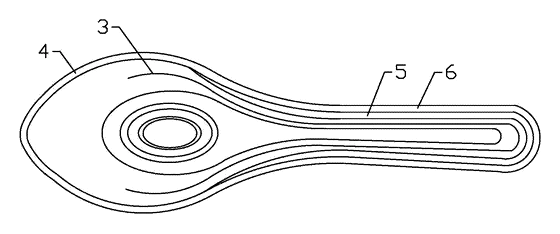
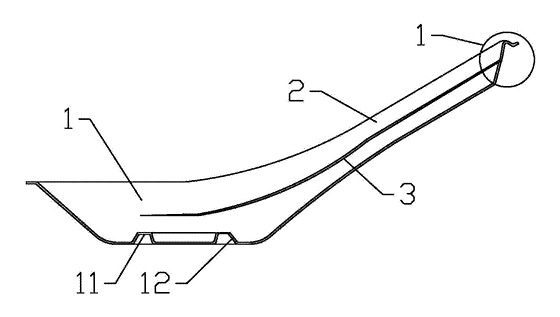
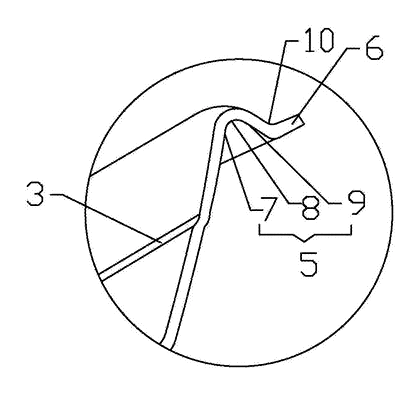
Drawings reproduced from the public patent document for reference.