At a glance
| Patent number | CN207023588U (application CN201720757423) |
| Type | China utility model (实用新型) - protects product shape and structure |
| Original title | A kind of essential oil heater of hair straightener (一种精油直发器) |
| Patent owner | Yueli Group Co ltd |
| Inventors | Li Yong |
| Filing date | 2017-06-27 |
| Grant date | 2018-02-23 |
| Status (China) | In force in China until at most 2027-06-27 (if annual fees are paid) |
| Patent family | Chinese filings only - no US, European, Japanese, PCT or other filings listed |
| Cited by | 14 later documents |
| Source | Google Patents (search for CN207023588U) |
What the claims cover, in plain language
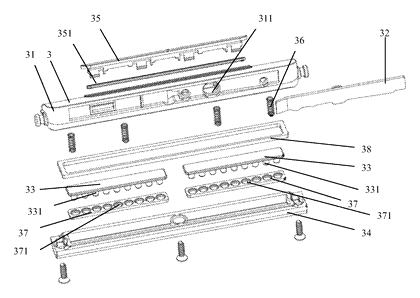
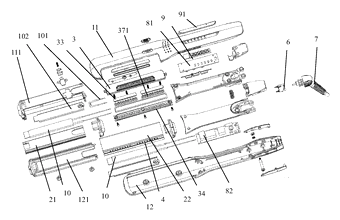
Claim 1 defines the core assembly: a hair straightener having an upper handle and a lower handle hinged at one end, each with a heating board on the facing side. An elongated essential oil case is mounted on the side of the upper heating board and is rotatably connected to the upper handle. Several spike teeth are fixed to the lower heating board, positioned opposite the oil case. The oil case itself comprises a casing with an oil inlet and an outlet, a removable feed cover sealing the inlet, two aluminum strips slidably connected to the outlet with protrusions on their lower surfaces, and a case lid fixed to the outlet having holes that align with those protrusions. When assembled, the spike teeth press against the protrusions through the holes.
Claim 2 adds a transparent window on the upper surface of the casing with a sealing ring. Claim 3 specifies springs inside the casing pushing against the inner wall and the top faces of the aluminum strips. Claim 4 states the upper ends of the spike teeth abut the protrusions respectively. Claim 5 arranges the spike teeth and protrusions in a linear array along the length of the oil case. Claims 6-7 introduce sealing strips between the aluminum strips and the case lid, with through-holes matching the protrusions. Claim 8 adds a sealing ring between the case lid and the casing. Claim 9 describes the oil case and upper handle forming a single integral body. Claim 10 covers a decorative transparent cover on the upper handle with an internal light guide sheet facing it.
This is a simplified reading for orientation only. The legal scope is defined by the exact claim wording in the official Chinese document.
What this means for US production
This patent was filed only in China. It is currently in force in China until at most 2027-06-27 (if annual fees are paid), meaning manufacturing or selling this exact design within China requires the patent owner’s permission. It has no US or other foreign counterpart, so the design is not restricted by this specific document in the United States or elsewhere outside China.
Two points to settle early:
- Freedom to operate (FTO). While this particular utility model does not extend to the US, heated hair styling tools with fluid dispensing features are actively patented by major beauty appliance companies globally. A thorough FTO search covering US patents related to liquid-dispensing flat irons, cartridge-fed styling tools, and mechanical metering valves in hair appliances is necessary before committing to tooling for the American market.
- Electrical safety baseline. Any heated styling tool sold in the US must meet stringent electrical and thermal safety standards regardless of patent status. The mechanical oil-dispensing feature does not exempt the underlying heating element and corded/cordless power system from certification.
Customization and manufacturing
What can be customized
| Area | Options |
|---|---|
| Plate material | Titanium, tourmaline-coated ceramic, or pure ceramic heating boards |
| Plate width | Narrow (about 1 inch) for short hair/detail work, wide (about 2 inches) for long/thick hair |
| Cartridge capacity | Volume of the casing interior to be confirmed in design based on target usage cycles per fill |
| Oil viscosity range | Spring tension and strip gap calibrated for the chosen oil |
| Temperature control | Digital display with adjustable settings, or fixed-temperature analog dial |
| Housing finish | Matte soft-touch coating, glossy plastic, metallic paint, or custom brand colors |
| Power source | Corded (AC) or cordless (lithium battery pack, affects handle weight and size) |
| Sealing materials | Food-grade or cosmetic-grade silicone rings for the feed cover, lid and window seals |
Things to plan for (US market)
- UL 859 / UL 1727 - Standard for Household Electric Personal Grooming Appliances. The straightener must pass dielectric voltage-withstand, leakage current, abnormal operation and temperature tests.
- FCC Part 15 - If the unit includes digital temperature controls, displays or wireless features, it must comply with FCC electromagnetic interference limits.
- FDA 21 CFR - The essential oil itself is a cosmetic. If marketed with drug claims (e.g., treating hair loss), it falls under FDA drug regulations. The tool manufacturer should ensure the hardware is compatible with cosmetics-grade oils and avoid medical claims in marketing copy.
- California Proposition 65 - Plastics, coatings, cord insulation and any metals used in the housing or plates must be screened for listed chemicals.
- CPSC - General consumer product safety requirements apply, including proper labeling, warnings about burn hazards and child safety considerations.
How a project runs
- Inquiry - Define plate size, cartridge volume, power type, target oil viscosity and quantity.
- Design & Engineering - CAD modeling of the hinge geometry, spring calibration for the aluminum strips, placement of spike teeth relative to the protrusions, and thermal isolation between the heating board and the oil casing.
- Prototyping - 3D-printed or CNC-machined samples to verify the mechanical dispensing action, seal integrity and ergonomic balance when the cartridge is full.
- Testing & Certification - Electrical safety testing (UL), EMC testing (FCC), thermal profiling of the plates, and cycle testing of the spring-and-strip mechanism over thousands of open/close actions.
- Production - Injection molding for plastic housings, stamping/machining for heating plates and aluminum strips, assembly of seals and springs, final electrical QA and packaging.
Quantities & timeline
This product requires injection molds for the upper and lower handles, precision tooling for the heating plates, and specialized dies for the aluminum strips and spike teeth. The spring calibration and sealing ring tolerances demand iterative prototyping to prevent oil leakage when the iron is stored vertically. Electrical certification (UL/FCC) adds significant lead time before mass production can begin. Send us your specifications regarding plate size, power type, target oil viscosity, estimated quantities and branding requirements, and we will reply with a tailored project plan.
Patent drawings
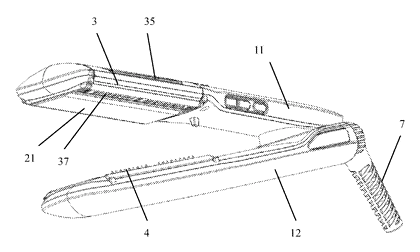
Drawings reproduced from the public patent document for reference.