At a glance
| Patent number | CN207040403U (application CN201720962125) |
| Type | China utility model (实用新型) - protects product shape and structure |
| Original title | Illumination-controllable enoki mushroom cultivation rack (光照可控的金针菇培养架) |
| Patent owner | Tianjin Mao Mushroom Development Co Ltd |
| Inventors | Zhou Renjie |
| Filing date | 2017-08-03 |
| Grant date | 2018-02-27 |
| Status (China) | Lapsed - terminated for non-payment of annual fees (recorded 2024-07-02) |
| Patent family | Chinese filings only - no US, European, Japanese, PCT or other filings listed |
| Cited by | 38 later documents |
| Source | Google Patents (search for CN207040403U) |
What the claims cover, in plain language
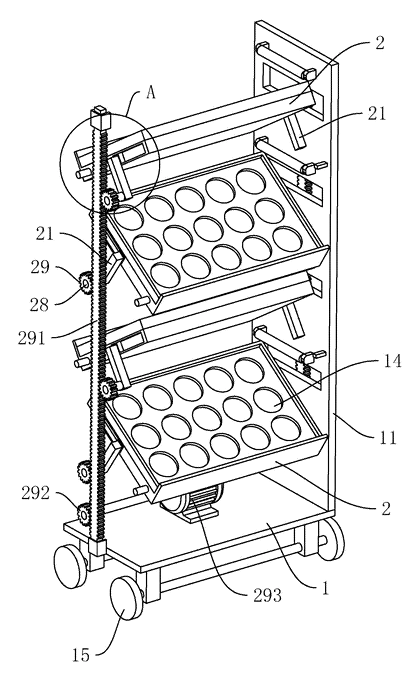
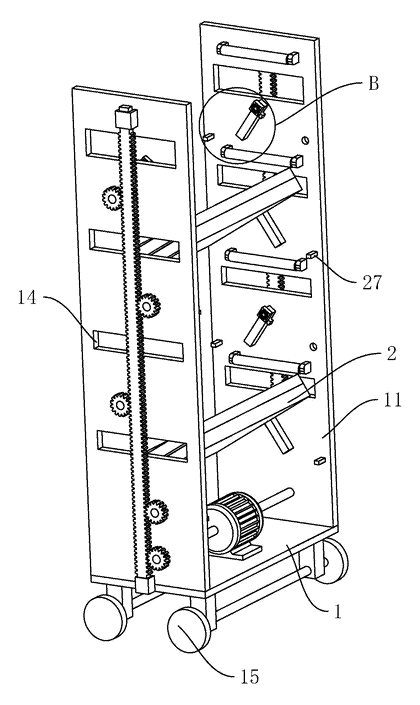
Claim 1 - A cultivation rack comprising a base, two opposing support plates standing on the base, and at least four shelves arranged vertically between the support plates. Each shelf is tilted, and adjacent shelves face different directions. An adjustable-intensity LED is provided between two shelves on the support plate.
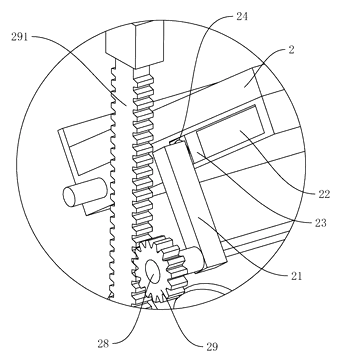
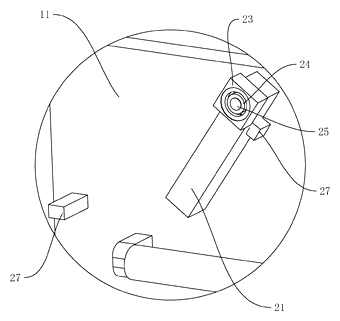
Claim 2 - One end of the shelf is hinged between the two support plates. A push rod is rotatably connected to the inner face of the support plate and slides along the side wall of the shelf via a rotational connection. Claim 3 - The shelf side wall has a chute containing a slider with a bearing; the push rod connects to the bearing’s inner ring via a pivot pin. Claim 4 - The support plate inner face has an upper limit position block and a lower position block. When the shelf is horizontal, the lower block supports it; when tilted to the limit, the upper block stops the push rod. Claim 5 - Hinge points of adjacent shelves are on opposite sides of the support plate. Each push rod connects to a rotating shaft extending through the plate, ending in a driven gear on the outside. A double-sided rack slides on the outer wall, meshing with the driven gears on both sides so adjacent gears turn oppositely. Claim 6 - A driving gear at the base meshes with the rack, driven by a motor. Claim 7 - The support plate surface has ventilating openings. Claim 8 - The shelf upper surface has standing grooves for holding culture dishes. Claim 9 - The base bottom has road wheels.
This is a simplified reading for orientation only. The legal scope is defined by the exact claim wording in the official Chinese document.
What this means for US production
This patent was filed only in China and has lapsed due to non-payment of annual fees, so it no longer restricts anyone in China either. It has no US or other foreign counterpart.
Two points to settle early:
- Other patents may exist. Indoor farming racks, adjustable grow-light shelving and motorized agricultural tilt mechanisms are actively patented by vertical farming companies and greenhouse equipment makers, so a freedom-to-operate (FTO) review of the rack-and-pinion tilt and LED integration is needed before tooling.
- Electrical safety. The combination of a drive motor, LED drivers and a humid growing environment requires careful component selection and enclosure ratings to meet US electrical standards.
Customization and manufacturing
What can be customized
| Area | Options |
|---|---|
| Frame size | Overall height, width and depth; number of shelf tiers (four or more) |
| Shelf capacity | Groove spacing and dimensions matched to standard culture trays or custom containers |
| Tilt range | Maximum angle set by the upper limit block position and push rod length |
| Drive system | Motor voltage and power; manual hand-crank option instead of motor |
| Lighting | LED spectrum, wattage and dimming control protocol (0-10V, PWM) |
| Material and finish | Stainless steel, powder-coated aluminum or galvanized steel; food-safe coatings |
| Mobility | Caster size, locking brakes, floor-track compatibility |
Things to plan for (US market)
- UL 8800 / UL 1598 - Horticultural lighting equipment and general luminaires used in damp agricultural environments must meet specific safety standards; LED drivers need appropriate wet/damp location ratings.
- FCC Part 15 - The drive motor controller and any LED dimming electronics emitting radio frequency energy must comply with FCC limits for unintentional radiators.
- OSHA / NEC (NFPA 70) - Wiring methods, grounding and GFCI protection in wet agricultural facilities are strictly regulated; the rack’s electrical integration must suit the facility’s code requirements.
- FDA 21 CFR 117 - If the rack contacts food or is used in a food production facility, materials and cleanability must align with current good manufacturing practices for food contact surfaces.
How a project runs
- Inquiry - tray dimensions, number of tiers, target tilt angles, lighting specs and quantity.
- Design - structural calculations for loaded shelves, gear ratio selection, motor sizing, electrical layout.
- Prototype - a single bay built to verify tilt synchronization, LED coverage uniformity and tray retention.
- Pilot run - testing in a real or simulated humid grow room to check corrosion, motor duty cycle and cleaning access.
- Production - sheet metal fabrication, welding, coating, gear machining, electrical assembly and final QA.
Quantities & timeline
The frame requires sheet metal laser cutting, bending and welding jigs for consistency. Driven gears and the double-sided rack need precision machining or casting depending on volume. Motor and LED sourcing adds lead time, especially if specific horticultural spectra or UL-listed drivers are required. Assembly involves both mechanical linkage tuning and electrical wiring. Send us your tray sizes, tier count, lighting needs, quantity and target price and we will reply with options.
Patent drawings
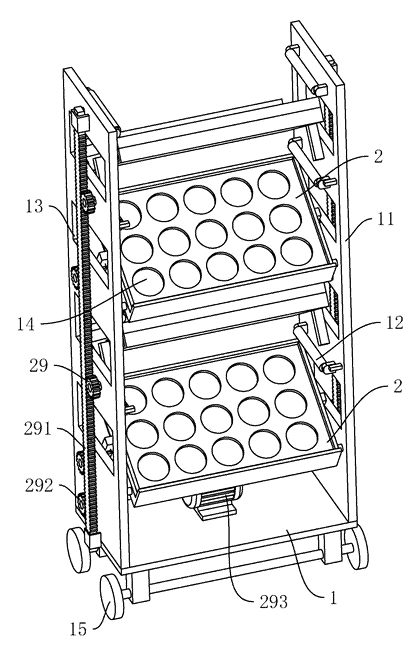
Drawings reproduced from the public patent document for reference.