
Patent CN207241257U
Updated October 23, 2026Long-Point Sketch Pencil Sharpener
Artists want a long, round graphite point for shading - about 30 mm of exposed lead. Ordinary sharpeners grind the lead into a short cone, so most artists still carve their pencils with a craft knife. This crank sharpener's helical cutter is shaped to cut only the wood and leave the graphite core round, with a push button to clear any broken lead.
- China utility model - lapsed
- No filings outside China
- Art supplies
- Gear-driven crank mechanism
Splat! What let you down?
✏️
A long, round point
About 30 mm of exposed graphite, still cylindrical - ideal for side shading and long strokes.
🔪
No more knife carving
Artists get the knife-carved point without the time, waste and risk of carving by hand.
⚙️
Familiar crank action
Uses the proven gear-and-helical-cutter mechanism of desktop crank sharpeners.
🧹
Clears broken leads
A quick push button at the back pushes out any broken lead from the channel.
Bring this product to market
- ✓ Patent vetted China-only family and legal status checked
- 2 Product brief · now How it works, uses and options written up
- 3 Prototype First samples for buyers to review
- 4 Pilot run Small first batch for launch customers
- 5 Volume production Repeat orders at scale
Buyer interest
– of 100 buyers needed to start prototyping
One click, no sign-up. Each vote is one real visitor, and products with the most interest go to prototyping first.
Build team: no members yet. Need a partner, co-funding or skills to build this? Join and we introduce the team once it forms.
The problem
Sketch artists, art students and illustrators shade with the side of the graphite. For that they want a long, cylindrical point - typically around 30 mm of exposed lead - not the short cone an ordinary sharpener produces.
So most of them still sharpen with a craft knife: carve the wood back by hand, then shape the lead on sandpaper. It is slow, wasteful, messy, and risky for students. Earlier long-point sharpeners used a fixed blade in a long tapered hole, but traditional crank sharpeners still cut the lead into a cone and could not give an even lead diameter.
The solution
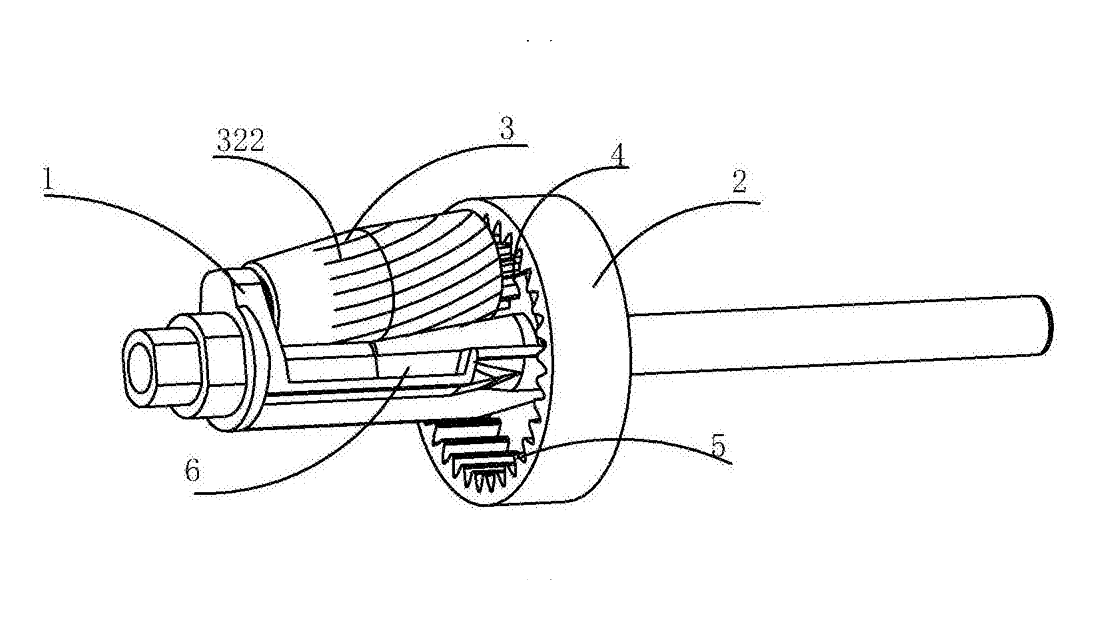
This design keeps the familiar desktop crank sharpener - a cutter that orbits the pencil while spinning on its own axis, driven by a gear ring - and changes the shape of the cutter:
- The main cutter body is cylindrical and set at an angle to the pencil, so it cuts the wood into a cone.
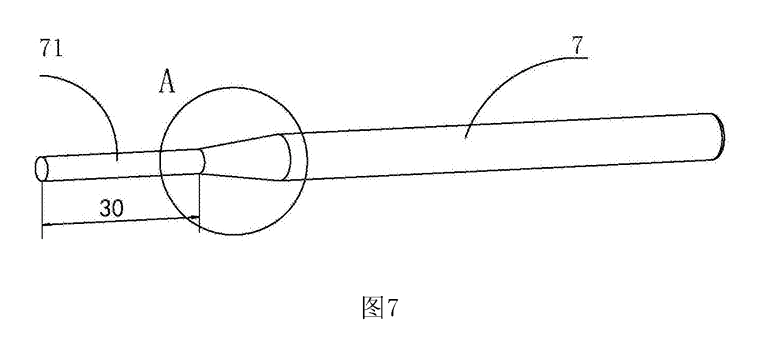
- A tapered auxiliary section at the front of the cutter has a cutting line parallel to the pencil axis, placed at a distance equal to or just under the radius of the lead.
- As the pencil is fed in, the cutter removes the wood around the lead but does not cut into the lead - at most it skims off leftover wood, keeping the lead round.
- A lead channel behind the cutter lets the exposed lead pass through, and a quick push button at the back clears broken leads.
Who it is for
- Art-supply brands and stationery companies looking for a premium sharpener with a clear benefit for artists.
- Art schools, studios and teachers who want students to stop carving pencils with knives.
- Amazon and art-store sellers - a giftable desk tool for illustrators and drawing hobbyists.
How it works
The main parts
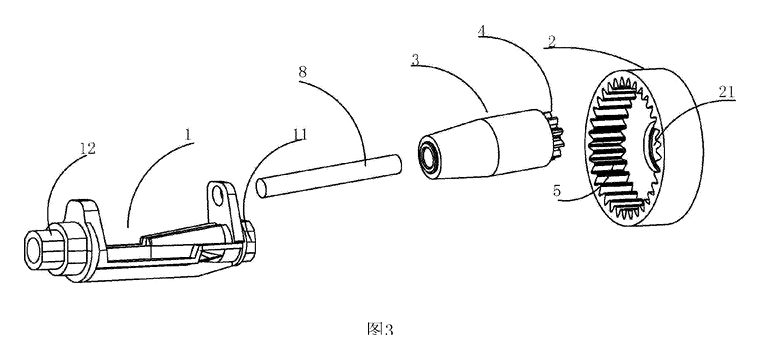
| No. | Part | What it does |
|---|---|---|
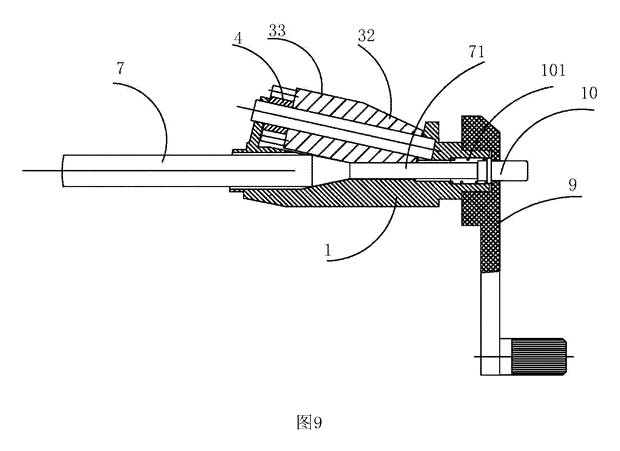
| 1 | Cutter frame | Holds the cutter and the pencil channel; turned by the crank. Front end (11) has the pencil entry, back end (12) the lead channel. |
| 2 | Gear ring seat | Fixed ring with an internal gear (5); the frame turns inside it. |
| 3 | Helical cutter | Spiral cutting roller mounted on the frame at an angle to the pencil. |
| 32 | Tapered auxiliary section | Front part of the cutter, narrowing toward the front; its cutting line (321) runs parallel to the pencil axis. |
| 33 | Main cutter body | Cylindrical section that cuts away the wood. |
| 4 | Cutter gear | Gear on one end of the cutter that meshes with the internal gear, making the cutter spin. |
| 6 | Pencil channel | Holds the pencil; axis (61). The lead passes on into the lead channel (62). |
| 8 | Pivot pin | Mounts the cutter on the frame. |
| 9 | Crank arm | Turns the cutter frame. |
| 10 | Push button | At the back, lined up with the lead channel; pushes out broken leads. |
Sharpening, step by step
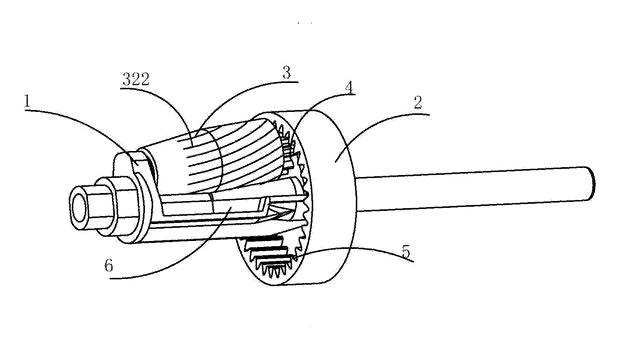
- Insert the sketch pencil into the pencil channel (6).
- Turn the crank (9). The cutter frame (1) rotates, carrying the cutter (3) around the pencil.
- Cutter spins. Its gear (4) runs on the fixed internal gear (5), so the cutter also spins on its own axis - the classic crank-sharpener action.
- Wood only. The main body (33), set at an angle, cuts the wood into a cone. The auxiliary section’s cutting line (321) sits at a distance from the pencil axis equal to - or just under - the lead radius, so the lead is left round.
- Feed in. As the pencil advances, the exposed lead slides into the lead channel (62) and the point grows to the target length.
- Clear jams. If a lead breaks, press the push button (10) to push it out of the channel.
Why the lead stays round
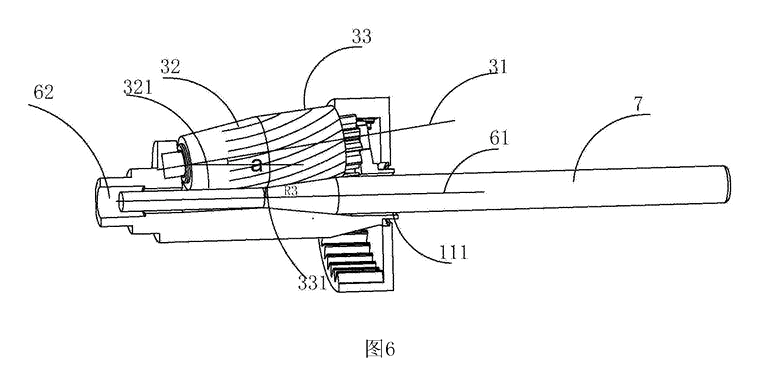
The angle between the cutter and the pencil sets the taper of the wood. The parallel cutting line of the tapered section sets the diameter of the exposed lead: if its distance from the pencil axis equals the lead radius, the lead is not touched; if slightly smaller, the cutter just skims the lead to clean off leftover wood and make it perfectly even.
Applications
Art students and art schools
Drawing classes go through many pencils a day. A sharpener that gives the knife-carved point in seconds saves class time and keeps craft knives away from younger students.
Professional illustrators and concept artists
Graphite artists working on large drawings need many long-point pencils ready in different grades. A desk sharpener makes preparing a full set quick and consistent.
Charcoal and carbon pencils
Wood-cased charcoal and carbon pencils are often sharpened the same way. Cutter settings can be tuned for their larger or softer cores during design.
Architects and designers
Long points are useful for sketching and rendering by hand; a consistent point means consistent line quality.
Drawing hobbyists
The growing hobby-drawing market - adult learners, online-course students - buys tools that make getting started easier.
Where it is less suitable
- Writing pencils - students writing notes want a short, sharp cone; a standard sharpener is better.
- Very soft or fragile leads - very soft grades break more easily when exposed this far; recommended pencil grades should be tested.
Frequently asked questions
How long is the exposed lead?
The patent’s example leaves about 30 mm of lead. The exact length is set by the cutter geometry and can be tuned during design.
Why does it not cut the lead?
The front section of the cutter is shaped so its cutting edge runs parallel to the pencil, at a distance equal to (or just under) the lead’s radius. It removes the wood around the lead but leaves the lead round.
Which pencils does it work with?
Standard wood-cased graphite sketch pencils. Settings for charcoal and carbon pencils with larger cores can be developed and tested.
What if the lead breaks inside?
Press the push button at the back - it is lined up with the lead channel and pushes the broken lead out.
Can I still shape the lead tip?
Yes. Many artists give the long lead a final touch on sandpaper to get a chisel or needle point - the sharpener does the slow wood-carving part.
Is it safe for students?
It replaces knife carving, which is a common cause of cuts in art classes. Versions for children should meet US children’s-product requirements.
Can this design be made and sold in the US?
The patent was filed only in China and lapsed in 2023, so it does not restrict anyone. Other long-point sharpener designs may be patented - see Patent & Production - so we recommend a freedom-to-operate check before volume production.
Are you affiliated with the patent owner?
No. IP2M is an independent design and manufacturing service working from the public patent document.
Request a quote
Click Request a Quote below to see our email address - copy it, or open your email app with a ready-made message. Please mention patent CN207241257U in the subject.
Helpful details to include:
- Your company and target market (art-supply brand, school supply, Amazon…)
- Pencil types - graphite, charcoal, carbon; brands you want supported
- Point length and housing style - desktop or clamp-on
- Branding - colors, logo, bundles with pencil sets
- Estimated quantity and target price
- Timeline - when you would like samples and the first shipment
You can also reach us at (332) 203-9997.
Explore this product
Interested in building this?
Tell us your target market, quantity and timeline. We reply with options for prototyping, small-batch runs or volume production.
Send your inquiry to
Please put CN207241257U in the subject line and tell us your company, country, estimated quantity and timeline.
Prefer to talk? Call (332) 203-9997.
More product-ready patents
All School, Office & Art patents →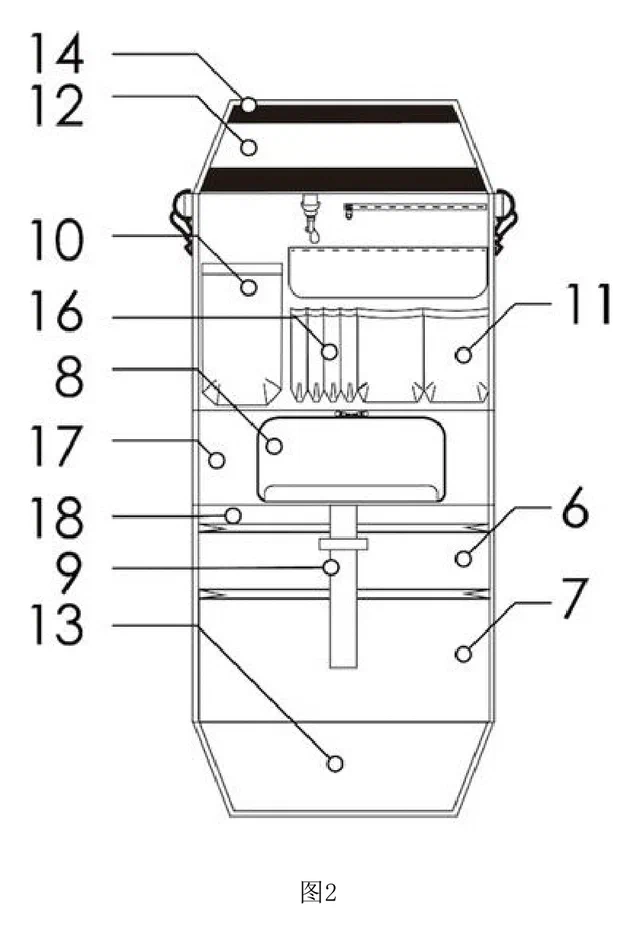
School, Office & Art
Fold-Out Desk Organizer Insert for School Backpacks
Backpack insert that unfolds into a hanging desk organizer for workbooks, stationery and a water bottle.
Patent CN209436546U
School, Office & Art
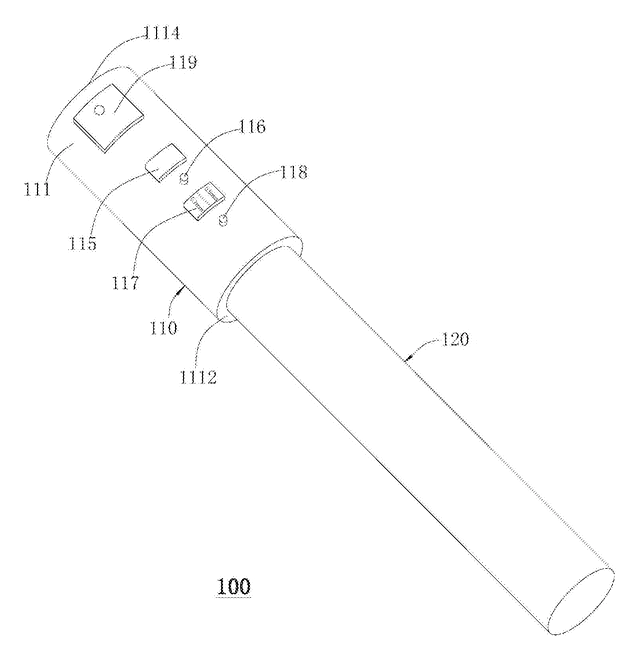
Smart Pencil Cap That Checks the Point with a Camera
Electronic pencil cap that photographs the point, measures it and reminds you to sharpen.
Patent CN106427302B
School, Office & Art
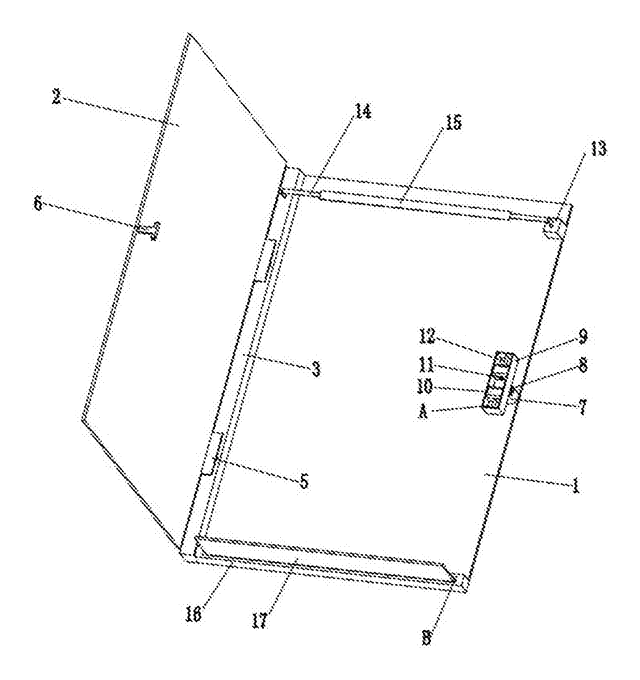
Expanding Clipboard Folder with Spring-Mounted Hinge and Catch
Hard folder whose spring-mounted hinge and catch let the cover clamp any thickness of paper.
Patent CN105667120B
School, Office & Art
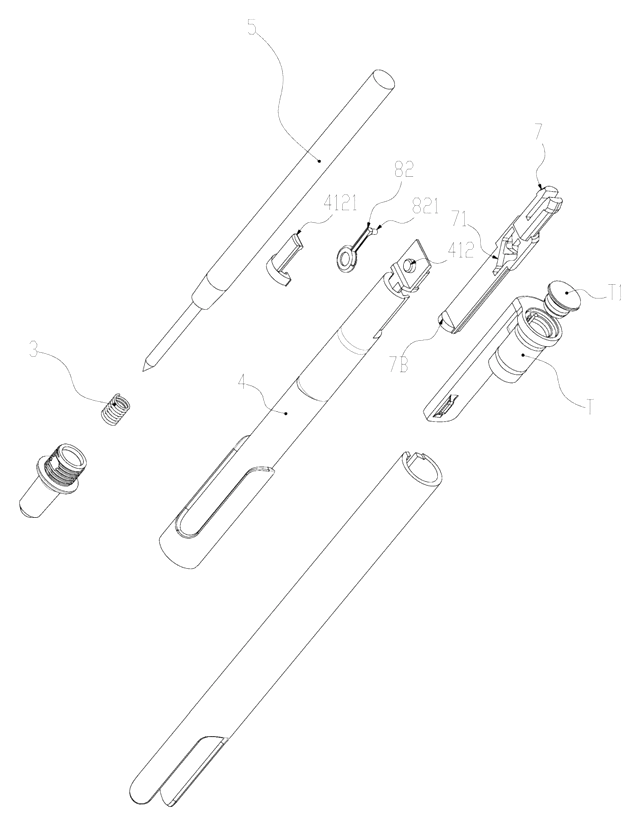
Slide-Action Retractable Pen with a Friction-Loaded Cam That Ignores Gravity
Slide-action retractable pen whose spring-pressed cam latch stays put whichever way the pen is held.
Patent CN217671900U
School, Office & Art
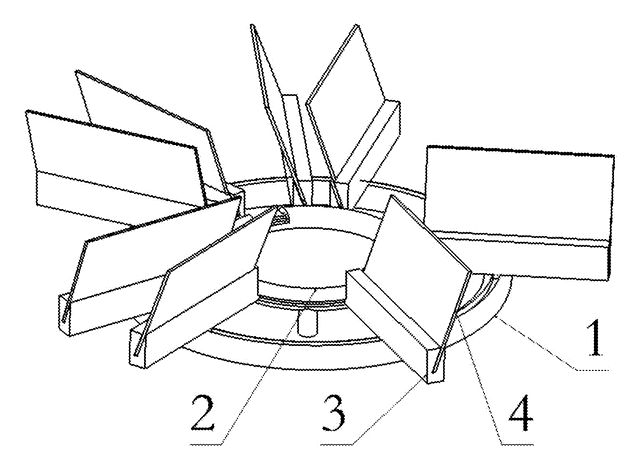
Carousel Business Card Holder with Rolling Card Trays on Twin Ring Tracks
Desk card holder: angled card trays roll on wheels around two concentric ring tracks and lift out.
Patent CN105774300B
School, Office & Art
Dust-Collecting Chalkboard Eraser with Rotating Ring Brush and Electrostatic Trap
Chalkboard eraser: ring brush airflow plus electrostatic plates collect chalk dust into a removable bin.
Patent CN106515284B
Browse by category
- Apparel & Accessories (22)
- Baby & Kids (16)
- Bags & Luggage (9)
- Bath & Personal Care (16)
- Car Accessories (10)
- Furniture, Bedding & Storage (12)
- Garden & Outdoor (18)
- Health & Wellness (8)
- Home, Kitchen & Cleaning (24)
- Lighting (12)
- Packaging & Containers (6)
- Pet Products (6)
- Phone & Camera Accessories (4)
- Retail Display (13)
- School, Office & Art (19)
- Sports & Recreation (25)
- Tools & Workshop (27)
- Toys & Games (12)
This page is based on the public patent document CN207241257U, assigned to Yiwu Dingbang Stationery and Sporting Goods Co., Ltd.. IP2M is an independent manufacturing service and is not affiliated with, endorsed by or licensed by the patent owner. Images marked as concept renderings are illustrations, not photos of an existing product. Patent status information is provided for reference only and is not legal advice; confirm freedom to operate for your market before production. Full disclaimer.