At a glance
| Patent number | CN207298471U (application CN201620992355) |
| Type | China utility model (实用新型) - protects product shape and structure |
| Original title | Portable work lamp (便携式工作灯) |
| Patent owner | NINGBO JINLIDA LAMP DECORATION CO Ltd |
| Inventors | Li Zheyi |
| Filing date | 2016-08-30 |
| Grant date | 2018-05-01 |
| Status (China) | Lapsed - terminated for non-payment of annual fees (recorded 2019-08-16) |
| Patent family | Chinese filings only - no US, European, Japanese, PCT or other filings listed |
| Cited by | 1 later document |
| Source | Google Patents (search for CN207298471U) |
What the claims cover, in plain language
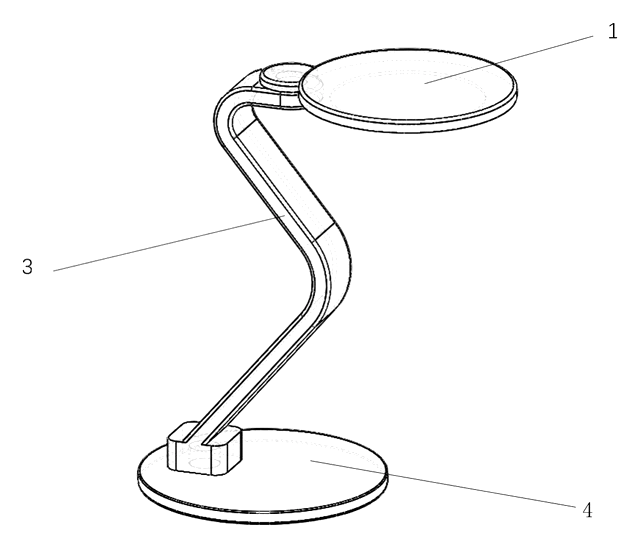
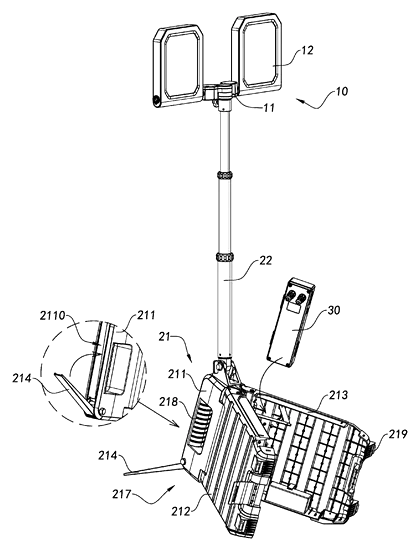
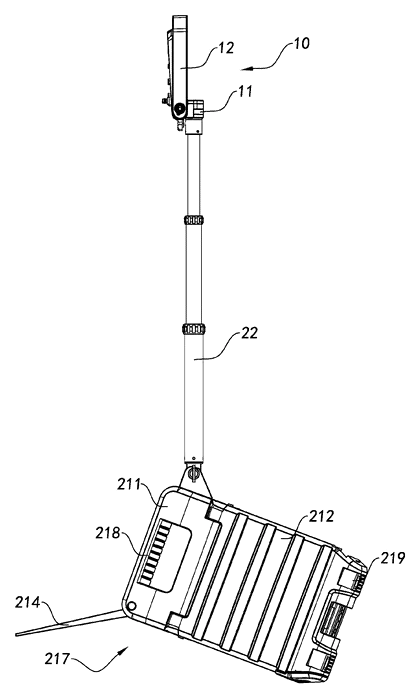
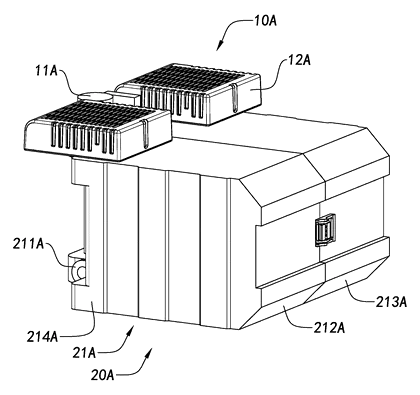
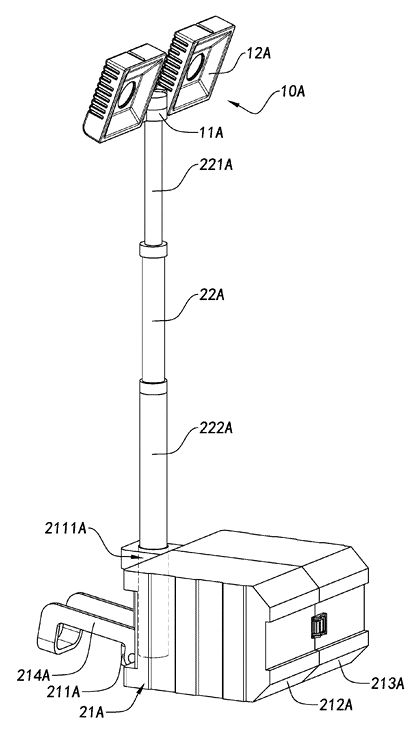
Claim 1 - a portable work lamp comprising a light-emitting device and a support device. The support device has a base component and a supporting member with a high end and a low end. The low end is adjustably arranged on the base component, and the light-emitting device sits at the high end. Adjusting the low end relative to the base raises the light to a preset height, switching the lamp from a folded state to an unfolded state.
Claim 2 - the low end connects to the base component via an axis connection (pivot). Claim 3 - the base component contains an extendable room; the low end telescopes inside it. Claims 4-5 - the base component further comprises a support element, a first arm element, a second arm element and a base body, all joined by axis connections to form a triangular structure when expanded. Claim 6 - after expansion, a supporting and space exists between the elements so their free ends make only point contact with the environment surface. Claims 7-8 - the base body has a positioning groove for a support element and a leader. Claim 9 - the first and second arm elements each have at least one support foot at their free ends. Claims 10-11 - the light-emitting device includes at least one mounting portion rotatably arranged at the high end, with at least one illuminating part adjustably mounted on it. Claims 12-13 - the first and second arm elements fold face to face, allowing the illuminating parts to fold into or between their surfaces. Claims 14-15 - two mounting portions and two illuminating parts are used; the arms form an accommodation space with an opening, the illuminating parts house inside the space and the mounting portions stay at the opening. Claim 16 - the supporting member is a telescopic rod or a folding bar.
This is a simplified reading for orientation only. The legal scope is defined by the exact claim wording in the official Chinese document.
What this means for US production
This patent was filed only in China and lapsed due to non-payment of annual fees (termination recorded 2019-08-16), so it no longer restricts anyone in China either. It has no US or other foreign counterpart.
Two points to settle early:
- Other patents may exist. Portable tripod work lights are heavily patented by major tool brands covering specific hinge locks, telescoping detents and panel arrangements, so a freedom-to-operate (FTO) review of the folding mechanism and panel nesting geometry is needed before tooling.
- Electrical safety. The patent covers only the mechanical structure. The light modules, drivers, battery pack (if cordless) and wiring must be engineered to meet US electrical standards separately.
Customization and manufacturing
What can be customized
| Area | Options |
|---|---|
| Pole length | Extended height and collapsed length to be confirmed in design |
| Light source | SMD LED panels, COB strips, or hybrid configurations; color temperature selectable |
| Power | AC corded, rechargeable lithium-ion battery pack, or dual-power |
| Leg material | Aluminum extrusion, steel tube, or reinforced polymer |
| Feet | Rubber pads, spiked tips, or magnetic bases for steel surfaces |
| Brightness control | Rotary dimmer, multi-step switch, or remote/app control |
| Finish | Anodized, powder-coated, or high-visibility safety yellow/orange |
Things to plan for (US market)
- UL 1598 / UL 153 - luminaires standard (fixed) or portable electric lamps standard; applicable depending on whether the unit is corded or battery-powered.
- FCC Part 15 - any LED driver or wireless dimming circuitry must be tested for electromagnetic interference.
- UN 38.3 - if a lithium-ion battery pack is integrated for cordless operation, cells and packs require transport testing.
- California Title 20 - appliance efficiency regulations apply to certain portable lamps sold in California.
- California Prop 65 - plastics, coatings and metal alloys screened for listed substances.
How a project runs
- Inquiry - target brightness, power source, extended height, folded dimensions and quantity.
- Design - engineering the hinge joints, telescoping detent mechanism, LED thermal path and battery compartment around the patent’s structural concept.
- Prototype - 3D-printed or CNC-machined samples to verify folding action, stability at full extension and panel nesting clearance.
- Pilot run - injection molds for plastic hubs, extrusion dies for aluminum legs; electrical safety and FCC pre-compliance testing.
- Production - die-casting or extrusion, machining, anodizing/powder coating, PCB assembly, final assembly and burn-in testing.
Quantities & timeline
The base body and leg hinges typically require aluminum die-cast or precision injection molds, while the telescoping rod needs extrusion tooling with custom detent profiles. LED panel assemblies involve separate SMT lines and optical lens tooling. Safety certification testing (UL, FCC) adds lead time before volume shipment. Send us your target height, power preference, brightness level, quantity and intended sales channel and we will reply with options.
Patent drawings
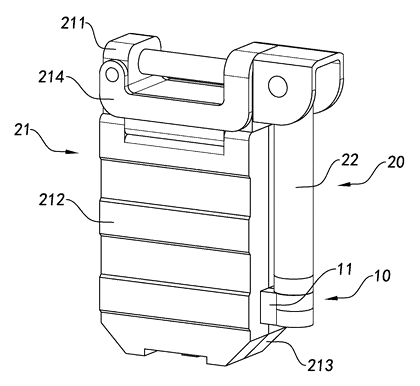
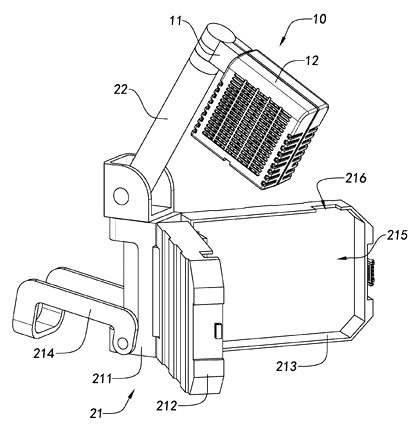
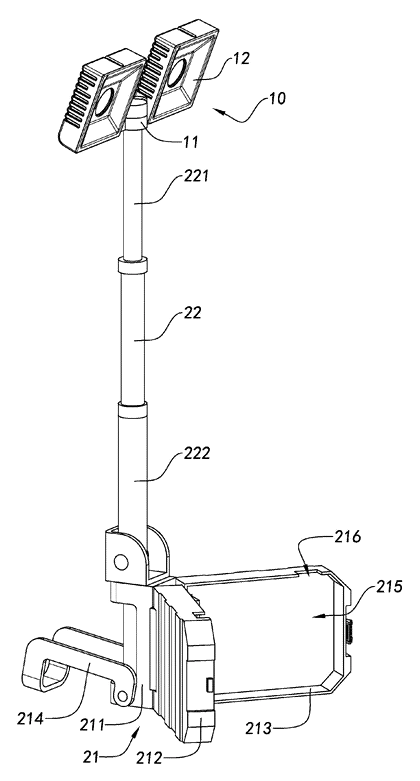
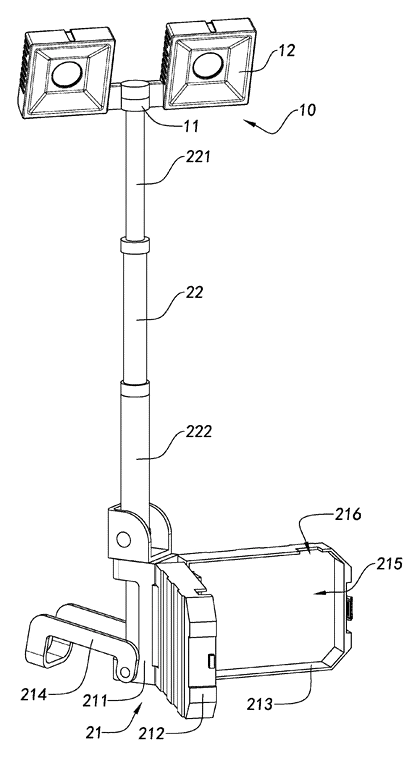
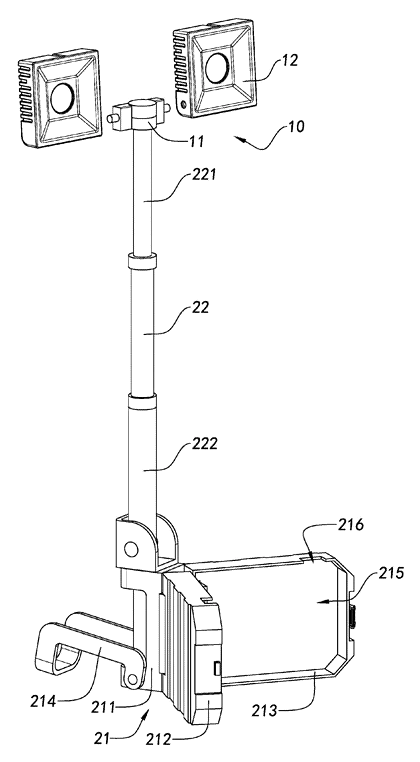
Drawings reproduced from the public patent document for reference.