At a glance
| Patent number | CN207344510U (application CN201720729802) |
| Type | China utility model (实用新型) - protects product shape and structure |
| Original title | A kind of practical shock-absorbing type claw hammer for building (一种建筑用实用减震型羊角锤) |
| Patent owner | Wuyi Huali Electric Appliances Manufacturing Co Ltd |
| Inventors | Chen Yafei |
| Filing date | 2017-06-22 |
| Grant date | 2018-05-11 |
| Status (China) | In force in China until at most 2027-06-22 (if annual fees are paid) |
| Patent family | Chinese filings only - no US, European, Japanese, PCT or other filings listed |
| Cited by | 4 later documents |
| Source | Google Patents (search for CN207344510U) |
What the claims cover, in plain language
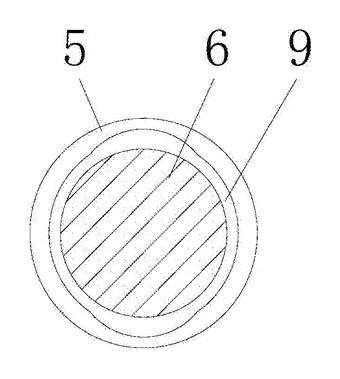
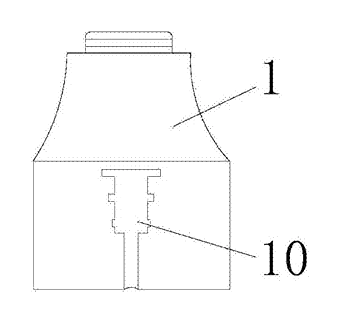
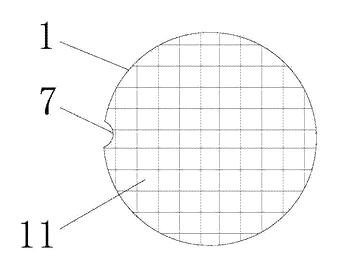
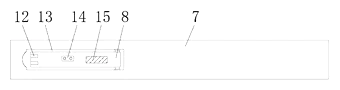
Claim 1 defines the complete hammer: a connecting rod covered by a handle, with a goat’s horn tup (claw head) fixed to one end of the rod. Movable plate mounting grooves are cut into two symmetrical sides of the rod, holding a movable plate that rotates on a shaft. The plate carries an embedded headlamp, a light switch on its side, and a storage battery inside. A tup mounting groove at one end of the handle holds a circular tup. Damping springs are installed between the connecting rod and the handle. A hexagonal grooving is provided on the side of the claw head, and a square hammer connects to one end of the claw head. The square hammer has an anti-skidding percussion face on its bottom and a band magnetic nail groove on its lateral wall. The headlamp, light switch and storage battery are electrically connected.
Claim 2 specifies that the magnetic nail groove includes three cross spacing grooves. Claim 3 states that there are several damping springs in total, evenly distributed between the connecting rod and the handle. Claim 4 adds that the square hammer and the circular tup connect to the claw head through threaded engagement. Claim 5 notes that the square hammer, the circular tup and one end of the handle also connect through threaded engagement.
This is a simplified reading for orientation only. The legal scope is defined by the exact claim wording in the official Chinese document.
What this means for US production
This patent was filed only in China and is currently in force there until at most 2027-06-22, provided annual fees are paid. Making or selling this exact design in China needs the owner’s permission. There is no US or other foreign counterpart, so the Chinese utility model itself does not restrict manufacturing or sales in the United States.
Two points to settle early:
- Other patents may exist. Shock-absorbing handles, interchangeable hammer faces and built-in tool lights are active areas of development. Vision Devices GmbH holds a later European patent (EP3825082A1) that cites this Chinese filing, indicating ongoing innovation in related tool fields. A freedom-to-operate (FTO) review covering US hand-tool patents—especially those involving spring-dampened handles and magnetic nail starters—is recommended before committing to tooling.
- Electrical components in striking tools. Integrating a battery, switch and LED into a hammer head introduces vibration and impact loads on the electronics. The circuit housing, potting method and battery retention must be engineered to survive repeated shocks without failure or leakage.
Customization and manufacturing
What can be customized
| Area | Options |
|---|---|
| Overall weight | To be confirmed in design (e.g., about 16 oz or 20 oz heads) |
| Handle material | Fiberglass, steel tube with overmold, or solid wood core |
| Grip | TPR overmold texture, length and flare |
| Strike faces | Steel hardness, face diameter, knurling or smooth finish |
| Spring rate | Number, wire gauge and distribution of damping springs |
| LED module | Lumen output, beam angle, color temperature |
| Battery type | Replaceable coin cell or rechargeable lithium cell (capacity set in design) |
| Magnet strength | Grade of magnet in the nail slot to hold specific fastener sizes |
Things to plan for (US market)
- ASME B107.41 - standard for hammers, covering head hardness, handle attachment strength and marking requirements.
- California Proposition 65 - materials in the grip, paint, battery and lead-containing alloys must be screened for listed chemicals.
- UN 38.3 - if the storage battery is a lithium cell, it must pass transport testing for shipping into and within the US.
- FCC Part 15 - applies if the LED circuit includes any unintentional radiator components, though simple DC LED circuits typically fall outside strict certification; verify based on final schematic.
How a project runs
- Inquiry - target weight class, volume, feature set and market channel.
- Design - CAD modeling of the rod, handle interface, spring seats, threaded face geometry and movable plate hinge.
- Prototype - CNC machined or 3D printed samples for fit checks; functional prototypes with real springs and LED modules for swing tests.
- Pilot run - small batch using soft tooling or initial hard tooling to validate impact durability, battery retention under shock, and thread wear.
- Production - forging or casting of the head, machining of threads and grooves, spring winding, injection molding of grips, PCB assembly for the light, final press-fit and quality inspection.
Quantities & timeline
Forging dies for the claw head and machining fixtures for the threaded interfaces are required for each weight class. Injection molds are needed for the handle overmold and the movable plate housing. Certification tests such as ASME handle-pull and head-strike durability, plus UN 38.3 if a lithium battery is selected, add to the schedule. Spring tuning to balance shock absorption with head stability takes multiple prototype cycles. Send us your target weight, quantity, feature preferences, grip material and timeline and we will reply with options.
Patent drawings
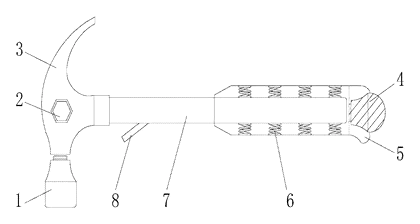
Drawings reproduced from the public patent document for reference.