At a glance
| Patent number | CN207590408U (application CN201720429446) |
| Type | China utility model (实用新型) - protects product shape and structure |
| Original title | Portable neckpillow (便携式颈枕) |
| Patent owner | Shenzhen Mianchong Technology Co Ltd |
| Inventors | Miao Kejun, Liu Jiaqiang |
| Filing date | 2017-04-21 |
| Grant date | 2018-07-10 |
| Status (China) | Lapsed - terminated for non-payment of annual fees (recorded 2025-04-15) |
| Patent family | Chinese filings only - no US, European, Japanese, PCT or other filings listed |
| Cited by | 9 later documents |
| Source | Google Patents (search for CN207590408U) |
What the claims cover, in plain language
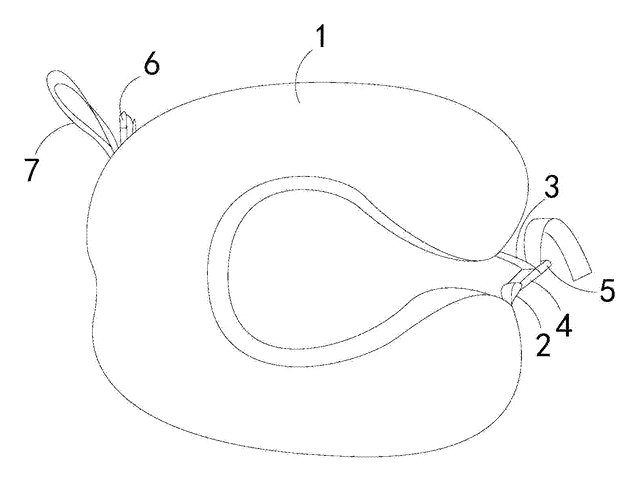
Claim 1 - a portable neck pillow comprising a pillow body and a storage belt. The pillow body includes a nape support body and a first neck side support body and a second neck side support body connected to it, with an opening between the ends of the two side supports. One end of the storage belt is fixed to the end of the first neck side support body. The belt carries a first connector, and the end of the first neck side support body has a second connector. The belt wraps sequentially around the second neck side support body, the nape support body, and the first neck side support body. The first connector mates with the second connector so the belt compresses the support bodies together.
Claim 2 - the end of the second neck side support body has a third connector that connects with the first connector to reduce the opening. Claim 3 - the first connector is a shoulder strap pin thread and the second and third are female threads, or vice versa. Claim 4 - the first connector is a velcro hook piece and the second and third are velcro villus pieces, or vice versa. Claim 5 - the top of the nape support body raises up to form a support portion for when the user’s neck tilts backward. Claim 6 - the inside of the first neck side support body has a first rake (angled portion) to fit the neck when tilted toward it, and the second side support has a symmetrical second rake. Claim 7 - the pillow includes a pillowcase and a pillow core inside it; the pillowcase has an installation entrance sealed by a slide fastener. Claim 8 - the core is slow-recovery sponge, natural emulsion, foam particle, cotton, feather, or PP. Claim 9 - the slow-recovery sponge is inertia sponge, memory foam, low bounce-back sponge, slow bullet, or zero-pressure sense sponge. Claim 10 - the pillowcase is flannelette or fiber.
This is a simplified reading for orientation only. The legal scope is defined by the exact claim wording in the official Chinese document.
What this means for US production
This patent was filed only in China and is lapsed (terminated for non-payment of annual fees, recorded 2025-04-15), so it no longer restricts anyone in China either. It has no US or other foreign counterpart.
Two points to settle early:
- Other patents may exist. Cixi Letu Tourism Products Co., Ltd. holds a later international filing (WO2020211230A1) citing this patent in the travel pillow field, so a freedom-to-operate (FTO) review of the belt-wrapping compression mechanism and connector placement is needed before tooling.
- Core density and compression ratio. The force required to compress the chosen foam core dictates the tensile strength of the storage belt and the holding power of the connectors; these parameters must be matched during prototyping.
Customization and manufacturing
What can be customized
| Area | Options |
|---|---|
| Core material | Memory foam, natural latex, foam particles, cotton, feather, or PP fiber |
| Cover fabric | Flannelette, polyester fiber, spandex blends, or custom textiles |
| Connectors | Velcro hook-and-loop patches, snap buttons, or buckle straps |
| Belt length and width | Sized to match the compression force of the selected core |
| Ergonomic angles | First and second rake angles adjusted based on target user anthropometry |
| Branding | Embroidery, printed labels, or woven tags on the pillowcase |
Things to plan for (US market)
- CPSC 16 CFR Part 1500 / 16 CFR 1501 - if marketed for children under 12, small parts like buckles or snap connectors must pass choke-hazard testing.
- California TB 117-2013 - smolder resistance requirements for upholstered furniture and bedding components sold in California, which some buyers extend to travel pillows.
- CPSIA - lead and phthalate limits apply if the product is classified as a children’s product.
- Textile Fiber Products Identification Act (TFPIA) - requires accurate labeling of fiber content, country of origin, and manufacturer identity on textile covers.
How a project runs
- Inquiry - core material, cover fabric, connector type, and estimated quantities.
- Design - pattern making for the pillowcase, sizing the storage belt, selecting connector hardware, and defining the rake angles.
- Prototype - cutting and sewing samples, pouring or cutting foam cores, and testing the compression cycle to ensure the belt holds the bundle securely.
- Pilot run - verifying seam strength, slide fastener durability, and connector retention over repeated packing cycles.
- Production - foam molding or cutting, textile cutting and sewing, belt attachment, final assembly, and quality inspection.
Quantities & timeline
Production requires cutting dies or CNC patterns for the pillowcase panels, molds for poured foam cores (if applicable), and assembly jigs for fixing the storage belt to the first neck side support body. Certification tests for textiles and foam emissions add to the initial schedule. Send us your core material preference, cover fabric, connector type, quantity and target price and we will reply with options.
Patent drawings
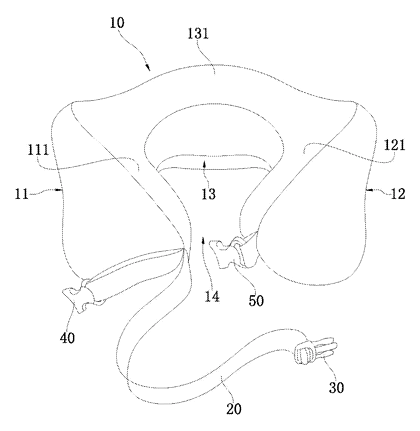
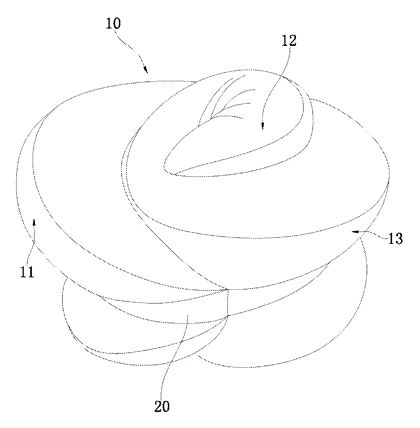
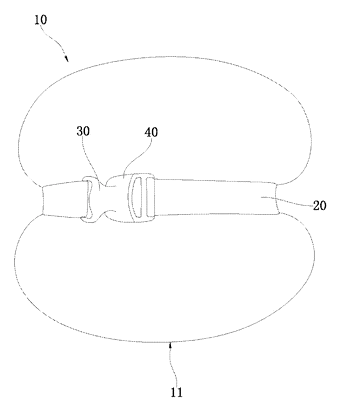
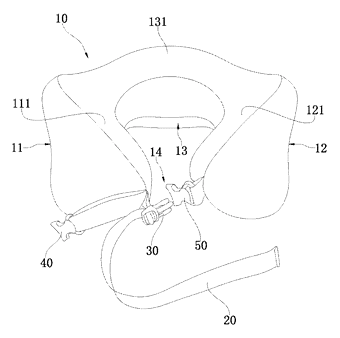
Drawings reproduced from the public patent document for reference.