
Patent CN207631319U
Updated October 26, 2026Motorized Stair-Climbing Baby Stroller with Tri-Wheel Front Assembly
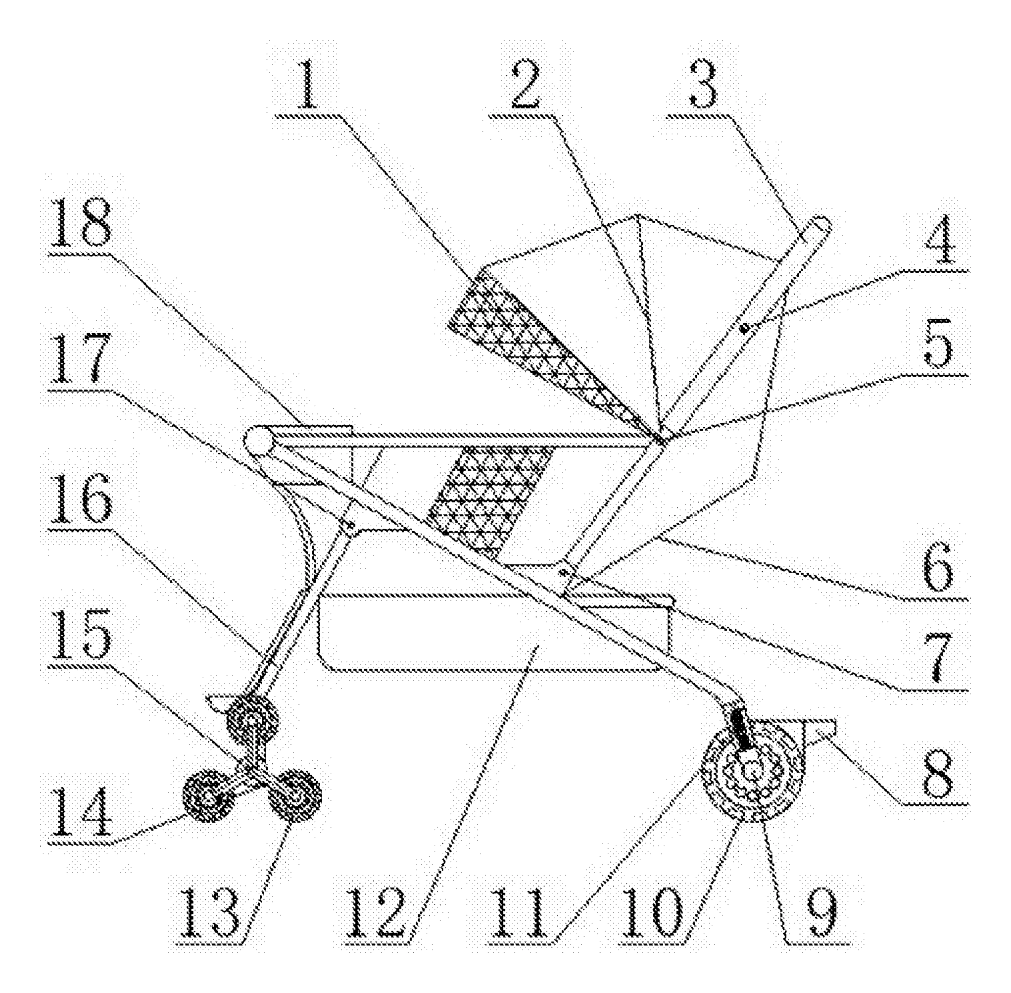
Standard baby strollers stop at stairs and high curbs, forcing caregivers to lift the entire cart and child by hand. This design solves that problem by mounting three front wheels in an equilateral triangle arrangement on a single carrier shaft. On flat ground, two wheels touch the surface and the stroller rolls normally. When steps are ahead, pressing a control button on the push rod activates a motor housed inside the front-wheel connecting rod. The motor drives a transmission shaft that rotates the triangular wheel assembly, allowing the wheels to step up one after another while the caregiver steers the push rod firmly. Rear shock-absorbing springs smooth out bumps, and a sitting posture adjusting rod lets the seat recline or sit upright.
- China utility model - lapsed
- No filings outside China
- Baby strollers & mobility
- Motorized tri-wheel front, shock-absorbing rear
Splat! What let you down?
🔺
Tri-wheel front assembly
Three front wheels are arranged in an equilateral triangle around a carrier shaft to step over obstacles.
⚡
Motor-driven rotation
A control button activates a motor that turns the front wheel assembly via a transmission shaft for stair climbing.
🛡️
Shock-absorbing springs
Springs mounted near the rear wheels absorb energy from bumpy roads to keep the cart stable.
🔄
Adjustable seating
A sitting posture adjusting rod allows the seat angle to be changed for sleeping or sitting up.
Bring this product to market
- ✓ Patent vetted China-only family and legal status checked
- 2 Product brief · now How it works, uses and options written up
- 3 Prototype First samples for buyers to review
- 4 Pilot run Small first batch for launch customers
- 5 Volume production Repeat orders at scale
Buyer interest
– of 100 buyers needed to start prototyping
One click, no sign-up. Each vote is one real visitor, and products with the most interest go to prototyping first.
Build team: no members yet. Need a partner, co-funding or skills to build this? Join and we introduce the team once it forms.
The problem
Caregivers pushing standard baby strollers frequently encounter stairs, raised curbs, and uneven sidewalks where small fixed wheels cannot pass. Lifting a loaded stroller and a child manually is physically demanding and risks dropping the cart or straining the caregiver’s back. Conventional stroller frames lack a powered mechanism to overcome vertical steps, meaning the journey must often be interrupted or rerouted to find a ramp. Additionally, rigid frames transmit every bump from rough pavement directly to the seat, which disturbs a resting infant. A mechanical solution is needed to climb steps smoothly while maintaining stability and comfort on flat surfaces.
The solution
- Three front wheels (13) are mounted in an equilateral triangle arrangement around a front wheel carrier shaft (15) on a front wheel carrier (14). During normal walking, two wheels land on the ground, functioning like a standard stroller.
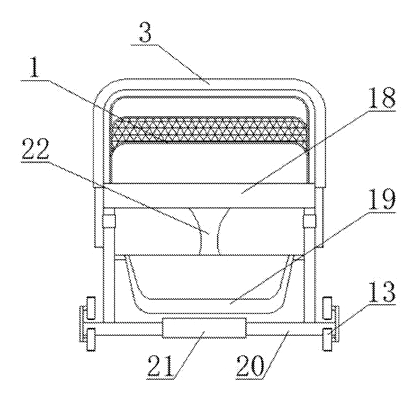
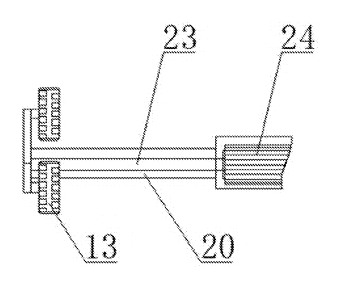
- A motor (24) is housed inside a motor casing (21) positioned at the middle of a front-wheel connecting rod (20). The motor connects electrically to a control button (4) located on the outer surface of the push rod (3).
- When stairs or a curb must be climbed, the caregiver presses the control button. The motor drives a transmission shaft (23) that rotates the three front wheels alternately, stepping them upward. The caregiver steers and supports the cart firmly via the push rod.
- Bradyseism springs (11) are installed near the cart trailing wheels (10) to absorb energy conducted from bumpy roads, keeping the vehicle body stable.
- A sitting posture adjusting rod (6) allows the seat angle to be changed, letting the infant sleep or sit up comfortably.
Who it is for
- Baby product brands looking to add a motorized stair-climbing feature to their stroller lineup for urban markets where apartments lack elevators.
- Amazon sellers and e-commerce retailers sourcing differentiated mobility products that solve a specific pain point for parents navigating city infrastructure.
- Wholesalers of childcare equipment supplying daycares, pediatric clinics, or home-care services where moving infants across thresholds and steps is a daily task.
- Contract manufacturers seeking documented mechanical designs for motorized stroller frames to produce under their clients’ specifications.
How it works
The main parts
| No. | Part | What it does |
|---|---|---|
| 1 | Sunshade | Covers the top; includes a sunshading awning bracket (2) and a transparent window design to check on the baby. |
| 3 | Push rod | Main handle used to steer the stroller; holds the control button (4). |
| 4 | Control button | Located on the push rod; electrically connected to the motor to activate stair climbing. |
| 6 | Sitting posture adjusting rod | Adjusts the seat angle for sleeping or sitting. |
| 10 | Cart trailing wheel | Rear wheels that support the back of the stroller. |
| 11 | Bradyseism spring | Absorbs vibrations from uneven ground to stabilize the cart. |
| 13 | Cart front-wheel | Three wheels arranged in an equilateral triangle for climbing. |
| 15 | Front wheel carrier shaft | Central axis around which the three front wheels are distributed. |
| 20 | Front-wheel connecting rod | Connects the front assembly to the frame; houses the motor casing (21). |
| 23 | Transmission shaft | Transfers power from the motor to the front wheel assembly. |
| 24 | Motor | Drives the rotation of the front wheels when the control button is pressed. |
Operating steps
- Prepare the stroller - Place the infant in the seat and secure them with the safety belt (22). Store items in the storing basket (12).
- Walk normally - Push the push rod (3). Two of the three front wheels rest on the ground, and the bradyseism springs (11) mitigate vibrations from the road.
- Approach stairs - Press the control button (4) to power on the motor (24).
- Climb - The motor turns the transmission shaft (23), rotating the three cart front-wheels (13) alternately. Steer the push rod firmly to guide the vehicle body up the steps.
- Stop and park - Use the brake button (8) above the right end of the cart trailing wheel (10) to fix the rear wheel to the trailing wheel shaft (9) when stationary.
Applications
Urban apartment buildings without elevators
Parents living in walk-up apartments face daily flights of stairs. Carrying a standard stroller and a child simultaneously is exhausting. This design allows the motor to rotate the front wheels up the steps while the parent guides the push rod, reducing physical strain.
City sidewalks with high curbs
Navigating street crossings often requires lifting a stroller over tall concrete curbs. The triangular front wheel assembly can be activated to roll over these vertical barriers smoothly. Caregivers do not need to tilt the entire frame backward dangerously.
Public transit stations and bus boarding
Boarding buses or trains involves gaps and raised thresholds. The motorized front wheels bridge these steps without requiring assistance from bystanders. The compact tri-wheel footprint fits within standard aisle widths.
Parks and unpaved pathways
Gravel paths and dirt trails create constant vibration. The bradyseism springs on the rear wheels absorb this energy before it reaches the seat. Infants remain undisturbed during outdoor walks on rough terrain.
Where it is less suitable
- Smooth indoor environments - Shopping malls and flat indoor floors do not require the motorized climbing function, adding unnecessary weight and complexity compared to basic strollers.
- Air travel - The inclusion of a motor and battery means the stroller must comply with airline lithium battery regulations, making it less convenient for frequent flyers than foldable manual models.
- Jogging - The triangular front wheel geometry is built for stepping, not for the sustained high-speed rolling required by running parents.
Frequently asked questions
How does the stair-climbing mechanism work?
The stroller has three front wheels arranged in an equilateral triangle around a central carrier shaft. During normal walking, two wheels rest on the ground. When approaching stairs, a motor rotates the entire triangular assembly via a transmission shaft, causing the wheels to step up alternately.
How is the motor controlled?
A control button is mounted on the outer surface of the push rod. The button is electrically connected to the motor housed inside the front-wheel connecting rod. Pressing it powers the motor to turn the transmission shaft.
Does the stroller still work on flat ground?
Yes. The patent describes that in normal walking, two of the three front wheels land on the ground, which does not influence the normal use of the perambulator. The motor remains off until the control button is pressed.
What absorbs the bumps on rough roads?
Bradyseism springs are installed near the rear wheels. According to the patent, these springs absorb the energy conducted from the ground on bumpy roads, mitigating vibrations and keeping the cart more stable.
Can the seat angle be adjusted?
Yes. A sitting posture adjusting rod is provided next to the push rod rotating shaft. This allows the caregiver to change the seat angle so the infant can sleep or sit up.
How many front wheels are there?
The patent specifies exactly three cart front-wheels, distributed around the outside of the front wheel carrier shaft to form the climbing geometry.
Can this design be made and sold in the US?
The patent was filed only in China and has lapsed due to non-payment of annual fees, so it does not restrict the design in the US or in China. Motorized strollers may be covered by other US patents - see Patent & Production - so we recommend a freedom-to-operate check before volume production.
Are you affiliated with the patent owner?
No. IP2M is an independent design and manufacturing service working from the public patent document.
Request a quote
Click Request a Quote below to see our email address - copy it, or open your email app with a ready-made message. Please mention patent CN207631319U in the subject.
Helpful details to include:
- Your company and channel (baby product brand, Amazon seller, wholesaler, contract manufacturer)
- Target step height and maximum child weight
- Battery and motor preferences (voltage, expected runtime)
- Frame material and fabric colors
- Estimated quantity and target price
- Timeline - when you would like samples and the first shipment
You can also reach us at (332) 203-9997.
Explore this product
Interested in building this?
Tell us your target market, quantity and timeline. We reply with options for prototyping, small-batch runs or volume production.
Send your inquiry to
Please put CN207631319U in the subject line and tell us your company, country, estimated quantity and timeline.
Prefer to talk? Call (332) 203-9997.
More product-ready patents
All Baby & Kids patents →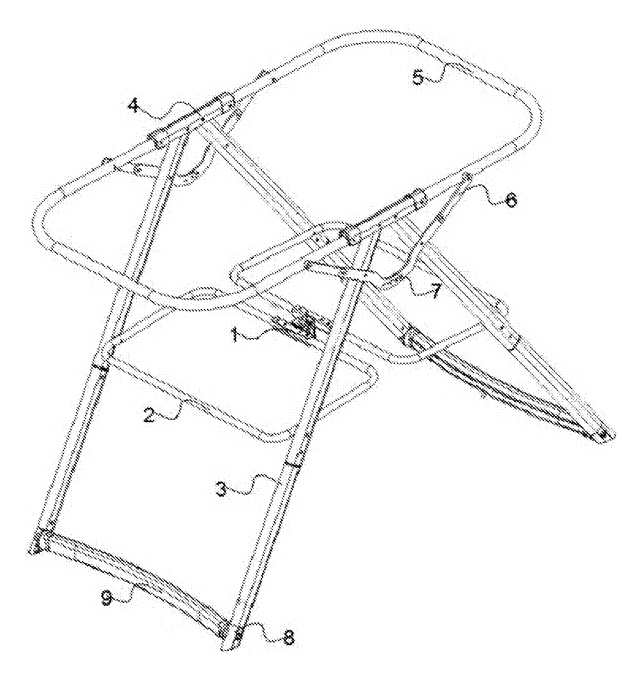
Baby & Kids
Portable Folding Rocking Bassinet Frame
Rocking bassinet frame that folds flat: telescopic hub, folding rails, two-part legs, curved rockers.
Patent CN206910143U
Baby & Kids
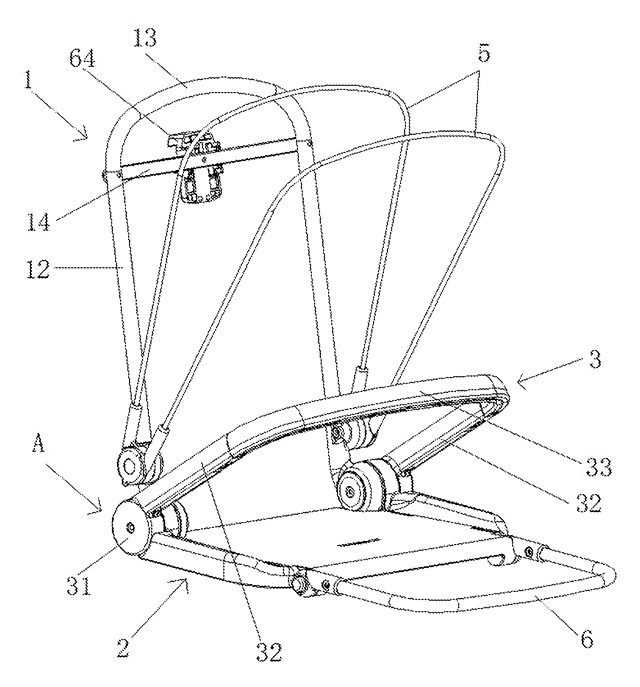
Stroller Seat with Linked Fold-Away Armrest
Stroller seat whose armrest unlocks and folds automatically when the backrest is folded forward.
Patent CN206856772U
Baby & Kids
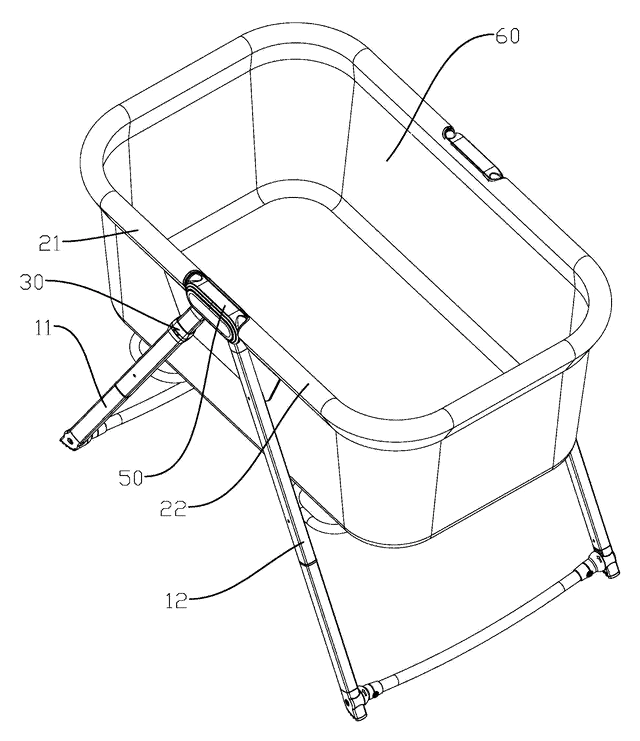
One-Motion Folding Baby Crib with Linked Frame
Portable baby crib whose top rails fold down automatically as the A-frame legs are closed.
Patent CN207202585U
Baby & Kids
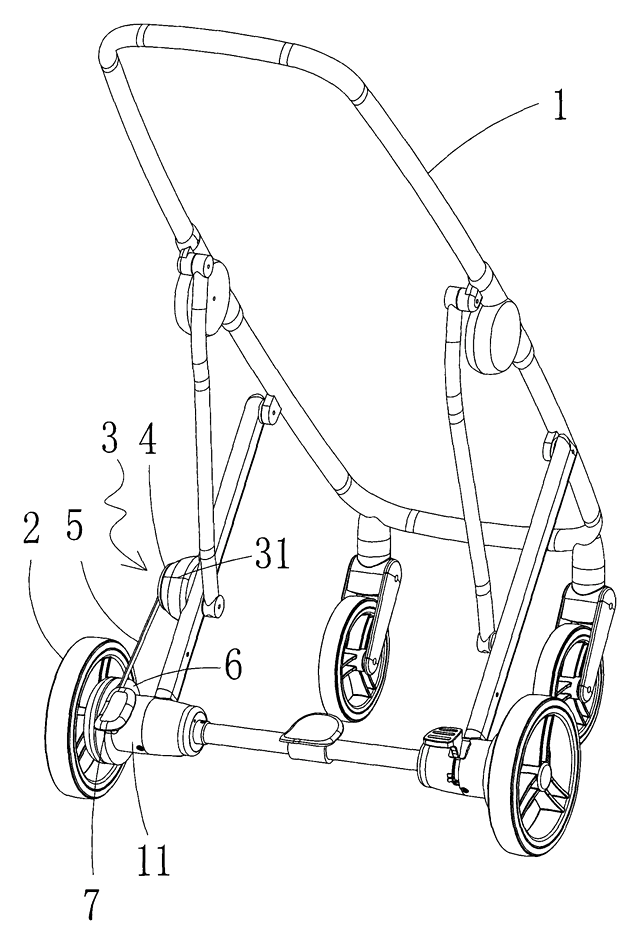
Motorized Rocking Stroller That Rocks by Turning Its Wheels
Baby rocker or stroller whose motor turns the wheels back and forth; a clutch switches to pushing.
Patent CN208119238U
Baby & Kids
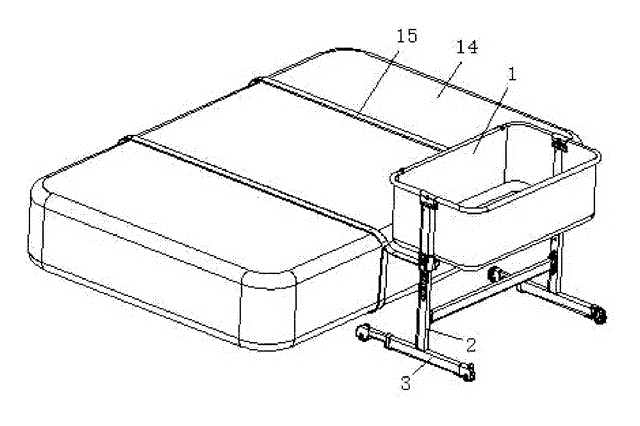
Bedside Crib Base with Spring-Loaded Telescoping Caster Legs
Bedside crib feet with spring-loaded sliding casters: wide when alone, short to sit flush at the bed.
Patent CN207168269U
Baby & Kids
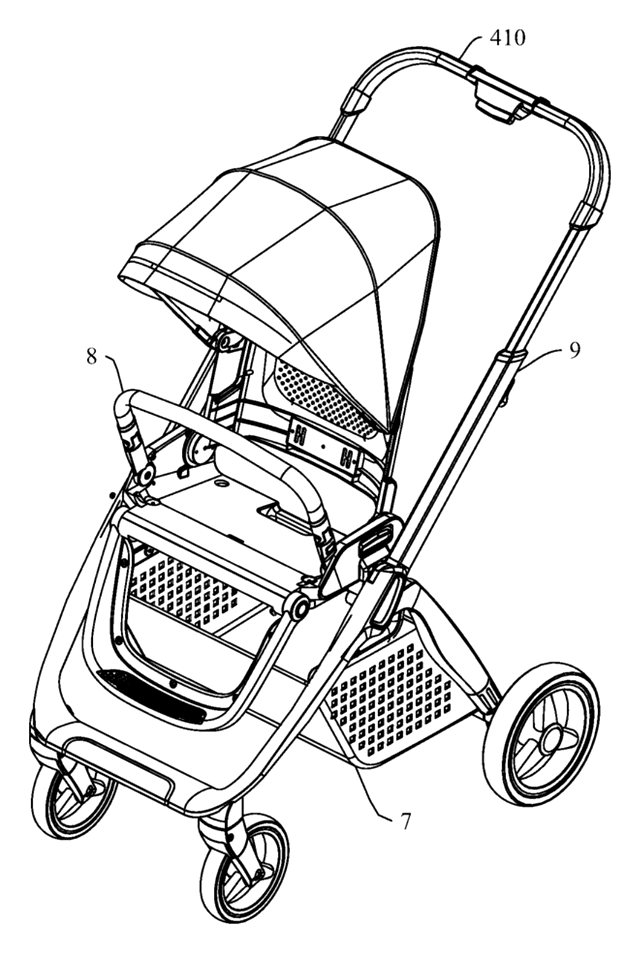
Compact-Fold Stroller with a Four-Bar Side Frame and Telescoping Handle
Stroller with four-bar side frames: handle and rear leg fold onto the front leg, handle telescopes.
Patent CN213799844U
Browse by category
- Apparel & Accessories (22)
- Baby & Kids (16)
- Bags & Luggage (9)
- Bath & Personal Care (16)
- Car Accessories (10)
- Furniture, Bedding & Storage (12)
- Garden & Outdoor (18)
- Health & Wellness (8)
- Home, Kitchen & Cleaning (24)
- Lighting (12)
- Packaging & Containers (6)
- Pet Products (6)
- Phone & Camera Accessories (4)
- Retail Display (13)
- School, Office & Art (19)
- Sports & Recreation (25)
- Tools & Workshop (27)
- Toys & Games (12)
This page is based on the public patent document CN207631319U, assigned to Shanghai Ning Lan Xin Mstar Technology Ltd. IP2M is an independent manufacturing service and is not affiliated with, endorsed by or licensed by the patent owner. Images marked as concept renderings are illustrations, not photos of an existing product. Patent status information is provided for reference only and is not legal advice; confirm freedom to operate for your market before production. Full disclaimer.