At a glance
| Patent number | CN207631319U (application CN201721232137) |
| Type | China utility model (实用新型) - protects product shape and structure |
| Original title | A kind of stroller of climbing stairs (一种可爬楼梯的婴儿推车) |
| Patent owner | Shanghai Ning Lan Xin Mstar Technology Ltd |
| Inventors | Song Yan |
| Filing date | 2017-09-25 |
| Grant date | 2018-07-20 |
| Status (China) | Lapsed - terminated for non-payment of annual fees (recorded 2020-09-15) |
| Patent family | Chinese filings only - no US, European, Japanese, PCT or other filings listed |
| Cited by | 5 later documents |
| Source | Google Patents (search for CN207631319U) |
What the claims cover, in plain language
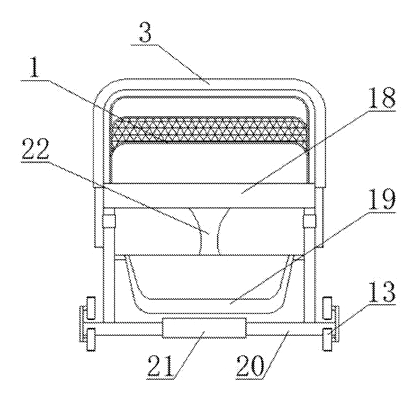
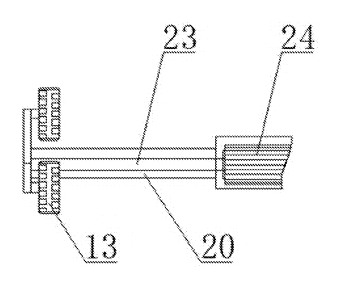
Claim 1 - A stair-climbing stroller comprising a sunshade (1), a front-wheel connecting rod (20), and a transmission shaft (23). The sunshade contains a sunshading awning bracket (2) ending in a sunshade shaft (5). A push rod (3) sits above the shaft, holding a control button (4) at its center and a push rod rotating shaft (7) below its left end. A sitting posture adjusting rod (6) is placed to the right of the rotating shaft, with a storing basket (12) underneath. A cart trailing wheel (10) is at the lower right, mounted on a trailing wheel shaft (9), with a brake button (8) above it and a bradyseism spring (11) to its left. Below the storing basket is a front wheel carrier (14) with a front wheel carrier shaft (15) and cart front-wheels (13) on the outside. A front wheel supporting bar (16) rises from the front wheels to a supporting rod shaft (17) and handrail disk (18). The front-wheel connecting rod mounts to the left of the front wheels, containing a motor casing (21) topped by a foot pedal (19) and safety belt (22). The transmission shaft is inside the connecting rod, linked to a motor (24) that is electrically connected to the control button.
Claim 2 - There are exactly three cart front-wheels (13) distributed around the outside of the front wheel carrier shaft (15). Claim 3 - The sunshading awning bracket (2) and push rod (3) are rotatably connected through the sunshade shaft (5). Claim 4 - The cart front-wheels (13) and motor (24) are sequentially connected through the transmission shaft (23). Claim 5 - The cart trailing wheel (10) and trailing wheel shaft (9) are fixedly connected through the brake button (8).
This is a simplified reading for orientation only. The legal scope is defined by the exact claim wording in the official Chinese document.
What this means for US production
This patent was filed only in China and has lapsed due to non-payment of annual fees, so it no longer restricts anyone in China either. It has no US or other foreign counterpart.
Two points to settle early:
- Other patents may exist. Motorized stair-climbing mechanisms for wheeled carts and baby strollers are covered by various international patents held by different entities, so a freedom-to-operate (FTO) review of the tri-wheel drive system and motor integration is needed before tooling.
- Electrical safety and battery housing. Integrating a motor into a baby stroller requires secure battery enclosures and wiring layouts to prevent pinching, short circuits, or access by children, which must be engineered during the design phase.
Customization and manufacturing
What can be customized
| Area | Options |
|---|---|
| Frame material | Aluminum alloy or steel tubing, thickness set in design |
| Wheel size | Diameter to be confirmed in design based on target step height |
| Motor and battery | Voltage and capacity set in design / confirmed on prototypes |
| Fabric and canopy | Colors, patterns, and materials per brand specification |
| Handle | Height adjustment range, grip material |
| Braking system | Foot-operated or hand-operated parking brake style |
Things to plan for (US market)
- CPSC 16 CFR 1227 / ASTM F833 - Standard Consumer Safety Specification for Carriages and Strollers sold in the US, covering latching, stability, braking, and structural integrity.
- UN 38.3 - Required testing for lithium batteries used to power the motor if the stroller will be shipped via air or ocean freight.
- FCC Part 15 - Applies if the motor controller or any electronic switch emits radio frequency energy.
- California Prop 65 - Plastics, fabrics, and metal finishes must be screened for listed chemicals.
How a project runs
- Inquiry - Define target load capacity, step height, battery life, and quantity.
- Design - Engineer the frame geometry, motor mount, transmission shaft alignment, and electrical routing.
- Prototype - Build samples to test the tri-wheel rotation, motor torque, and spring damping.
- Pilot run - Conduct stability tests, brake holding tests, and battery cycle tests per ASTM F833.
- Production - Tube cutting, welding, powder coating, injection molding for plastic parts, motor assembly, and final quality inspection.
Quantities & timeline
The frame requires welding jigs and bending dies specific to the chosen tube profiles. The triangular front wheel carrier needs custom machining or casting molds, and the motor casing requires injection molds. Certification testing against ASTM F833 and UN 38.3 adds time before volume shipping can begin. Send us your target step height, load capacity, battery requirements, quantity and target price and we will reply with options.
Patent drawings
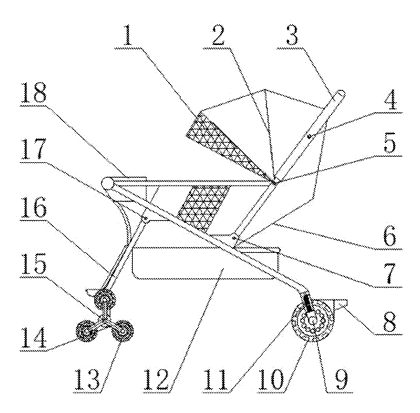
Drawings reproduced from the public patent document for reference.