
Patent CN207729302U
Updated November 8, 2026Touch-Controlled LED Desk Lamp with Integrated Dimming Circuit
Traditional desk lamps require separate switches or remote controls, adding clutter and failure points. This design integrates the switch into the body. The lamp stand is made of conductive metal, such as copper, and serves as the connectivity port. When a user touches the stand, the change in capacitance is detected by the main control chip inside the base. The chip sends a PWM signal to a MOSFET, which rapidly switches the LED current on and off. Short touches toggle power; long touches fade brightness up or down. The system remembers the last brightness level upon restart.
- China utility model - lapsed
- No filings outside China
- Touch-controlled lighting
- PWM dimming, metal stand sensor
Splat! What let you down?
👆
Stand-as-Switch
The conductive metal lamp stand acts as the touch sensor, eliminating external buttons.
🎚️
Smooth PWM Dimming
Pulse-width modulation prevents color shift and allows gradual brightness adjustment.
💾
Memory Function
The controller restores the previous brightness level when the lamp is powered back on.
🔌
Integrated Base
Power supply and control circuits are housed within the weighted pedestal.
Bring this product to market
- ✓ Patent review Patent family and legal status reviewed in the relevant jurisdictions.
- 2 Product brief · now How it works, uses and options written up
- 3 Prototype First samples for buyers to review
- 4 Pilot run Small first batch for launch customers
- 5 Volume production Repeat orders at scale
Buyer interest
– of 100 buyers needed to start prototyping
One click, no sign-up. Each vote is one real visitor, and products with the most interest go to prototyping first.
Build team: no members yet. Need a partner, co-funding or skills to build this? Join and we introduce the team once it forms.
Patent Rights & Team Participation
Before joining a development team, participants should ensure they have the necessary rights or authorization to participate in the project.
Participation is generally appropriate where:
- You own the relevant patent rights or have obtained permission or a license from the rights holder.
- The relevant patent rights have expired or have been legally invalidated in the jurisdictions where the planned activities will take place.
- The planned development, manufacturing, and commercialization activities have been independently assessed and do not infringe applicable patent rights in the relevant jurisdictions.
Important: Being located outside a country where a patent is protected does not automatically exempt you from patent infringement risks. Patent rights may apply based on where development, manufacturing, use, sale, or import activities take place.
IP2M does not grant any patent license or authorization through team participation. Joining a project does not provide permission to use, manufacture, or commercialize patented technology.
The problem
Standard desk lamps often rely on mechanical push-buttons, rotary knobs, or separate remote controls. Mechanical switches wear out over time and can feel stiff. Remote controls are easily lost and require battery replacements. Additionally, many basic LED lamps use simple on/off drivers or poor-quality dimmers that cause flickering or noticeable color shifts (chromaticity drift) as the brightness decreases. Users want a clean aesthetic with intuitive control that does not compromise light quality.
The solution
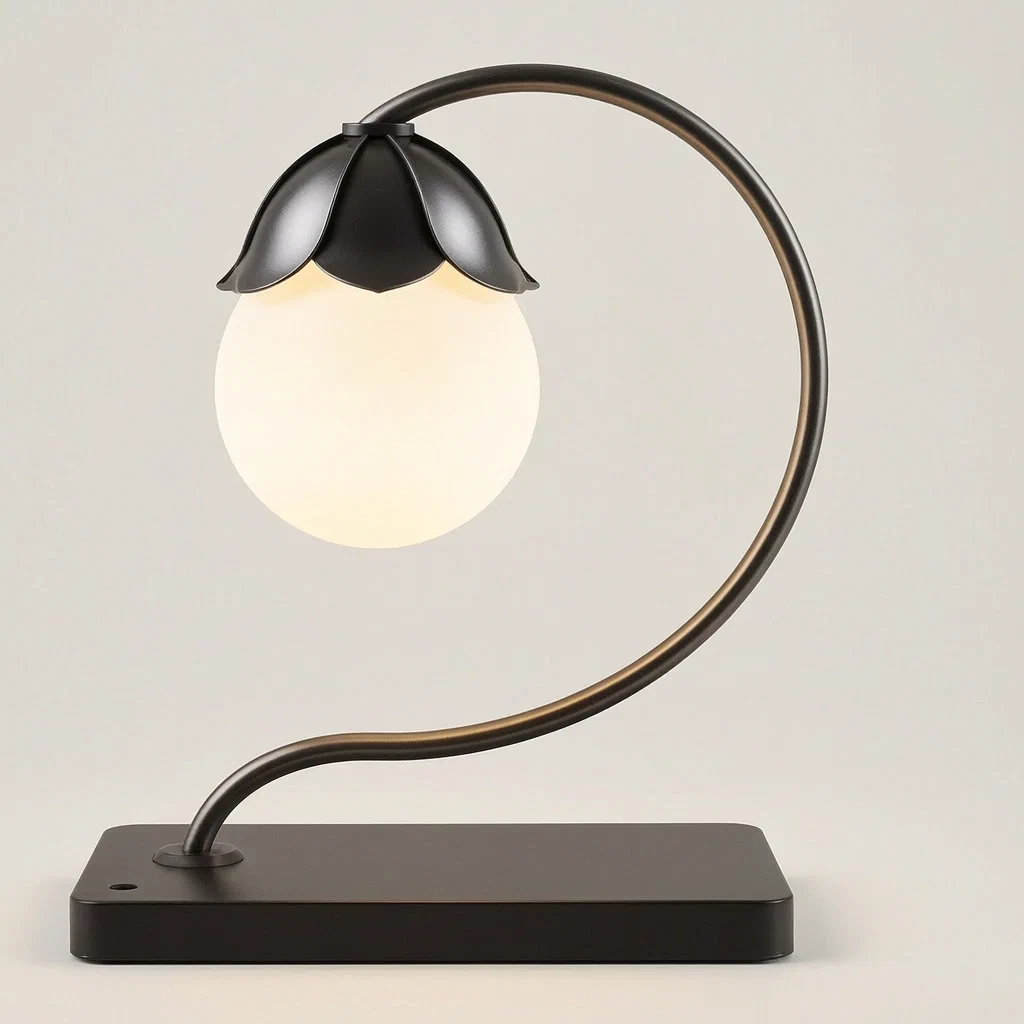
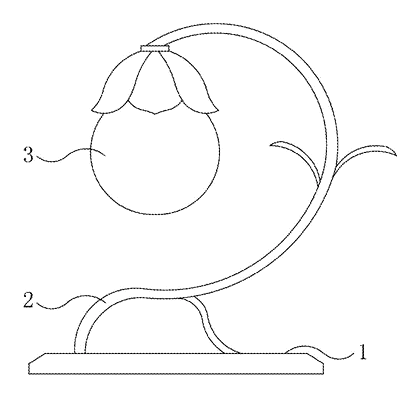
This patent describes a desk lamp where the structural element—the lamp stand—doubles as the user interface. The assembly includes a control pedestal (1) at the bottom, a lamp stand (2) extending upward, and a light bulb (3) at the top.
- The lamp stand (2) is constructed from conductive metal material, such as copper. It contains internal connectivity ports (TP) that connect to the electronics in the base.
- The control pedestal (1) houses a lamp dimmer consisting of a power supply circuit and an adjusting circuit.
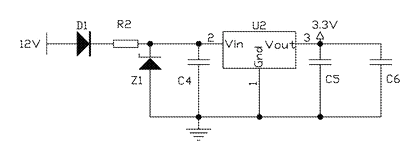
- The power supply circuit accepts a standard input voltage (described as about 12 V nominal, but operable between about 5 V and 24 V) and stabilizes it to about 3.3 V using a voltage regulator chip (U2, described as HT7533).
- The adjusting circuit uses a main control chip (U1, described as D1582) to detect capacitive signals from the metal stand.
- When the user touches the stand, the chip processes the signal and outputs a Pulse Width Modulation (PWM) signal.
- This PWM signal drives a MOSFET (Q1), which switches the current to the LED light source inside the bulb on and off rapidly.
- The fast switching controls the average power delivered to the LEDs, resulting in smooth dimming without significant color temperature shift.
Who it is for
- Home Office Brands: Companies looking for minimalist desk lighting solutions that reduce part count by removing physical switches.
- Study & Reading Niche Sellers: Amazon sellers targeting students who need adjustable brightness for different tasks (reading vs. ambient background).
- Interior Design Suppliers: Wholesalers providing sleek, button-free lighting fixtures for modern decor where visual clutter is undesirable.
- OEM Manufacturers: Factories producing small consumer electronics that can leverage this integrated PCB-to-stand connection method to simplify assembly lines.
How it works
The main parts
| No. | Part | What it does |
|---|---|---|
| 1 | Control Pedestal | Houses the power supply and control PCBs. Provides stability. |
| 2 | Lamp Stand | Conductive metal rod. Acts as the touch sensor electrode. Contains connectivity ports (TP). |
| 3 | Light Bulb | Contains the LED light source. Electrically connected to the top of the stand. |
| U1 | Main Control Chip | Detects touch capacitance. Generates PWM signals based on touch duration. |
| U2 | Voltage Stabilizing Chip | Regulates input voltage to 3.3V for the logic circuit. |
| Q1 | MOSFET | Power switch controlled by PWM to drive the LED array. |
Operating Logic
The system distinguishes user intent based on how long the metal stand is touched:
- Short Touch (< 550ms): Toggles the lamp ON or OFF.
- Long Touch (> 550ms): Enters dimming mode.
- If currently ON, holding the touch gradually increases brightness.
- Releasing stops the increase at the current level.
- Holding again reverses the direction (decreases brightness).
- Limits: Brightness caps at maximum or minimum levels automatically.
- Memory: Upon power loss and restoration, the lamp returns to the last set brightness level.
Applications
Home Office Workstations
Workers spend hours at desks where changing light intensity reduces eye strain during screen work versus document reading. The touch stand allows quick adjustments without reaching for a side switch, maintaining workflow focus.
Student Study Areas
Students often study late at night while others sleep. The ability to dim the light to a low level (the patent describes a minimum of about five percent) provides just enough illumination for textbooks without disturbing roommates, while the memory function recalls their preferred setting next day.
Bedside Night Lamps
In bedrooms, users may wake up disoriented. A single short touch turns the light on at a remembered low level, avoiding the harsh glare of a full-brightness startup. The absence of clicking mechanical switches ensures silent operation.
Retail Display Lighting
Small retail displays benefit from uniform, adjustable lighting to highlight products. The clean look of a switch-less lamp enhances the display aesthetic, and PWM dimming ensures product colors remain accurate across brightness levels.
Where it is less suitable
- High-Humidity Environments: While the patent does not specify IP ratings, exposed conductive stands in bathrooms or kitchens may pose safety risks if not properly insulated or certified for damp locations.
- Industrial Settings: The lightweight plastic/metal construction typical of desk lamps is not designed for vibration resistance or heavy-duty impact protection required in workshops.
Patent & Production
At a glance
| Patent number | CN207729302U (application CN201721547117) |
| Type | China utility model (实用新型) - protects product shape and structure |
| Original title | Desk Lamp Using Adjustable Light Controller (一种应用可调节灯光控制器的台灯) |
| Patent owner | Individual |
| Inventors | Li Peisen |
| Filing date | 2017-11-20 |
| Grant date | 2018-08-14 |
| Status (China) | Lapsed - terminated for non-payment of annual fees (recorded 2022-11-01) |
| Patent family | Public record shows Chinese filings only - no US, European, Japanese, PCT or other filings listed |
| Cited by | 2 later documents |
| Source | Google Patents (search for CN207729302U) |
What the claims cover, in plain language
Claim 1 defines a desk lamp comprising a control pedestal (1), a lamp stand (2), and a light bulb (3). The bulb connects to the top of the stand, and the pedestal to the bottom. Key features include: the stand is made of metal; the pedestal contains a lamp dimmer; the stand has internal connectivity ports (TP); and the bulb contains an LED light source.
Claim 2 specifies the dimmer includes a power supply circuit and an adjusting circuit, where the power supply provides operating voltage to the adjusting circuit.
Claim 3 details the power supply circuit components: a voltage stabilizing chip (U2), zener diode, diode, resistors, and capacitors arranged to output 3.3V.
Claim 4 details the adjusting circuit: a main control chip (U1), a MOSFET (Q1), and associated passive components. The chip receives signals from the connectivity ports (TP) and drives the MOSFET, which controls the LED light source.
This is a simplified reading for orientation only. The legal scope is defined by the exact claim wording in the official Chinese document.
What this means for US production
This patent was filed in China and is now lapsed due to non-payment of fees. The public record shows no US or other foreign counterpart.
Two points to settle early:
- Other patents may exist. Touch-control lighting and PWM driver circuits are widely patented fields. Major lighting manufacturers hold numerous patents on specific touch algorithms, capacitive sensing methods, and driver IC designs. A freedom-to-operate (FTO) review is essential before mass production to ensure your specific implementation of the touch stand and PWM logic does not infringe on active US patents.
- Safety Standards. Electrical products sold in the US must meet strict safety standards regarding insulation, grounding, and component ratings, regardless of the patent’s status.
Customization and manufacturing
What can be customized
| Area | Options |
|---|---|
| Stand Material | Copper, aluminum, or steel alloys (must be conductive for touch sensing). |
| Finish | Anodized, painted, brushed, or polished metal finishes. |
| PCB Layout | Component placement can vary based on available space in the pedestal. |
| LED Module | Color temperature (2700K-6500K), CRI, and beam angle. |
| Input Voltage | Patent supports 5V-24V range; adapters can be customized. |
| Base Weight | Adjusted to prevent tipping given the height of the stand. |
Things to plan for (US market)
- UL 153 / FCC Part 15: Lighting fixtures must meet electrical safety standards (UL/ETL) and electromagnetic compatibility (FCC) requirements.
- California Title 20: Energy efficiency regulations apply to portable luminaires sold in California.
- Prop 65: Materials used in plastics and metals must be screened for hazardous substances.
- RoHS/REACH: Compliance with substance restrictions is standard for global supply chains.
How a project runs
- Inquiry - Define target brightness, color temperature, and aesthetic style.
- Design - Finalize PCB layout for the touch algorithm and select appropriate MOSFET/driver ICs.
- Prototype - Build functional samples with 3D-printed housings and off-the-shelf drivers to test touch sensitivity.
- Pilot Run - Validate thermal performance and EMI shielding.
- Production - Injection molding of bases, die-casting/extrusion of stands, PCB assembly, and final assembly.
Quantities & timeline
Tooling for injection-molded pedestals and custom extruded or cast stands requires upfront investment. PCB assembly is typically outsourced to specialized EMS providers. Certification testing (UL/FCC) takes several weeks. Send us your target specifications, quantity, and timeline and we will reply with options.
Production notes
Tooling and process
Injection molding is likely required for the control pedestal housing. The metal stand may be produced via extrusion or die-cast aluminum depending on the desired profile. PCB assembly involves surface-mount technology for the control chips and MOSFETs.
Cost drivers
Driver quality and heat sink size are significant cost factors. LED count and binning affect light consistency. Complex PCB layouts with specific touch-sensing components may increase assembly costs compared to simple mechanical switches.
Prototyping path
Initial prototypes typically use 3D-printed housings and off-the-shelf drivers to validate the touch functionality. Thermal tests are critical to ensure the MOSFET and LEDs do not overheat within the enclosed base.
What we would change before tooling
We would optimize the PCB footprint to fit smaller bases. Ensuring proper strain relief for wires connecting the stand to the base is crucial to prevent failures during assembly and shipping.
Common failure points
Heat buildup in the base can shorten component life. Flicker at low dimming levels is a common issue with poorly tuned PWM frequencies. Water ingress at seals could damage the exposed conductivity of the stand if not properly isolated.
Patent drawings
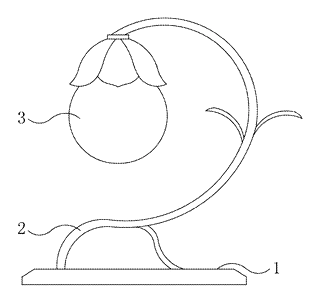
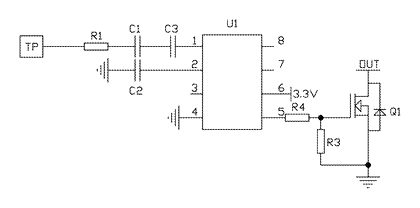
Drawings reproduced from the public patent document for reference.
Frequently asked questions
How does the touch control work?
The lamp stand is made of conductive metal. When you touch it, your body adds capacitance to the system. A chip in the base detects this change. Short touches turn the lamp on or off. Long touches gradually increase or decrease the brightness.
Does the light flicker when dimmed?
The patent describes using Pulse Width Modulation (PWM) at a frequency of 20kHz. This high frequency is generally above the threshold for human perception, so visible flicker is minimized. It also helps prevent color shifting (chromaticity drift) that occurs in some lower-quality dimmers.
What is the power input?
The circuit is designed to accept a range of voltages. The patent mentions a standard 12V input but notes the device can operate within a 5V to 24V range. This allows flexibility in choosing power adapters.
Can I customize the color temperature?
Yes. The patent specifies an LED light source but does not restrict its color. You can choose warm white, cool white, or tunable white LEDs depending on your market needs. The dimming circuit adjusts intensity, not hue.
Is the metal stand safe to touch?
The stand acts as a sensor electrode. In typical low-voltage DC applications (like 12V), the risk of shock is minimal. However, final products must comply with US safety standards (such as UL 153) which dictate insulation and creepage distances. We recommend working with a certified lab for safety validation.
Does it remember my settings?
Yes. The patent describes a “memory pattern.” If the lamp is turned off and then turned back on, it resumes at the same brightness level it was at before being switched off.
Can this design be made and sold in the US?
The patent was filed in China and is currently lapsed. The public record shows no US counterpart. Therefore, this specific patent document does not restrict manufacturing or selling in the US. However, touch-control lighting is a crowded field with many active US patents held by other companies. A freedom-to-operate (FTO) search is strongly recommended to avoid infringement of other intellectual property rights.
Are you affiliated with the patent owner?
No. IP2M is an independent design and manufacturing service working from the public patent document.
Request a quote
Click Request a Quote below to see our email address - copy it, or open your email app with a ready-made message. Please mention patent CN207729302U in the subject.
Helpful details to include:
- Your company and channel (home office brand, student supplies, retail chain)
- Target specifications (lumens, color temp, finish)
- Quantity estimates
- Timeline for samples and first order
You can also reach us at (332) 203-9997.
Page editor: Daniel Chen, Product Research Editor · IP2M
Last updated November 8, 2026. If something on this page looks wrong, email [email protected] and we will check it against the patent.
Interested in building this?
Tell us your target market, quantity and timeline. We reply with options for prototyping, small-batch runs or volume production.
Send your inquiry to
Please put CN207729302U in the subject line and tell us your company, country, estimated quantity and timeline.
Prefer to talk? Call (332) 203-9997.
More product-ready patents
All Lighting patents →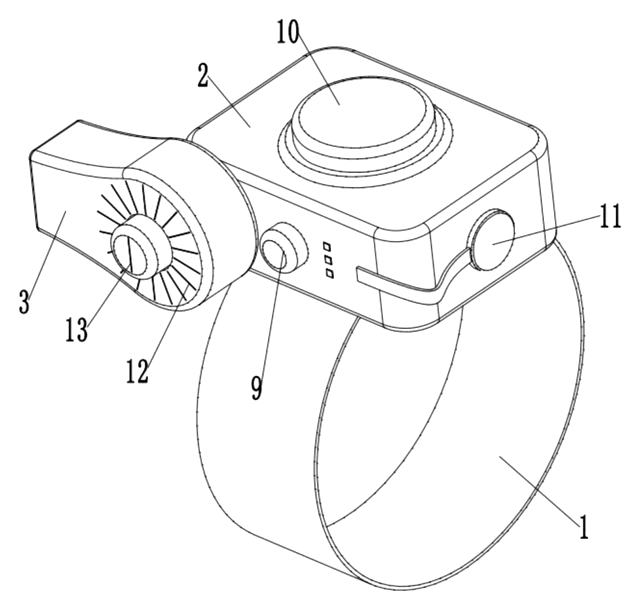
Lighting
Wrist-Worn Flashlight with Click-Lock Angle Adjustment
Rechargeable wrist flashlight whose lamp turns and locks at an angle with a push button.
Patent CN113915544B
Lighting
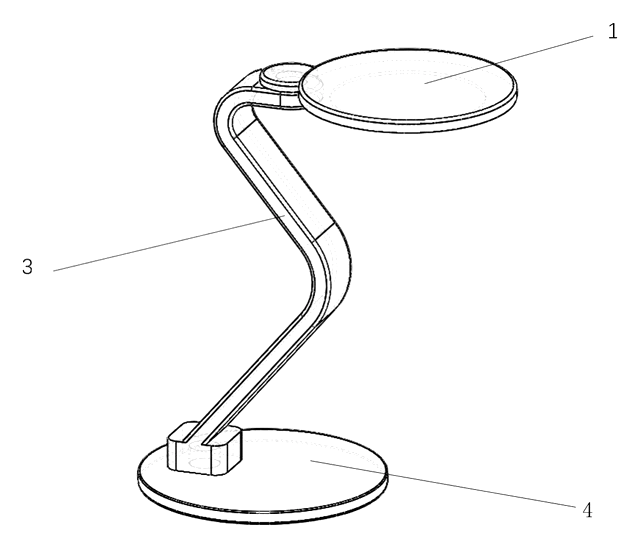
Self-Folding Desk Lamp That Turns into a Phone Stand
Desk lamp with a shape-memory stem that unfolds when warm and folds into a phone stand.
Patent CN213237087U
Lighting
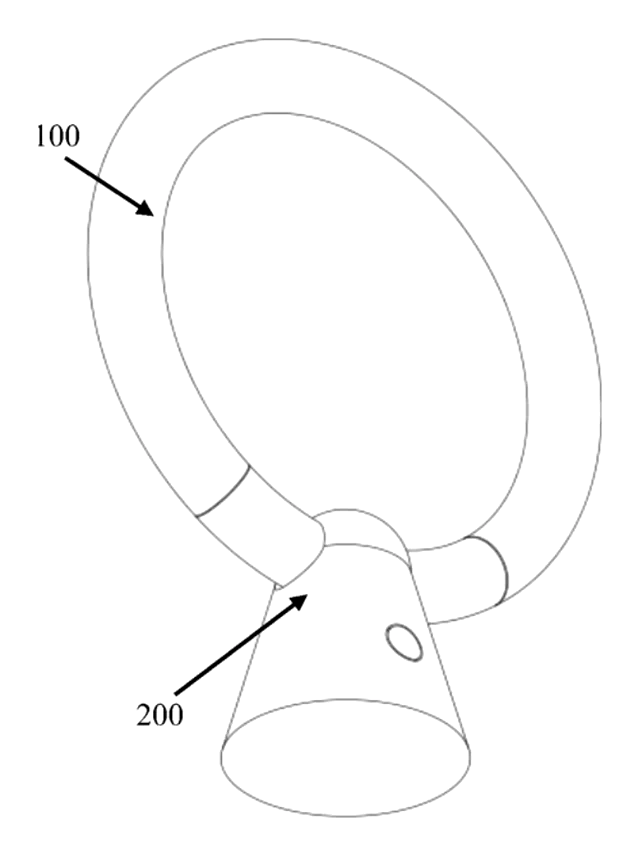
Ring-Shaped Outdoor Lantern That Lifts Off a Power-Bank Charging Base
Ring lantern with a battery handle that docks in a cone base with its own battery, clamp and charging plug.
Patent CN212408329U
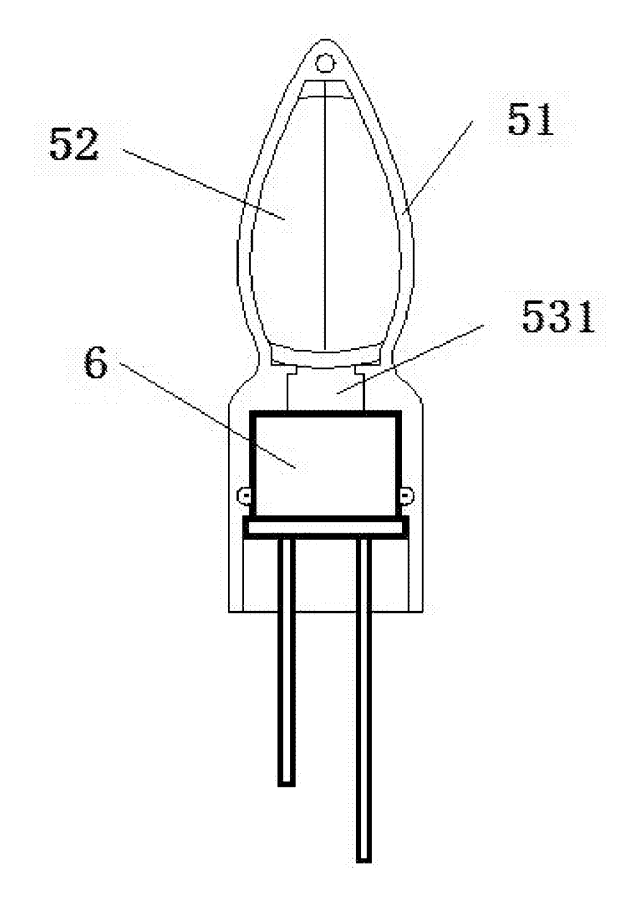
Lighting
LED Flameless Candle with an Outside Flame Shade and Wax Dish Top
Battery LED candle: flame shade stands above a dished wax top, angled LEDs light a printed wick.
Patent CN205424561U
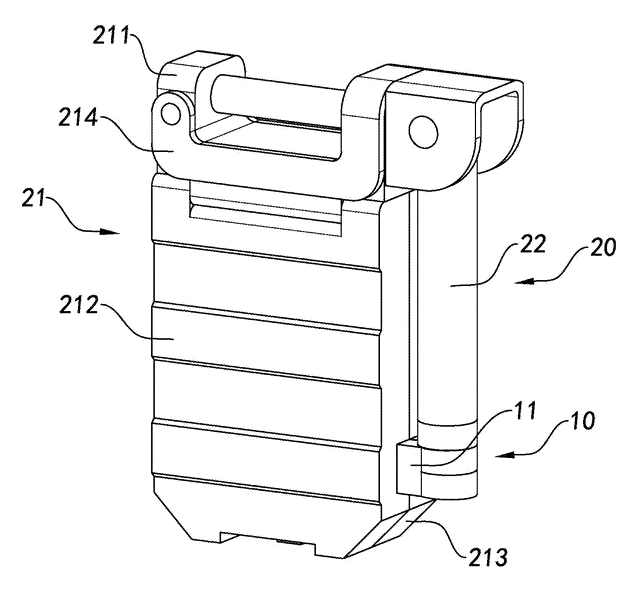
Lighting
Telescoping Tripod Portable Work Light with Fold-In Light Panels
Telescoping tripod work light with dual light panels that fold flat into the base.
Patent CN207298471U
Lighting
Self-Cooling and Self-Cleaning LED Street Light with Rainwater Harvesting
LED street lamp that harvests rain to cool its heat sink and spray-wash the lens automatically.
Patent CN205480639U
Browse by category
- Apparel & Accessories (50)
- Baby & Kids (29)
- Bags & Luggage (17)
- Bath & Personal Care (33)
- Car Accessories (26)
- Furniture, Bedding & Storage (25)
- Garden & Outdoor (34)
- Health & Wellness (14)
- Home, Kitchen & Cleaning (52)
- Lighting (24)
- Packaging & Containers (13)
- Pet Products (12)
- Phone & Camera Accessories (9)
- Retail Display (26)
- School, Office & Art (38)
- Sports & Recreation (48)
- Tools & Workshop (56)
- Toys & Games (23)
This page is based on the public patent document CN207729302U, assigned to Individual. IP2M is an independent manufacturing service and is not affiliated with, endorsed by or licensed by the patent owner. Images marked as concept renderings are illustrations, not photos of an existing product. Patent status information is provided for reference only and is not legal advice; confirm freedom to operate for your market before production. Full disclaimer.