
Patent CN207884908U
Updated November 3, 2026Hair Dryer Ceramic Thick Film Heater with Double Insulation and Vacuum Layer
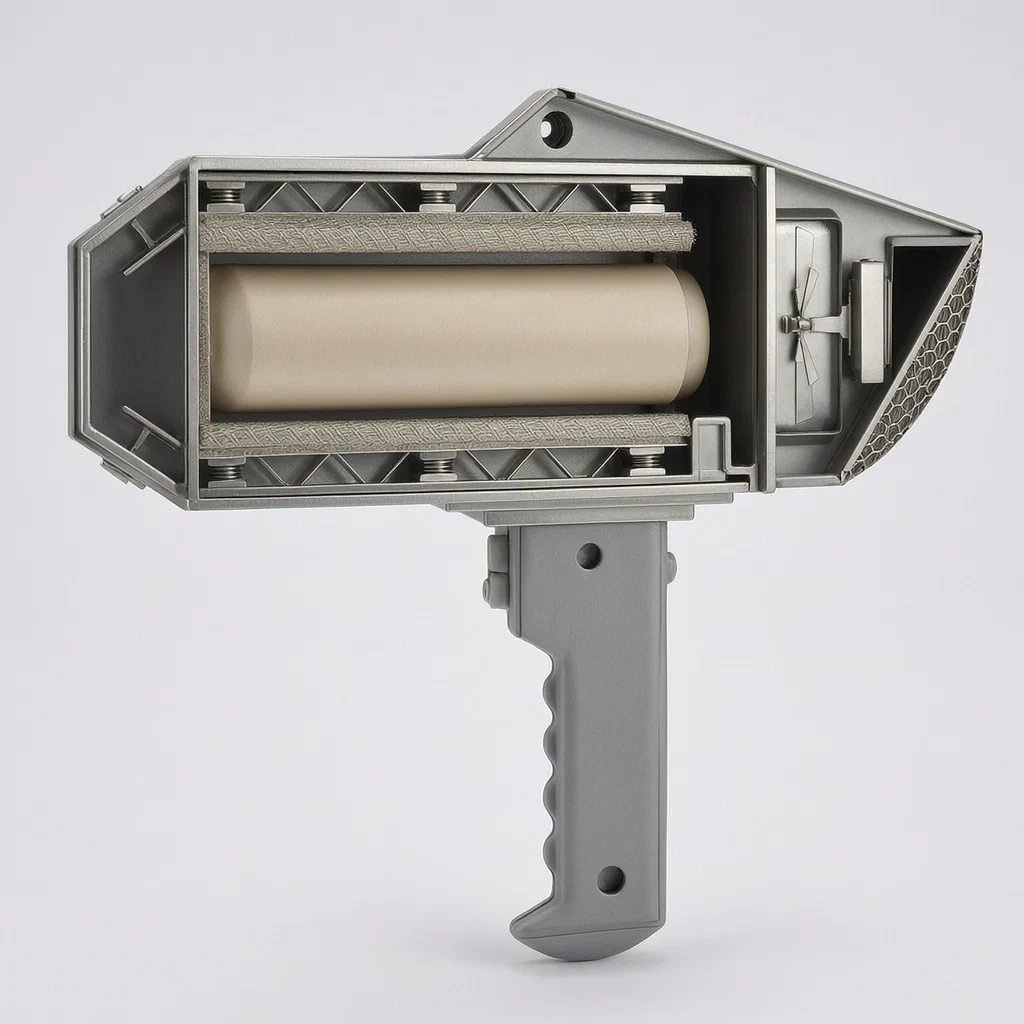
Standard hair dryer heaters often run hot on the outside or lack precise airflow control. This design uses two ceramic thick-film pipes: the inner one heats the air passing through it, while the outer one, backed by an asbestos mesh, blocks heat from reaching the device's casing. A vacuum layer inside the shell prevents electrical conduction issues. The heater is held by damping springs to resist shock, and hinged baffles on rails let users adjust the exit angle of the warm air stream.
- China utility model - lapsed
- No filings outside China
- Hair dryer heating elements
- Ceramic thick film, asbestos mesh, vacuum layer
Splat! What let you down?
🔥
Double Ceramic Pipes
Inner pipe heats; outer pipe shields heat from the casing.
🛡️
Asbestos & Vacuum Insulation
Mesh and vacuum layer block heat and prevent electrical conduction.
🎚️
Adjustable Airflow
Sliding baffles change the angle of the exiting warm air.
⚙️
Damped Mounting
Springs hold the heater steady against drops and vibration.
Bring this product to market
- ✓ Patent vetted China-only family and legal status checked
- 2 Product brief · now How it works, uses and options written up
- 3 Prototype First samples for buyers to review
- 4 Pilot run Small first batch for launch customers
- 5 Volume production Repeat orders at scale
Buyer interest
– of 100 buyers needed to start prototyping
One click, no sign-up. Each vote is one real visitor, and products with the most interest go to prototyping first.
Build team: no members yet. Need a partner, co-funding or skills to build this? Join and we introduce the team once it forms.
The problem
In many hair dryers, the heating element transfers significant heat to the outer plastic or metal casing, making the handle or body uncomfortably warm during prolonged use. Additionally, standard fixed-position outlets limit how the user can direct the airflow, requiring awkward wrist angles to style specific sections of hair. There is also a risk of electrical conduction within the housing if insulation fails, and mechanical shocks from dropping the device can damage brittle ceramic heating components.
The solution
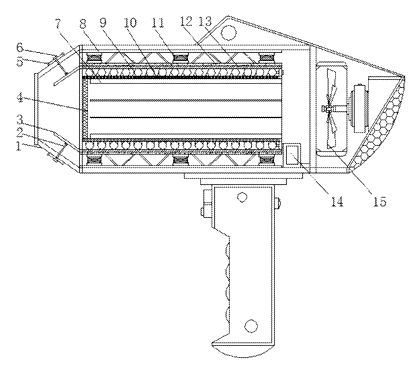
- Dual Ceramic Structure: An inner ceramic thick film pipe (10) houses evenly arranged heating tubes (9) on its exterior wall and heat-conducting plates (7) on its interior wall. An outer ceramic thick film pipe (13) surrounds this assembly.
- Thermal Shielding: Between the outer pipe and the main shell (1), an asbestos gauge (12) is placed to thoroughly insulate the device, preventing the external temperature from becoming excessively high and damaging the operator.
- Electrical Safety: A vacuum layer (8) is formed in the internal side wall of the shell to electrically isolate the heating components.
- Vibration Protection: The asbestos gauge is held in place by symmetrically arranged damping springs (11), which connect to the gauge and absorb shocks from drops or movement.
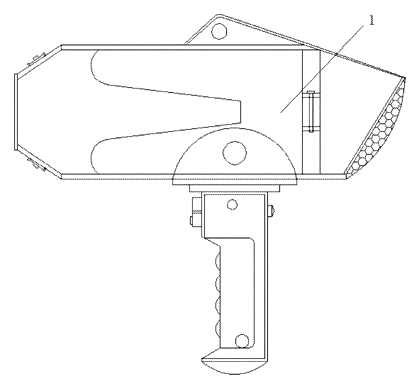
- Airflow Control: At the outlet end, baffles (3) are hinged to hinge bars (2). These bars connect to sliding blocks (6) that move along sliding rails (5) mounted on the shell’s exterior, allowing the user to adjust the angle of the air exit.
- Power Regulation: A constant-voltage controller (14) regulates power to the heating tubes, ensuring stable operation.
Who it is for
- Personal care appliance manufacturers looking for heater assemblies that reduce casing heat rise without adding bulky external guards.
- Salon equipment brands needing durable components that withstand frequent handling and accidental drops better than rigidly mounted ceramics.
- Consumer electronics designers seeking adjustable airflow features directly integrated into the heating module rather than relying solely on nozzle attachments.
- OEM suppliers who want a standardized heating unit with built-in safety layers (vacuum and asbestos) to simplify compliance testing.
How it works
The main parts
| No. | Part | What it does |
|---|---|---|
| 1 | Shell | Main housing containing the vacuum layer and mounting points. |
| 10 | Inner ceramic pipe | Core heating zone with aluminum oxide material for conductivity. |
| 9 | Heating tubes | Embedded in the outer wall of the inner pipe; generate heat. |
| 7 | Heat-conducting plates | Inside the inner pipe; spread heat to the air flowing through. |
| 13 | Outer ceramic pipe | Surrounds the inner pipe; acts as a first thermal barrier. |
| 12 | Asbestos gauge | Mesh layer outside the outer pipe; final thermal insulation. |
| 11 | Damping springs | Hold the asbestos gauge; absorb mechanical shock. |
| 8 | Vacuum layer | In the shell wall; provides electrical insulation. |
| 3, 5, 6 | Baffle system | Sliding rails and hinged baffles adjust the exit air angle. |
| 14 | Controller | Constant-voltage regulator connected to heating tubes. |
| 15 | Wind turbine | Fan located near the inlet to draw air through the heater. |
Operating steps
- Power On: The constant-voltage controller (14) activates the heating tubes (9) wrapped around the inner ceramic pipe (10).
- Heat Transfer: Heat radiates outward to the outer ceramic pipe (13) but is primarily conducted inward to the heat-conducting plates (7). The wind turbine (15) pushes air through the inner pipe, where it absorbs heat from the plates.
- Insulation Action: The outer ceramic pipe (13) and the asbestos gauge (12) block residual heat from escaping toward the shell (1). The vacuum layer (8) ensures no electrical leakage occurs between the hot components and the housing.
- Airflow Adjustment: The user slides the blocks (6) along the rails (5). This moves the hinge bars (2), tilting the baffles (3) at the outlet to direct the warm air stream up or down.
- Shock Absorption: If the device is dropped, the damping springs (11) compress, protecting the brittle ceramic pipes and asbestos mesh from cracking.
Applications
Professional Salon Styling
Stylists need precise control over airflow direction when drying different sections of hair. The sliding baffle system allows quick adjustments without changing hand position, improving efficiency during busy salon hours.
Home Consumer Dryers
For daily home use, the double-insulation structure keeps the handle and body cool to the touch, reducing discomfort during long drying sessions. The vacuum layer adds a safety margin against electrical faults common in humid bathroom environments.
Travel-Size Appliances
Compact hair dryers often suffer from heat buildup due to tight component packing. This heater’s self-contained insulation layers (ceramic + asbestos) allow for a smaller overall footprint while maintaining safe external surface temperatures.
High-Humidity Environments
In bathrooms where steam is prevalent, the vacuum layer provides robust electrical isolation. This reduces the risk of short circuits compared to designs relying solely on air gaps or plastic barriers.
Where it is less suitable
- Ultra-lightweight models: The addition of multiple ceramic pipes, asbestos mesh, and metal springs increases weight compared to simple wire-mesh heaters.
- Low-cost disposable units: The complex assembly of sliding rails and hinged baffles requires more manufacturing steps than basic fixed-nozzle designs.
- High-temp industrial tools: While designed for hair dryers, the specific materials and voltage controls may not suit higher-power industrial heat guns.
Frequently asked questions
Why does the patent mention asbestos? Is it usable today?
The original patent describes an “asbestos gauge” for insulation. However, asbestos is banned or heavily restricted in most markets, including the US. For modern production, you must replace this with compliant materials like fiberglass, silica cloth, or ceramic fiber paper that offer similar thermal resistance.
How does the double ceramic pipe work?
The inner pipe carries the heating elements and conducts heat to the air passing through it. The outer pipe acts as a thermal shield, keeping the heat contained near the core so the outer casing stays cooler. This two-layer approach improves energy efficiency and user comfort.
Can the airflow angle really be adjusted?
Yes. The design includes sliding rails and hinged baffles at the outlet. By moving the sliders, the user changes the tilt of the baffles, directing the warm air stream up or down. This is useful for styling without constantly rotating the entire dryer.
How durable is the heater against drops?
The assembly uses damping springs to hold the insulation layers. These springs absorb shock from accidental drops, protecting the brittle ceramic pipes from cracking. The patent specifies symmetrical placement of these springs to maintain stability.
What is the role of the vacuum layer?
The vacuum layer is integrated into the shell’s inner wall. Its primary purpose is electrical insulation, preventing current leakage from the high-voltage heating components to the outer casing. It also contributes slightly to thermal isolation.
Does it have a filter?
Yes, Claim 5 mentions an air filter at the inlet end of the inner ceramic pipe. This prevents hair clippings and dust from entering the heating chamber, which could cause burning smells or fire hazards.
Can this design be made and sold in the US?
The patent was filed only in China and has lapsed, so it does not restrict the design in the US or in China. However, hair dryer technology is crowded with active patents. You must conduct a freedom-to-operate check and ensure all materials (especially insulation) comply with US EPA and CPSC regulations.
Are you affiliated with the patent owner?
No. IP2M is an independent design and manufacturing service working from the public patent document.
Request a quote
Click Request a Quote below to see our email address - copy it, or open your email app with a ready-made message. Please mention patent CN207884908U in the subject.
Helpful details to include:
- Your company and channel (appliance brand, OEM manufacturer, retail private label)
- Target wattage and voltage (e.g., 120V, 1875W)
- Dimensions of the existing housing or desired form factor
- Insulation preference (fiberglass, mica, etc.)
- Features needed (adjustable baffles, digital temp control)
- Estimated quantity and target price
- Timeline - when you would like samples and the first shipment
You can also reach us at (332) 203-9997.
Explore this product
Interested in building this?
Tell us your target market, quantity and timeline. We reply with options for prototyping, small-batch runs or volume production.
Send your inquiry to
Please put CN207884908U in the subject line and tell us your company, country, estimated quantity and timeline.
Prefer to talk? Call (332) 203-9997.
More product-ready patents
All Bath & Personal Care patents →
Bath & Personal Care
Foot-Pedal Soap & Sanitizer Dispenser Stand
Hands-free, battery-free dispenser stand - step on a pedal to press the pump of any soap or sanitizer bottle.
Patent CN207461995U
Bath & Personal Care
Ear-Shaped Mask Strap Guard with Tension Adjuster
Ear-shaped silicone guard and strap-length adjuster that make ear-loop masks comfortable to wear for long hours.
Patent CN205456233U
Bath & Personal Care
Adjustable-Length Back Scrubber Strap with Push-Button Handles
Back-scrubber strap with push-button handles that set its length and a spring that keeps it taut.
Patent CN207041452U
Bath & Personal Care
Angled-Plate Hair Straightener
Flat iron with plates twisted 45-75° to the handle, a curling groove and rubber-capped tips.
Patent CN206137462U
Bath & Personal Care
Refillable Lipstick Case with Sealed Snap-In Refill Pods
Reusable twist-up lipstick case; sealed refill pods unlock at the top of the stroke for shade swaps.
Patent CN206909979U
Bath & Personal Care
Quick-Release Toilet Seat Hinge with a Push-Button Two-Strip Latch
Toilet seat hinge: drop the shaft onto a grooved post to lock; one push parks the latch open to lift it off.
Patent CN210370292U
Browse by category
- Apparel & Accessories (31)
- Baby & Kids (23)
- Bags & Luggage (14)
- Bath & Personal Care (23)
- Car Accessories (19)
- Furniture, Bedding & Storage (17)
- Garden & Outdoor (25)
- Health & Wellness (11)
- Home, Kitchen & Cleaning (36)
- Lighting (18)
- Packaging & Containers (9)
- Pet Products (8)
- Phone & Camera Accessories (7)
- Retail Display (19)
- School, Office & Art (27)
- Sports & Recreation (33)
- Tools & Workshop (41)
- Toys & Games (18)
This page is based on the public patent document CN207884908U, assigned to Shenzhen Aite Jia Technology Co Ltd. IP2M is an independent manufacturing service and is not affiliated with, endorsed by or licensed by the patent owner. Images marked as concept renderings are illustrations, not photos of an existing product. Patent status information is provided for reference only and is not legal advice; confirm freedom to operate for your market before production. Full disclaimer.