At a glance
| Patent number | CN208017763U (application CN201720799196) |
| Type | China utility model (实用新型) - protects product shape and structure |
| Original title | Nasal cavity cleaning device (一种鼻腔清洗装置) |
| Patent owner | Xinhai Star Technology (Dalian) Co., Ltd. |
| Inventor | Tan Jian |
| Filing date | 2017-07-03 |
| Grant date | 2018-10-30 |
| Status (China) | In force - no termination recorded; a China utility model lasts at most 10 years from filing (to 2027-07-03) |
| Patent family | Chinese filings only - no US, European, Japanese, PCT or other filings listed |
| Cited by | 5 later documents |
| Source | Google Patents (search for CN208017763U) |
What the claims cover, in plain language
Claim 1 - a nasal cleaning device with a hood that has a water baffle at the bottom and an inlet tube and outlet tube through its wall. Inside the hood the inlet tube connects to a first hose ending in a sponge-ball nose plug; outside, via connectors and a second hose, to a rinse syringe. The outlet tube connects by a conduit to a collection bottle, which is connected to a suction bulb.
Claim 2 - the hood is a blister with an air hole at the top. Claim 3 - a silicone seal at the hood opening. Claim 4 - the bottle has an inlet with a screw cap connected to the outlet tube. Claim 5 - an elastic strap on the hood. Claim 6 - a one-way exhaust valve on the suction bulb.
This is a simplified reading for orientation only. The legal scope is defined by the exact claim wording in the official Chinese document.
What this means for US production
This patent was filed only in China. It is still in force in China, so making or selling this design in China would need the owner’s permission while it lasts (at most until 2027-07-03). It has no US or other foreign counterpart and does not restrict the design outside China.
Before production, keep in mind:
- Other patents may exist. Nasal irrigation systems are covered by US patents. Have a freedom-to-operate (FTO) search done by a US patent attorney before volume production.
- Production location. Because the Chinese patent is in force, plan where the product is made with your patent counsel.
Customization and manufacturing
What can be customized
| Area | Options |
|---|---|
| Hood | Sizes, medical-grade silicone or TPE, strap type |
| Feed | Syringe volume; squeeze bottle or gravity bag instead of a syringe |
| Nose plug | Soft silicone or sponge tips, single-use or reusable |
| Collection | Bottle size, cap, suction bulb or small pump |
| Kit | Saline sachets (with a partner), case, instructions |
| Branding | Packaging and labeling for retail or clinical channels |
Things to plan for (US market)
- FDA regulation - nasal irrigation devices are regulated by the FDA as medical devices; the brand owner must confirm the classification, any premarket clearance needed, establishment registration and device listing, and the manufacturer must work under FDA quality system requirements.
- Water safety labeling - FDA advises that nasal rinsing use distilled, sterile or previously boiled water; this belongs in the instructions.
- Materials - patient-contacting parts should be made of biocompatible materials, tested as required.
- Claims - describe what the device does (delivers and collects rinse solution); avoid treatment claims unless cleared.
How a project runs
- Inquiry - target users, channel, regulatory route and quantity.
- Design - hood, seal, flow path, collection system and materials.
- Prototype - samples for fit, leak and usability tests.
- Pilot run - small batch under the agreed quality system, with biocompatibility testing.
- Production - volume production, packaging and shipping.
Quantities & timeline
The hood and bulb need silicone molds; tubes, syringes and bottles can use standard medical components. Timing depends on the regulatory route chosen by the brand owner. Send us your users, channel, regulatory plan, quantity and target price and we will reply with options.
Patent drawings
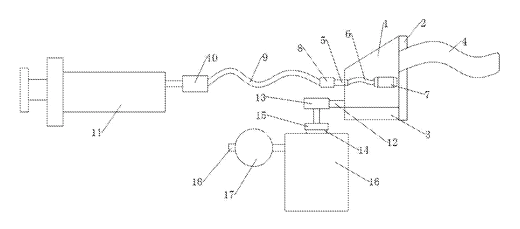
Drawing reproduced from the public patent document for reference.