At a glance
| Patent number | CN208084294U (application CN201820471878) |
| Type | China utility model (实用新型) - protects product shape and structure |
| Original title | A kind of twofold workbench (一种双折叠工作台) |
| Patent owner | Jinhua Yahu Tools Co Ltd |
| Inventors | Sheng Jing, He Zhanfeng, Wang Rongmin, Li Bao, Jing Yanpeng, Huang Yongping, Li Chenghua |
| Filing date | 2018-04-01 |
| Grant date | 2018-11-13 |
| Status (China) | In force in China until at most 2028-04-01 (if annual fees are paid) |
| Patent family | Chinese filings only - no US, European, Japanese, PCT or other filings listed |
| Cited by | 11 later documents |
| Source | Google Patents (search for CN208084294U) |
What the claims cover, in plain language
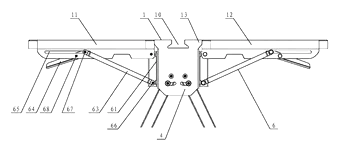
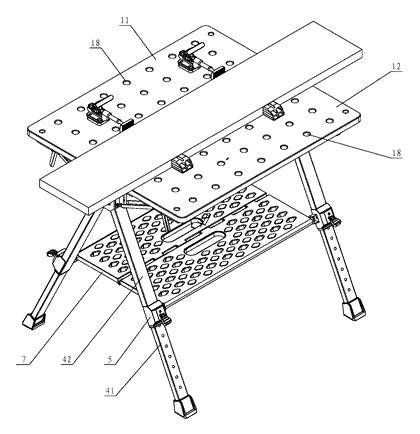
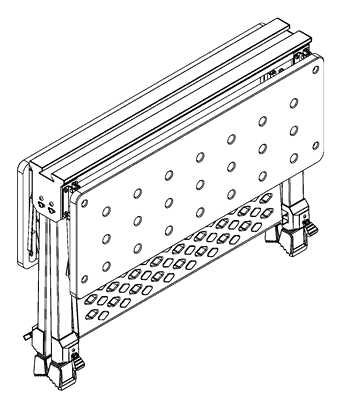
Claim 1 - a double-folding workbench comprising a tabletop and a supporting tripod. The tabletop includes a centrally located horizontal cross-member (1), a left deck plate (11) on the left, and a right deck plate (12) on the right. Both deck plates have mounting holes (18) for installing fixtures. The left and right deck plates are articulated to the cross-member via folding racks (6). The upper face of the cross-member has a recessed mounting groove (10), where the width of the first half of the groove is less than the width of the lower half.
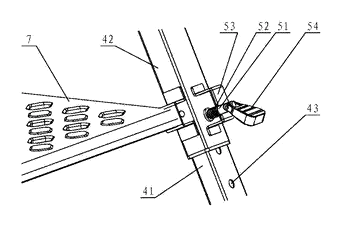
Claim 2 - the mounting groove is centered on the cross-member’s upper face and extends end-to-end; its cross-section is rectangular in the upper part and isosceles trapezoidal in the lower part. Claim 3 - the folding rack comprises a vertical first rod piece (61), a horizontal second rod piece (62) with a horizontal sliding slot (65), an inclined third rod piece (63), and a fourth rod piece (64) hinged below the sliding slot. An elastic torsional spring (69) is set at the hinge between the fourth and second rod pieces, and the fourth rod piece has a limiting slot (60) that engages the third shaft (67) of the third rod piece. Claim 4 - U-shaped tripod support elements (4) are fixed at both ends of the cross-member, each hinging two foot levers via an axis, with an arc-shaped locating slot and a locating rod. Claim 5 - each foot lever consists of an inner foot rod (41) socketed inside an outer foot rod (42); the outer rod has at least one location hole, the inner rod has several adjustment holes (43), and a telescoping control (5) manages the extension. Claim 6 - the telescoping control includes a pin member (51) interspersed in the location hole, a spring (52), a pedestal plate (53), and a telescoping switch part (54).
This is a simplified reading for orientation only. The legal scope is defined by the exact claim wording in the official Chinese document.
What this means for US production
This patent was filed only in China and is currently in force there (until at most 2028-04-01, provided annual fees are paid). It has no US or other foreign counterpart, so it does not restrict making or selling the described workbench in the United States. However, making or selling this exact design in China requires the owner’s permission while the patent remains active.
Two points to settle early:
- Other patents may exist. Several companies hold later US or foreign patents in the folding workbench and portable saw-stand field that cite this Chinese document. These include Suzhou Positec Power Tool Co., Ltd. (WO2021057999A1), Hangzhou Lianhe Tools Manufacturing Co., Ltd. (WO2022198375A1), The Stanley Works Israel Ltd. (US11597074B2, US11819120B2), and Techtronic Cordless Gp (US12036660B2). Because these holders have secured rights in other jurisdictions covering related folding mechanisms or workbench structures, a freedom-to-operate (FTO) review is recommended before launching a product based on this design in the US or elsewhere.
- Hinge and leg strength. The folding racks and telescopic legs bear the full working load. Material thickness, pin diameter, and spring tension must be confirmed on prototypes to meet commercial safety expectations.
Customization and manufacturing
What can be customized
| Area | Options |
|---|---|
| Tabletop dimensions | Length and width of the cross-member and deck plates to be confirmed in design |
| Deck plate material | Steel sheet, aluminum, or phenolic-coated plywood depending on target weight and cost |
| Mounting hole pattern | Hole diameter and spacing adjusted to fit specific brand fixtures or universal T-track bolts |
| Leg tube profile | Round or square steel tubing for the inner and outer foot rods |
| Height range | Number and spacing of adjustment holes set in design to define minimum and maximum standing heights |
| Surface finish | Powder coating, zinc plating, or paint colors specified by the buyer |
| Accessories | Add-on parcel shelf (7) with glove hole (71) as shown in the drawings, or custom clamp sets |
Things to plan for (US market)
- Rated load on the label - no mandatory federal standard covers portable folding workbenches, so the working load and clamping load are set by prototype testing (static load on the three-part tabletop, leg-lock hold under load) and printed on the product and carton.
- Pinch-point and collapse warnings - the folding hinges and telescopic legs can trap fingers; buyers usually add ANSI Z535.4-style warning labels and test that the leg locks cannot release under load (a CPSC general-duty concern for consumer tools).
- California Proposition 65 - powder coatings, plated pins, and plastic switch parts should be screened for listed chemicals.
- Amazon packaging requirements - if sold via e-commerce, ISTA 3A or SIOC packaging tests will be needed to prevent damage to the folding joints during shipping.
How a project runs
- Inquiry - target dimensions, materials, load capacity, and estimated order quantity.
- Design - CAD modeling of the cross-member, deck plates, folding rack geometry, and telescopic leg assembly.
- Prototype - fabrication of samples to verify the folding action, torsion spring engagement, and pin-lock alignment.
- Pilot run - load testing, cycle testing of the hinges, and stability checks with fixtures mounted.
- Production - tube cutting, stamping of deck plates and brackets, welding, surface finishing, and final assembly.
Quantities & timeline
Manufacturing requires stamping dies for the deck plates and mounting holes, tube-bending or cutting jigs for the foot rods, and injection molds if plastic telescoping switch parts are used. Certification tests such as stability and pinch-point evaluations add time to the development phase. Send us your target dimensions, material preferences, load requirements, estimated quantities and destination market, and we will reply with options.
Patent drawings
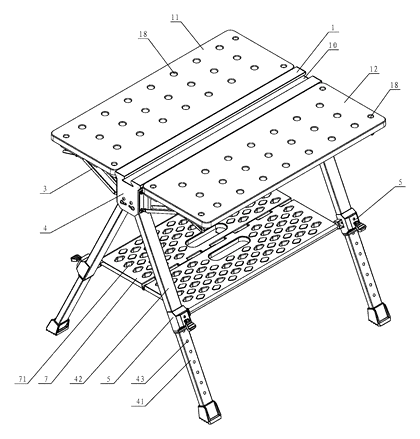
Drawings reproduced from the public patent document for reference.