At a glance
| Patent number | CN208355064U (application CN201721022127) |
| Type | China utility model (实用新型) - protects product shape and structure |
| Original title | A mandarin duck mattress (一种鸳鸯床垫) |
| Patent owner | Yunshitong (Huai’an) Furniture Technology Co.,Ltd. |
| Inventors | Chen Guanyu |
| Filing date | 2017-08-16 |
| Grant date | 2019-01-11 |
| Status (China) | In force in China until at most 2027-08-16 (if annual fees are paid) |
| Patent family | Chinese filings only - no US, European, Japanese, PCT or other filings listed |
| Cited by | 10 later documents |
| Source | Google Patents (search for CN208355064U) |
What the claims cover, in plain language
Claim 1 - A mattress comprising a bottom plate (4) sleeved by a rectangular cloth bag with a partition cloth sewn in its middle. The partition divides the bag into an independent cylinder spring bag (7) and a standard spring bag (11). Independent cylinder springs (5) are screwed vertically to the plate on one side, each sleeved in a non-woven tube bag (6) whose top contacts the inner roof of the pocket bag. Standard springs (8) are screwed to the plate on the other side. Open zippers (10) are sewn on both sides of the spring bags. A lower cotton pad (3) sits beneath the rectangular bag, an upper cotton pad (9) sits on top, and the assembly rests inside a mattress surface material bag (2). A mattress fabric zipper (1) at the opening of this bag connects to a removable mattress fabric cover (12).
Claim 2 - A rectangular non-woven block is glued to the top of each standard spring (8), contacting the inner top wall of the standard spring bag (11). Claim 3 - The standard springs (8) are distributed equidistantly and connected in series by stainless steel wire. Claim 4 - The tops of the independent springs (5) and standard springs (8) lie on the same horizontal plane, and their distribution areas are identical. Claim 5 - The top inner edges of the mattress surface material bag (2) connect to the outer wall of the rectangular cloth bag via concealed snaps, and the bag’s height is three-quarters of the rectangular cloth bag’s height. Claim 6 - Both the mattress surface material bag (2) and the cover (12) consist of two fabric layers sewn together by vertical cotton threads, with cotton filling between them.
This is a simplified reading for orientation only. The legal scope is defined by the exact claim wording in the official Chinese document.
What this means for US production
This patent was filed only in China and is currently in force in China until at most 2027-08-16 (if annual fees are paid). Manufacturing or selling this exact structure within China requires the patent owner’s permission during that term. It has no US or other foreign counterpart, so the design itself is not restricted by this specific document in the United States.
Two points to settle early:
- Other patents may exist. Mattress spring configurations—especially split-firmness designs, pocketed coil arrays, and zip-off covers—are heavily patented by major US and global bedding brands. A thorough freedom-to-operate (FTO) review focusing on the combination of a shared base plate with two distinct spring zones is essential before committing to tooling.
- Base plate construction. The patent specifies a bottom plate (4) to which springs are screwed. In US manufacturing, this might translate to a rigid border wire or a solid foundation board, which affects compression rolling and shipping logistics.
Customization and manufacturing
What can be customized
| Area | Options |
|---|---|
| Dimensions | Twin, Full, Queen, King, or custom lengths and widths |
| Spring gauge and count | Wire thickness, coil diameter, and number of coils per zone set in design |
| Zone ratio | Exact 50/50 split as described, or adjusted ratios (e.g., 60/40) confirmed on prototypes |
| Padding materials | Standard cotton pads, high-density polyurethane foam, memory foam, or latex layers |
| Cover fabrics | Knit, woven, or bamboo-blend textiles; quilting patterns and fill weights |
| Base structure | Rigid plate as patented, or adapted border-wire frame for flexibility |
| Fire barriers | Integrated FR socks or barrier layers to meet US standards |
Things to plan for (US market)
- 16 CFR Part 1633 and 1632 - Federal flammability standards for mattress sets. Every prototype must pass open-flame and cigarette smolder tests before sale.
- CPSC tracking labels - Required if marketed for children’s use, though standard adult mattresses follow general labeling rules.
- California TB 117-2013 / Technical Bulletin 600 - State-level requirements that often dictate the choice of fire-retardant barrier materials.
- CertiPUR-US or OEKO-TEX - While voluntary, US retailers and e-commerce platforms frequently require these certifications for foams and textiles used inside the mattress.
How a project runs
- Inquiry - target sizes, preferred spring gauges, padding stack, cover textile, and estimated volumes.
- Design - engineering the base plate or frame, mapping the spring layouts so both zones hit the same horizontal plane, and selecting barrier materials.
- Prototype - building samples to test the transition seam between the two spring zones, measuring motion isolation, and verifying zipper durability.
- Testing - submitting prototypes for 16 CFR 1633 flammability certification and optional foam/textile testing.
- Production - spring coiling, non-woven pocketing, assembly onto the base, padding lamination, and cover sewing.
Quantities & timeline
Manufacturing this mattress requires dedicated spring-coiling machinery, automated pocketing equipment for the independent zone, wire-stringing tools for the standard zone, and heavy-duty sewing lines for the quilted covers. Flammability testing adds lead time before mass production can begin. Send us your dimensions, material preferences, quantity and target price and we will reply with options.
Patent drawings
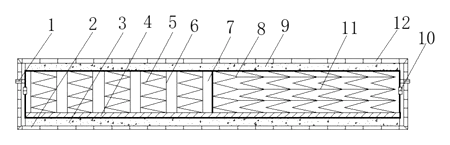
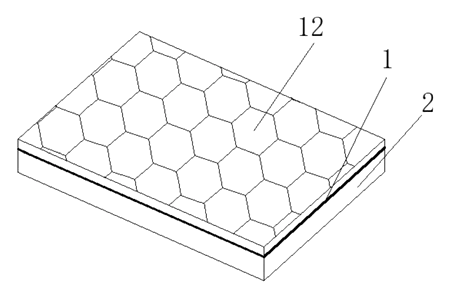
Drawings reproduced from the public patent document for reference.