At a glance
| Patent number | CN208541044U (application CN201820238337) |
| Type | China utility model (实用新型) - protects product shape and structure |
| Original title | An airbag U-shaped pillow (一种气囊U型枕头) |
| Patent owner | Guangzhou City Cai Dago Beauty Technology Ltd |
| Inventors | Liang Yuming, Dai Jisheng, Cai Laidi, Lu Weiwen, Luo Simin |
| Filing date | 2018-02-10 |
| Grant date | 2019-02-26 |
| Status (China) | Lapsed - terminated for non-payment of annual fees (recorded 2025-02-07) |
| Patent family | Chinese filings only - no US, European, Japanese, PCT or other filings listed |
| Cited by | 4 later documents |
| Source | Google Patents (search for CN208541044U) |
What the claims cover, in plain language
Claim 1 defines a U-shaped pillow with a first airbag in the inner middle, a second airbag on one side, and a third airbag on the other side. The first airbag connects to a first gas cell (squeeze bulb) via a first inflation tube. The second and third airbags are connected by a communication tube, and the second airbag connects to a second gas cell via a second inflation tube.
Claim 2 specifies the pillow body is integrally U-shaped. Claims 3-4 describe the geometry: the ends of the first airbag are higher than its middle, forming an arc-shaped contour. Claims 5-6 state the second and third airbags are higher than the first, and the combined exterior contour of all three bags is arc-shaped. Claim 7 places the first and second gas cells at the two ends of the pillow. Claim 8 notes the airbag positions are higher than the gas cell positions. Claim 9 details the air intake on the gas cells and deflation parts (valves) on the inflation tubes. Claim 10 specifies the outer layer is memory foam.
This is a simplified reading for orientation only. The legal scope is defined by the exact claim wording in the official Chinese document.
What this means for US production
This patent was filed only in China and has lapsed due to non-payment of fees. It currently offers no exclusive rights to the owner in China or elsewhere. It has no US or other foreign counterpart.
Two points to settle early:
- Other patents may exist. Travel pillows with internal inflation mechanisms are a competitive market. While this specific configuration is now free to use, check for newer US patents covering similar multi-zone inflation systems or specific valve technologies before tooling. A freedom-to-operate (FTO) review is recommended.
- Material Safety. The patent mentions memory foam and airbags but does not specify chemical composition. For US sales, materials must comply with flammability standards (e.g., Cal TB 117) and avoid restricted substances (Prop 65).
Customization and manufacturing
What can be customized
| Area | Options |
|---|---|
| Foam Density | Soft, medium, or firm memory foam for the outer shell. |
| Cover Fabric | Plush velvet, breathable mesh, or waterproof nylon. Removable/washable options. |
| Valve Type | Push-button release (as patented) vs. screw-cap valves for slower deflation. |
| Bulb Design | Size and texture of the squeeze bulbs for easier grip. |
| Colorway | Pantone matching for brand identity. |
| Packaging | Compression bags included for retail display. |
Things to plan for (US market)
- CPSC Flammability: Textiles and foams used in bedding/travel accessories must meet 16 CFR 1610 (standard for clothing textiles) or specific furniture flammability standards depending on classification. California Technical Bulletin 117-2013 is widely required for foam products.
- California Prop 65: Warning labels may be required if the foam or plastics contain listed chemicals (e.g., certain flame retardants or phthalates). Ensure material suppliers provide Prop 65 compliance statements.
- FDA: If marketed as a medical device (e.g., for cervical traction), FDA registration is required. However, standard travel pillows are generally classified as general wellness/consumer goods and do not require FDA clearance unless making specific medical claims.
How a project runs
- Inquiry - Define target price, quantity, and desired features (washable cover, specific foam density).
- Design - Finalize mold layouts for the airbags, select foam block dimensions, and choose fabric materials.
- Prototype - Produce samples to test inflation speed, valve reliability, and comfort ergonomics.
- Testing - Conduct cycle testing on valves and bulbs; verify flammability compliance on foam and fabric.
- Production - Injection molding for bulbs/valves, welding/sewing for airbags, foam cutting, assembly, and packaging.
Quantities & timeline
Tooling for the squeeze bulbs and valves requires steel molds. The airbags are typically made from TPU or PVC sheets welded together. Lead times depend on the complexity of the cover fabric sourcing. Send us your target specifications, quantity, and certification requirements and we will reply with options.
Patent drawings
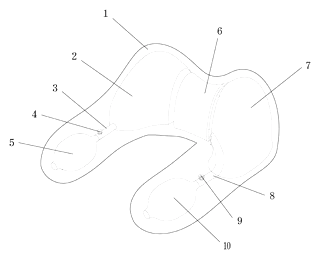
Drawings reproduced from the public patent document for reference.