
Patent CN208691875U
Updated October 27, 2026Vertical Crop Cultivation System with Nutrient, Light, Air and Audio Control
Indoor farming systems often struggle with nutrient solution temperature swings driven by outside weather, requiring costly heaters or chillers to keep water in range. This vertical crop cultivation system addresses that by embedding the nutrient reservoir below the ground surface, where soil acts as a thermal barrier. Inside the enclosed building facility, crops grow on layered cultivation beds within tiered frames. A light illuminating unit provides preset light sources over each bed through photoelectric modules. An air-conditioning unit manages the atmosphere using water curtains connected to supply equipment and bubble modules that can generate oxygen, carbon dioxide, or ozone bubbles. An audio frequency adjust unit introduces sound wave vibrations into the space via loudspeakers driven by an audio player. A central control unit connects electrically to the pumps, lights, bubble modules, and audio players, turning them on or off based on the actual growth state of the planted crops.
- China utility model - withdrawn
- No filings outside China
- Indoor agriculture & hydroponics
- Underground reservoir, layered beds, bubble generators, audio control
Splat! What let you down?
🌱
Layered cultivation beds
Plural layered beds sit within tiered frames inside an enclosed building facility to use terrace space effectively.
💧
Underground nutrient reservoir
The reservoir is embedded under the earth's surface so soil insulates the nutrient solution from outside air temperature.
💡
Photoelectric light modules
Preset light sources are generated by photoelectric modules positioned at each cultivation bed.
🫧
Bubble-based air conditioning
Water curtains and supply equipment feed bubble modules that can introduce oxygen, carbon dioxide, or ozone into the space.
Bring this product to market
- ✓ Patent vetted China-only family and legal status checked
- 2 Product brief · now How it works, uses and options written up
- 3 Prototype First samples for buyers to review
- 4 Pilot run Small first batch for launch customers
- 5 Volume production Repeat orders at scale
Buyer interest
– of 100 buyers needed to start prototyping
One click, no sign-up. Each vote is one real visitor, and products with the most interest go to prototyping first.
Build team: no members yet. Need a partner, co-funding or skills to build this? Join and we introduce the team once it forms.
The problem
In indoor and vertical farming, maintaining the correct water temperature for the nutrient solution is difficult when outside air temperatures fluctuate. Heating or cooling the liquid requires additional equipment that consumes energy and raises operating costs. Managing multiple environmental variables—light, nutrients, humidity, air composition, and even sound—at the same time across several growing layers adds complexity. Without coordinated control, conditions may drift away from what the specific crop needs during different growth stages, leading to uneven yields.
The solution
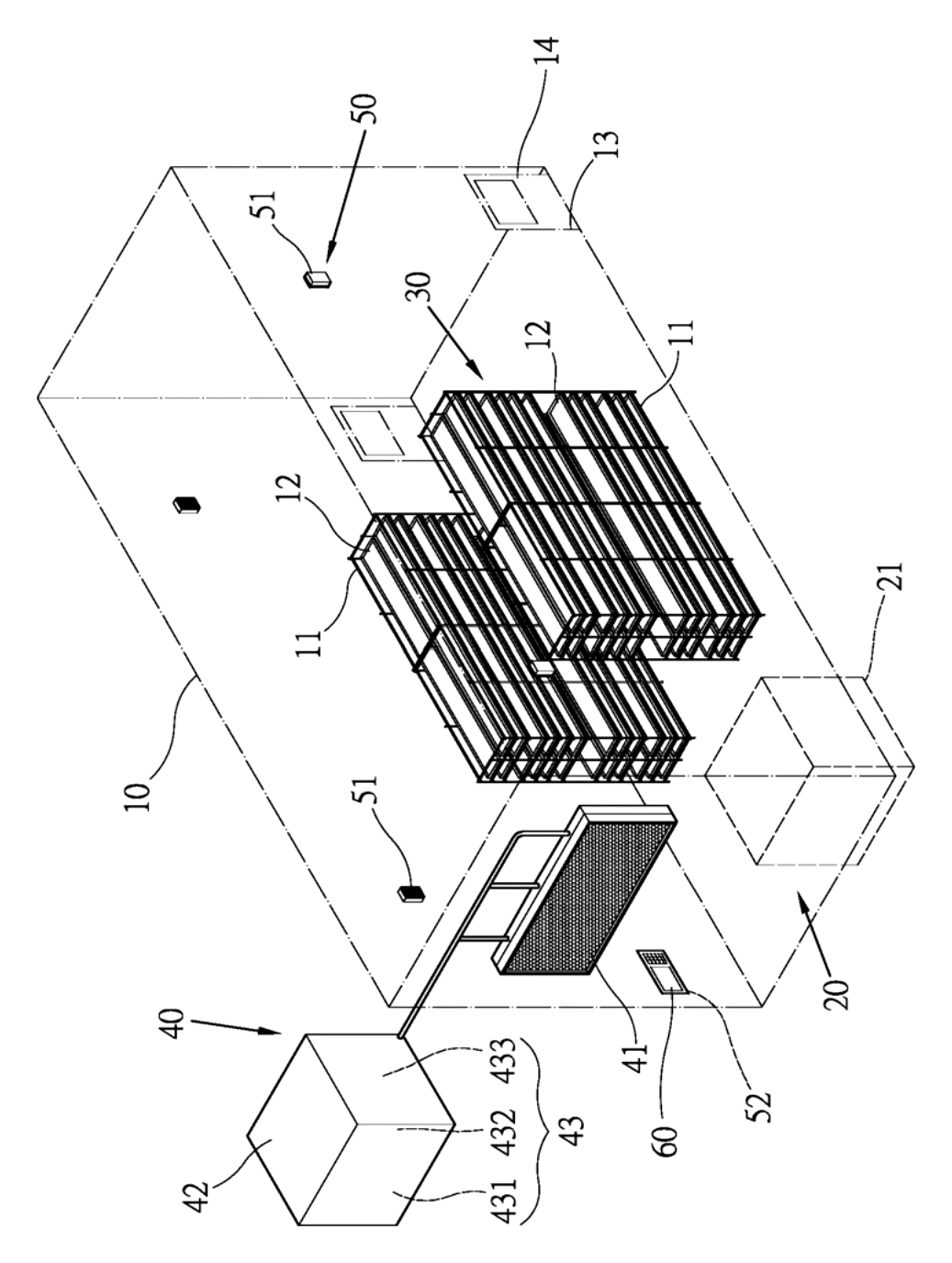
This system combines six main units to manage the growing environment inside a single enclosed space.
- A building facility (10) surrounds the cultivation space. Inside, at least one layer frame (11) holds plural cultivation beds (12) in a layered configuration. Personnel enter through a personnel’s entrance (13) covered by a channel gate (14).
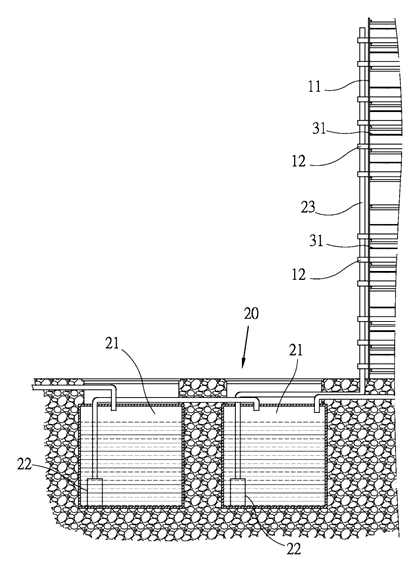
- A nutrient solution supply unit (20) includes at least one reservoir (21) embedded under the earth’s surface. A nutrient solution pumping device (22) moves liquid through nutrient solution transmission & distribution pipelines (23) to each bed. The soil barrier reduces outside temperature interference, helping avoid freezing or overheating.
- A light illuminating unit (30) places a photoelectricity mould group (31) at each cultivation bed to generate a preset light source after being powered.
- An air-conditioning unit (40) uses at least one water Lian (water curtain) (41) communicating with the cultivation space. Supply equipment (42) connects to the water curtains and feeds at least one bubble mould group (43), which can include oxygen bubble generators (431), carbon dioxide bubble generators (432), or ozone bubbles generators (433).
- An audio frequency adjust unit (50) places at least one loudspeaker (51) communicating with the cultivation space, driven by an audio player (52).
- A control unit (60) connects electrically to the pump (22), photoelectric modules (31), bubble modules (43), and audio player (52), controlling whether they act.
Who it is for
- Commercial vertical farm operators looking to build enclosed facilities with layered beds and integrated climate, light, and nutrient management.
- Hydroponic equipment manufacturers seeking a complete system design that incorporates underground reservoirs and bubble-based air conditioning to offer buyers.
- Agricultural technology brands expanding their catalog with controlled-environment agriculture setups that include audio frequency adjustment.
- Wholesalers supplying greenhouse builders who need a documented multi-unit architecture to source components like water curtains, bubble generators, and layer frames.
How it works
The main parts
| No. | Part | What it does |
|---|---|---|
| 10 | Building facility | Encloses the cultivation space. |
| 11 | Layer frame | Supports the layered cultivation beds. |
| 12 | Cultivation bed | Holds the crops; can use a water pan structure containing aqueous state. |
| 13, 14 | Personnel’s entrance, channel gate | Allows access while covering the opening. |
| 21 | Reservoir | Stores nutrient solution; embedded under the earth’s surface. |
| 22 | Nutrient solution pumping | Moves liquid from the reservoir. |
| 23 | Nutrient solution transmission & distribution pipelines | Delivers solution to each cultivation bed. |
| 31 | Photoelectricity mould group | Generates the preset light source at each bed (includes first 311, second 312, third 313 photoelectric cells). |
| 41 | Water Lian (water curtain) | Communicates with the cultivation space for air conditioning. |
| 42 | Supply equipment | Connects the water curtains to the bubble modules. |
| 43 | Bubble mould group | Introduces gas bubbles into the space. |
| 431, 432, 433 | Oxygen, carbon dioxide, ozone bubble generators | Specific generators within the bubble module. |
| 51 | Loudspeaker | Emits sound waves into the cultivation space. |
| 52 | Audio player | Electrically drives the loudspeakers. |
| 60 | Control unit | Electrically connects to and controls the pump, lights, bubble modules, and audio player. |
| 70 | Crops | The plants grown in the system. |
Operating steps
- Prepare the reservoir: The nutrient solution is held in the underground reservoir (21), where soil insulation maintains its temperature.
- Distribute nutrients: The control unit (60) activates the nutrient solution pumping (22) to send liquid through the pipelines (23) to the cultivation beds (12).
- Illuminate: The control unit powers the photoelectricity mould groups (31) to provide the preset light source to the crops (70).
- Condition the air: The supply equipment (42) drives the water curtains (41) and bubble mould groups (43). Depending on the setup, oxygen (431), carbon dioxide (432), or ozone (433) bubbles are introduced to adjust the air composition.
- Adjust audio: The control unit signals the audio player (52) to drive the loudspeakers (51), introducing sound wave vibration frequencies into the space.
- Coordinate: The control unit adjusts whether these components act based on the actual growth state of the planted crops.
Applications
Commercial leafy green production
Leafy greens require steady nutrient temperatures and consistent light. Operators use this system to grow crops on layered beds inside the building facility, relying on the underground reservoir to prevent the nutrient solution from overheating during warm seasons without adding external chillers.
Research and agricultural testing
Researchers studying plant responses to varied atmospheres use the bubble generators to introduce specific ratios of oxygen, carbon dioxide, or ozone. The control unit allows them to turn individual modules on or off to observe how the crops react to changes in air composition and sound wave vibration frequency.
Urban warehouse farming
When converting urban warehouses into farms, space utilization is critical. The tiered layer frames hold plural cultivation beds vertically, making effective use of the terrace space inside the enclosed building facility while personnel access the rows through the gated entrances.
Seedling propagation nurseries
Nurseries propagating seedlings need stable water temperatures to avoid shocking young roots. The soil barrier around the embedded reservoir keeps the nutrient solution within a suitable range, reducing the risk of freezing in colder months or overheating when outdoor temperatures rise.
Specialty herb cultivation
Herbs grown for culinary or aromatic purposes benefit from controlled environmental adjustments. Growers use the audio frequency adjust unit and the light illuminating unit together, letting the control unit manage both based on the practical growth conditions of the specific herbs.
Where it is less suitable
- Open-field agriculture - the system relies on an enclosed building facility and underground reservoirs, making it unsuitable for open fields.
- Large-scale grain farming - grains like wheat or corn require vast horizontal acreage rather than layered indoor beds.
- Low-budget hobby setups - integrating water curtains, multiple bubble generators, photoelectric modules, and a central control unit involves more infrastructure than a simple home grow tent.
Frequently asked questions
Why is the nutrient reservoir placed underground?
The patent describes embedding the reservoir under the earth’s surface so the soil acts as a barrier. This reduces interference from outside air temperature, helping to avoid freezing or overheating of the nutrient solution without needing extra heating or cooling equipment.
What gases can the bubble modules produce?
According to the patent, the bubble mould group can include oxygen bubble generators, carbon dioxide bubble generators, and ozone bubbles generators. Claims describe using these individually or in various combinations to adjust the air composition in the cultivation space.
How does the audio frequency adjust unit work?
The system includes loudspeakers communicating with the cultivation space, electrically connected to an audio player. The control unit manages whether the audio player acts, adjusting the sound wave vibration frequency according to the actual growth state of the planted crops.
Are the cultivation beds standard trays?
The patent mentions that the cultivation beds can use a water pan structure type that contains an aqueous state. Exact dimensions and capacities are set in design and confirmed on prototypes based on the crops being grown.
How are the lights arranged?
A photoelectricity mould group is equipped at each cultivation bed to generate a preset light source after being powered. The patent lists first, second, and third photoelectric cells within the module, but specific wavelengths or power ratings are to be confirmed in design.
Does the system automate everything?
The control unit electrically connects to the nutrient solution pump, the photoelectric modules, the bubble modules, and the audio player. It controls whether these components act, allowing the environmental conditions to be adjusted in time according to the actual growth state of the crops.
Can this design be made and sold in the US?
The patent was filed only in China and was withdrawn (the owner abandoned the patent right effective 2021-08-10), so it does not restrict the design in the US or in China. Vertical farming technologies may be covered by other US or foreign patents - see Patent & Production - so we recommend a freedom-to-operate check before commercial installation.
Are you affiliated with the patent owner?
No. IP2M is an independent design and manufacturing service working from the public patent document.
Request a quote
Click Request a Quote below to see our email address - copy it, or open your email app with a ready-made message. Please mention patent CN208691875U in the subject.
Helpful details to include:
- Your company and channel (commercial farm operator, hydroponic equipment manufacturer, agricultural technology brand, wholesaler)
- Facility dimensions and available space for the building enclosure
- Target crops and expected yield scale
- Number of layer frames and cultivation beds required
- Specific bubble generators needed (oxygen, carbon dioxide, ozone)
- Estimated quantity of systems and target price
- Timeline - when you would like prototypes and the final installation
You can also reach us at (332) 203-9997.
Explore this product
Interested in building this?
Tell us your target market, quantity and timeline. We reply with options for prototyping, small-batch runs or volume production.
Send your inquiry to
Please put CN208691875U in the subject line and tell us your company, country, estimated quantity and timeline.
Prefer to talk? Call (332) 203-9997.
More product-ready patents
All Garden & Outdoor patents →
Garden & Outdoor
2-in-1 Parent & Child Umbrella
Full-size umbrella with a nested smaller umbrella on top - a rotating decorative layer that detaches into a kid-size umbrella.
Patent CN205611962U
Garden & Outdoor
Wire-Mesh Tree Root & Trunk Guard Against Rodents
Three-part wire-mesh guard that protects the roots and lower trunk of young trees from burrowing and gnawing animals.
Patent CN206808261U
Garden & Outdoor
Adjustable-Angle Tree Support Prop
Tree prop with a pinned base, angle-locking hinge, twist-adjust tube and a locking trunk ring.
Patent CN208370491U
Garden & Outdoor
Self-Renewing Glue-Roller Mosquito Trap
UV insect trap with a glue roller that re-coats itself and scrapes the catch into a tray - no glue boards.
Patent CN217038569U
Garden & Outdoor
Cam-Lock Telescopic Pole for Garden Power Tools
Telescopic pole for garden power tools with cam-lever locks and a spring-button, tear-drop head socket.
Patent CN205812889U
Garden & Outdoor
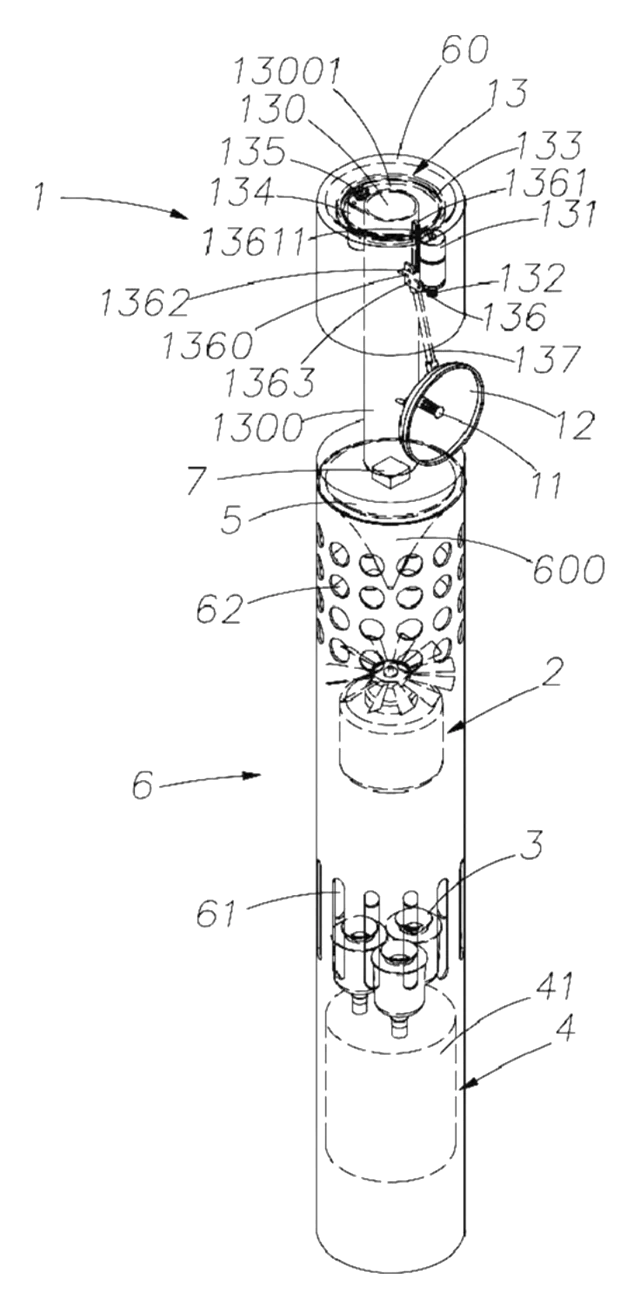
Mosquito Fan That Listens for Mosquitoes Before It Sprays
Fan with a scanning microphone dish that mists repellent only when it hears mosquitoes.
Patent CN208708542U
Browse by category
- Apparel & Accessories (22)
- Baby & Kids (16)
- Bags & Luggage (9)
- Bath & Personal Care (16)
- Car Accessories (10)
- Furniture, Bedding & Storage (12)
- Garden & Outdoor (18)
- Health & Wellness (8)
- Home, Kitchen & Cleaning (24)
- Lighting (12)
- Packaging & Containers (6)
- Pet Products (6)
- Phone & Camera Accessories (4)
- Retail Display (13)
- School, Office & Art (19)
- Sports & Recreation (25)
- Tools & Workshop (27)
- Toys & Games (12)
This page is based on the public patent document CN208691875U, assigned to Yuanxian Agricultural Biotechnology Co ltd. IP2M is an independent manufacturing service and is not affiliated with, endorsed by or licensed by the patent owner. Images marked as concept renderings are illustrations, not photos of an existing product. Patent status information is provided for reference only and is not legal advice; confirm freedom to operate for your market before production. Full disclaimer.