
Patent CN208875862U
Updated October 25, 2026Motorized Rotating Display Pedestal with Lift Column, Info Screen and Clip-On Display Racks
Design schools, galleries and trade-show booths keep moving exhibits around, and each exhibit needs a plinth, a light, a label and often a screen. This pedestal brings them together on wheels. At the top, a hollow cube turns slowly on a motor so all four faces pass the visitor; each face has its own LED light tube and two sockets that take display racks with holding grooves, locked at the right height by a bolt. Below it, an electric lift column raises or lowers the whole display, and a screen mounted on the column shows enlarged details of the piece or the designer's introduction. A battery and controller live in the body, so the stand runs without a cable, and lockable casters let one person move it.
- China utility model - lapsed
- No filings outside China
- Exhibition & retail display fixtures
- Sheet metal or MDF body, motor, lift column, LCD
Splat! What let you down?
🔄
Turning display cube
A motor turns the four-sided cube so every face passes the visitor.
↕️
Electric lift column
An electric telescopic column sets the display height for each exhibit.
🖥️
Info screen
A screen on the column shows details, close-ups or the designer's story.
🛞
Battery and casters
Built-in battery and lockable casters - move it and run it without a cable.
Bring this product to market
- ✓ Patent vetted China-only family and legal status checked
- 2 Product brief · now How it works, uses and options written up
- 3 Prototype First samples for buyers to review
- 4 Pilot run Small first batch for launch customers
- 5 Volume production Repeat orders at scale
Buyer interest
– of 100 buyers needed to start prototyping
One click, no sign-up. Each vote is one real visitor, and products with the most interest go to prototyping first.
Build team: no members yet. Need a partner, co-funding or skills to build this? Join and we introduce the team once it forms.
The problem
Exhibitions of design work, products and student projects use static plinths. Visitors see only one side, labels are small, and a separate screen or light needs its own stand and cable. According to the patent, the aim is a display stand that rotates the exhibit, adjusts its height to different needs and shows information about it on a screen.
The solution
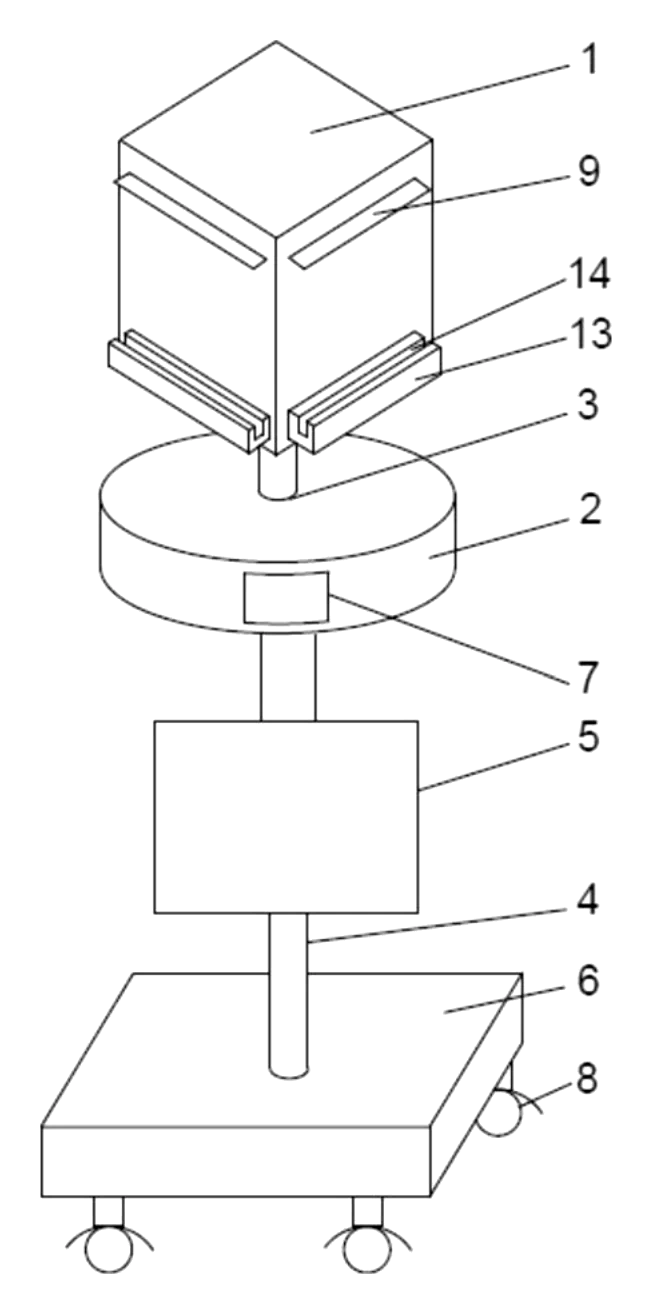
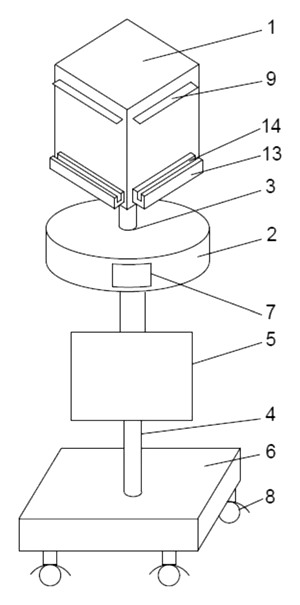
- A rotating display cube (1) - hollow, with four display faces - sits on top and is turned by a motor (3) through a shaft.
- The motor sits in the center of the stand body (2), together with a battery and a controller; a control panel (7) is on the outside.
- The body is joined to the base (6) by an electric telescopic rod (4), which sets the height.
- A display screen (5) is fixed to the telescopic rod.
- The base has casters (8) with brakes.
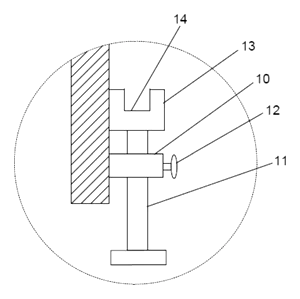
- On each face of the cube, an LED light tube (9) runs along the top. Near the bottom of each face, two sockets (10) take insert rods (11), locked by bolts (12); each rod carries a display rack (13) with a holding groove (14).
- Wiring runs inside the hollow cube.
Who it is for
- Exhibition and trade-show fixture makers looking for a premium, self-contained display unit for rental fleets and booth builders.
- Retail display suppliers serving jewelry, watch, eyewear and gadget stores that want product on a turning, lit plinth with a screen.
- Universities, design schools and museums that stage graduate shows and rotating exhibitions.
- Brand experience agencies building pop-up stores and product launches.
How it works
The main parts
| No. | Part | What it does |
|---|---|---|
| 1 | Rotating display cube | Four display faces, turned by the motor. |
| 2 | Stand body | Houses motor, battery and controller. |
| 3 | Motor | Turns the cube. |
| 4 | Electric telescopic rod | Sets the display height. |
| 5 | Display screen | Shows information about the exhibit. |
| 6, 8 | Base and casters | Mobile base with brakes. |
| 7 | Control panel | Controls screen content, rotation and height. |
| 9 | LED light tube | Lights each face. |
| 10-14 | Socket, rod, bolt, rack, groove | Clip-on display racks at adjustable height. |
Setting up an exhibit
- Roll the stand into place and lock the caster brakes.
- Fit display racks on the faces that need them and lock them at the right height.
- Place the exhibits on the faces or in the rack grooves.
- Set the height with the lift column and the rotation from the control panel.
- Load the screen with images or text about the work; the LED tubes light each face as it turns.
Applications
Design and art school exhibitions
Graduate shows present models, packaging and products on turning, lit plinths with the student’s story on screen.
Trade-show booths
A single stand shows several products in turn, with specs or video on the screen.
Jewelry, watch and eyewear stores
Small high-value items turn under light; the screen shows close-ups and prices.
Museums and visitor centers
Objects can be seen from all sides at an accessible height, with interpretation on screen.
Product launches and pop-up stores
Brand teams roll stands in and out of temporary venues and run them on battery.
Where it is less suitable
- Heavy exhibits - the cube and motor suit light to medium objects; sculptures need a heavy-duty turntable.
- Unsupervised public spaces - open racks and a screen need security for valuable items.
- Low-budget plinths - motor, lift, screen and battery cost far more than a painted box.
Frequently asked questions
How does the display turn?
A motor in the stand body turns the hollow display cube on a shaft, so all four faces pass the visitor. Speed and direction are set from the control panel.
How high does it go?
The patent gives no figures. An electric telescopic column sets the height; stroke and load are chosen in design for your exhibits.
What is the screen for?
It is mounted on the lift column and shows information about the exhibit - close-ups, the designer’s introduction, specifications or video.
Does it need a power cable?
No. The patent puts a battery and a controller in the body. Run time depends on battery size, screen and motor use, and is measured on prototypes; a mains-powered version is also possible.
How heavy can the exhibit be?
The patent does not say. Motor torque and column rating are sized for the exhibit weight you specify.
Can the display racks be moved?
Yes. Each face has two sockets; a rack on an insert rod slides in and is locked at the chosen height with a bolt.
Can this design be made and sold in the US?
The patent was filed only in China and has lapsed, so it does not restrict the design in the US or in China. Motorized display stands may be covered by other US patents - see Patent & Production - so we recommend a freedom-to-operate check before volume production.
Are you affiliated with the patent owner?
No. IP2M is an independent design and manufacturing service working from the public patent document.
Request a quote
Click Request a Quote below to see our email address - copy it, or open your email app with a ready-made message. Please mention patent CN208875862U in the subject.
Helpful details to include:
- Your company and channel (exhibition fixtures, retail display, museum, school)
- Exhibit types and weight
- Cube size, screen size and height range
- Power (battery, mains) and finish
- Estimated quantity and target price
- Timeline - when you would like a sample and the first shipment
You can also reach us at (332) 203-9997.
Explore this product
Interested in building this?
Tell us your target market, quantity and timeline. We reply with options for prototyping, small-batch runs or volume production.
Send your inquiry to
Please put CN208875862U in the subject line and tell us your company, country, estimated quantity and timeline.
Prefer to talk? Call (332) 203-9997.
More product-ready patents
All Retail Display patents →
Retail Display
Motorized Shelf Display That Presents a Product to Shoppers
Shelf unit that lifts a product over the price rail toward shoppers when a sensor detects them.
Patent CN215077184U
Retail Display
Portable Advertising Light Box with Spinning LED Display
Portable ad box whose spinning LED bars draw images and text; content changes by wireless or USB.
Patent CN207425291U
Retail Display
Automated Folding Store Shelf That Pushes Products Up to the Customer
Double-sided shelf for unmanned stores: folding tiers, screw pushers and lift cylinders present stock.
Patent CN109645754B
Retail Display
Thin Outdoor LED Video Wall Cabinet with Magnetic Modules and Tool-Free Locks
Thin outdoor LED wall cabinet: magnetic modules and rear body, rotary locks, finned rear cooling.
Patent CN205354557U
Store & Display
Magnetically Repositionable LED Advertising Panel
LED panel whose lamp beads slide to new positions via an external electromagnet.
Patent CN205487209U
Store & Display
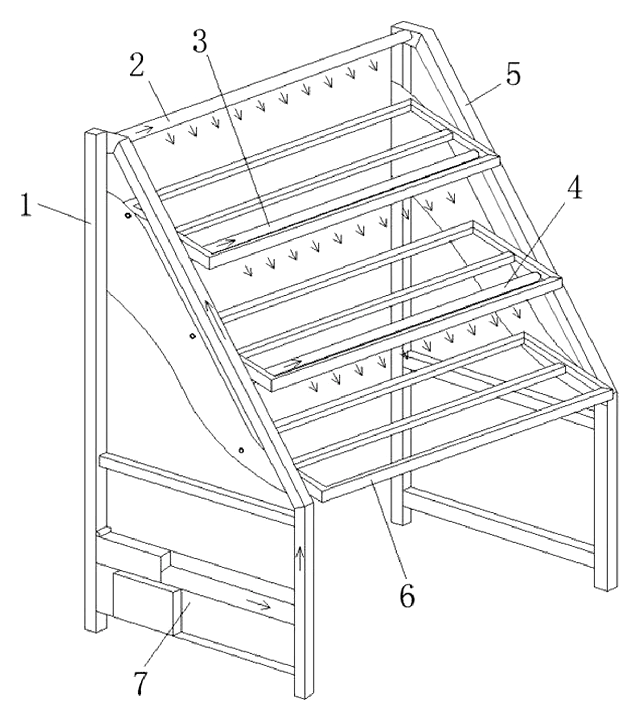
Mist-Cooled Produce Display Rack with Integrated Humidifier
Three-tier produce rack piping ultrasonic mist over each shelf to humidify fruits and vegetables.
Patent CN213640365U
Browse by category
- Apparel & Accessories (22)
- Baby & Kids (16)
- Bags & Luggage (9)
- Bath & Personal Care (16)
- Car Accessories (10)
- Furniture, Bedding & Storage (12)
- Garden & Outdoor (18)
- Health & Wellness (8)
- Home, Kitchen & Cleaning (24)
- Lighting (12)
- Packaging & Containers (6)
- Pet Products (6)
- Phone & Camera Accessories (4)
- Retail Display (13)
- School, Office & Art (19)
- Sports & Recreation (25)
- Tools & Workshop (27)
- Toys & Games (12)
This page is based on the public patent document CN208875862U, assigned to Pingdingshan University. IP2M is an independent manufacturing service and is not affiliated with, endorsed by or licensed by the patent owner. Images marked as concept renderings are illustrations, not photos of an existing product. Patent status information is provided for reference only and is not legal advice; confirm freedom to operate for your market before production. Full disclaimer.