At a glance
| Patent number | CN208876424U (application CN201721125408) |
| Type | China utility model (实用新型) - protects product shape and structure |
| Original title | A kind of mop and burnisher (一种拖把及清洁工具) |
| Patent owner | Individual |
| Inventors | Chen Linling |
| Filing date | 2017-09-04 |
| Grant date | 2019-05-21 |
| Status (China) | Lapsed - terminated for non-payment of annual fees (recorded 2021-08-17) |
| Patent family | Chinese filings only - no US, European, Japanese, PCT or other filings listed |
| Cited by | 1 later document |
| Source | Google Patents (search for CN208876424U) |
What the claims cover, in plain language
Claim 1 - A mop including a head and rod. The head comprises a mop disc, rotary head, rotatable movable part, and a unidirectional spline structure. The spline includes an active ratchet on the movable part and a driven ratchet. When the movable part moves upward, the ratchets engage to realize unidirectional rotation stop.
Claim 2 - Adds a driven member between the movable part and the mop disc. The driven ratchet is set on this driven member, which cooperates with the mop disc.
Claim 3 - Specifies that the rotary head is actively located in the mop disc, and the mop rod has a connection piece at the lower part that cooperates with the rotary head to realize vertical orientation.
Claim 4 - The rotary head is equipped with a through-hole.
Claim 5 - Describes a burnisher (cleaning tool) including a stand and the mop from Claim 1. The stand includes a fried dough twist part (twist rod) inside the staving. The mop’s movable part moves up and down along this twist rod.
Claim 6 - Similar to Claim 2 but applied to the burnisher context, specifying the driven member’s position and cooperation.
Claim 7 - Reiterates the connection piece and rotary head cooperation for vertical orientation in the burnisher.
Claim 8 - The rotary head has a through-hole that cooperates with the twist rod of the stand.
This is a simplified reading for orientation only. The legal scope is defined by the exact claim wording in the official Chinese document.
What this means for US production
This patent was filed only in China and has lapsed due to non-payment of fees. It no longer restricts anyone in China. It has no US or other foreign counterpart.
Two points to settle early:
- Other patents may exist. Spin mops are a crowded field with many active patents covering various wringing and spinning mechanisms (e.g., friction drives, centrifugal buckets). A freedom-to-operate (FTO) review is recommended to ensure your specific ratchet geometry and assembly do not infringe on newer US patents held by major cleaning brands.
- Material Durability. The patent describes plastic components for the ratchets. In mass production, material selection (e.g., POM vs. Nylon) affects the lifespan of the teeth under repeated impact.
Customization and manufacturing
What can be customized
| Area | Options |
|---|---|
| Ratchet Profile | Tooth angle and pitch can be adjusted to change the sensitivity of the upward stroke. |
| Materials | Mop disc and internal parts can be made from PP, ABS, or POM for different wear resistance. |
| Disc Size | Standard diameters (e.g., 15 cm, 18 cm) or custom sizes to match specific fiber lengths. |
| Connector Type | The connection piece (31) can be adapted to fit universal rod standards or proprietary brand rods. |
| Finish/Color | Injection molded colors; surface treatments for anti-slip properties on the grip area. |
Things to plan for (US market)
- ASTM F963 - If marketed primarily for children’s play areas or toy-like cleaning sets, safety standards apply. For general household cleaning, standard consumer product safety rules apply.
- Proposition 65 (California) - Ensure plastics and any additives in the rubberized grips meet California disclosure requirements.
- General Product Safety Directive - While not US-specific, global sellers must ensure the mechanism doesn’t pinch fingers or break easily under normal use.
How a project runs
- Inquiry - Define rod compatibility, disc size, and target price point.
- Design - Finalize ratchet tooth geometry and housing dimensions.
- Prototype - 3D print or soft-tool samples to test the “up-stroke” efficiency and durability.
- Pilot Run - Mold tooling creation, initial batch production, and quality control checks.
- Production - Full-scale injection molding, assembly of internal parts, and packaging.
Quantities & timeline
Tooling for the multi-part mold (disc, head, movable sleeve) takes several weeks. The critical path is often the precision of the ratchet teeth; poor tolerance leads to slipping. Send us your target disc diameter, rod connector specs, material preferences, quantity and target price and we will reply with options.
Patent drawings
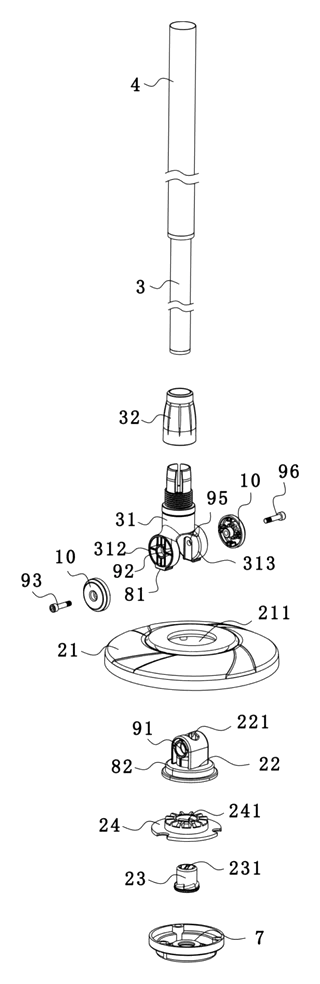
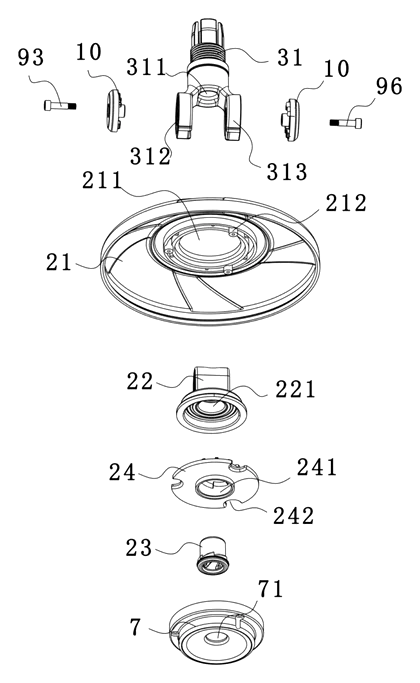
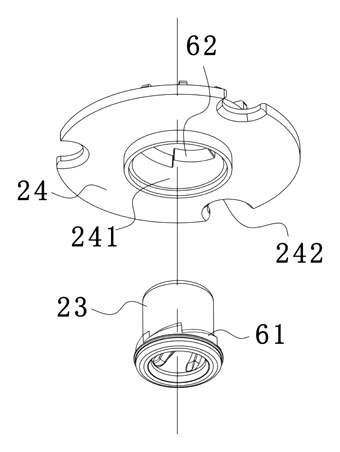
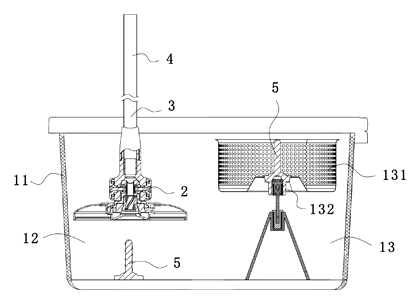
Drawings reproduced from the public patent document for reference.