At a glance
| Patent number | CN208930172U (application CN201821858309) |
| Type | China utility model (实用新型) - protects product shape and structure |
| Original title | Multi-function geological hammer (一种多功能地质锤) |
| Patent owner | Liu Zhihan (individual) |
| Inventors | Liu Zhihan |
| Filing date | 2018-11-12 |
| Grant date | 2019-06-04 |
| Status (China) | Lapsed - terminated for non-payment of annual fees (recorded 2021-10-26) |
| Patent family | Chinese filings only - no US, European, Japanese, PCT or other filings listed |
| Cited by | 5 later documents |
| Source | Google Patents (search for CN208930172U) |
What the claims cover, in plain language
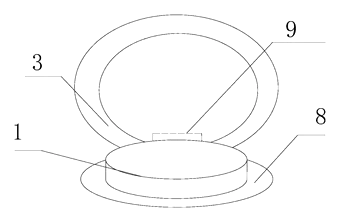
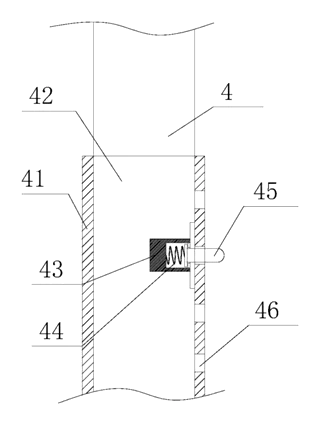
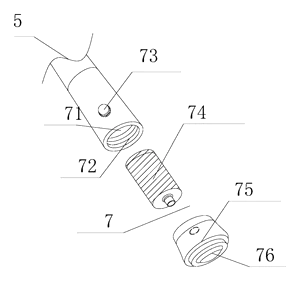
Claim 1 - a multi-function geological hammer with a hammer head, a scale, a hanging ring, a handle, a magnifying glass, an annular groove and a hinge, plus a telescopic device and a lighting device. The scale is bonded to the top front of the head and the ring is pivoted to the head. The telescopic device has a fixed rod, a telescopic rod, a groove, a return spring, a round pin and holes: the spring pushes the pin into a hole to lock the length. The lighting device in the handle has a mounting bore with a thread, a switch, a battery, a protective cap and a lamp connected to the battery.
Claim 2 - four holes evenly spaced on the fixed rod. Claim 3 - the pin is cylindrical with limiting plates. Claim 4 - the scale is square and marked in centimeters. Claims 5-7 - further features described in the patent, such as details of the cap and lamp.
This is a simplified reading for orientation only. The legal scope is defined by the exact claim wording in the official Chinese document.
What this means for US production
This patent was filed only in China and has lapsed, so it no longer restricts anyone in China either. It has no US or other foreign counterpart.
Two points to settle early:
- Other patents may exist. Rock hammers and multi-tool hammers are covered in the US mainly by design patents on head and handle shapes, plus utility patents on telescoping and multi-function handles; a freedom-to-operate (FTO) review should come before tooling.
- Strength of the telescoping joint. Striking loads pass through the spring-pin joint; the joint design and pin size must be proven by impact testing.
Customization and manufacturing
What can be customized
| Area | Options |
|---|---|
| Head | Pick or chisel tail, weight class, forged carbon steel |
| Handle | Steel or aluminum tube, rubber or TPR grip, number of length steps |
| Light | LED brightness, AAA or rechargeable cell, USB-C charging |
| Lens | Magnification and diameter, flip-out lens cover |
| Scale | Metric, inch or dual, laser-etched or printed |
| Branding | Logo on head or grip, sheath, gift box |
Things to plan for (US market)
- ASME B107.400 (striking tools) - professional buyers expect hammers to meet the ASME striking-tool standard for head retention and hardness; we test to it.
- Eye-protection warning - striking tools must carry a warning to wear safety glasses, on the tool or its label.
- Battery rules - a lithium rechargeable version needs UN 38.3 transport testing; replaceable alkaline cells avoid this.
- California Prop 65 - grips and coatings should be tested for listed substances.
How a project runs
- Inquiry - head style and weight, handle, light and quantity.
- Design - head forging, telescoping joint, light module and lens.
- Prototype - samples tested for head retention, joint strength and light function.
- Pilot run - small batch for finish, marking and packaging checks.
- Production - volume production, packaging and shipping.
Quantities & timeline
The head needs a forging die and heat treatment, the tubes and pin need machining, the grip needs an overmold, and the light needs an LED module and battery housing. Most development time goes into impact testing of the joint. Send us your head style, length range, light choice, quantity and target price and we will reply with options.
Patent drawings
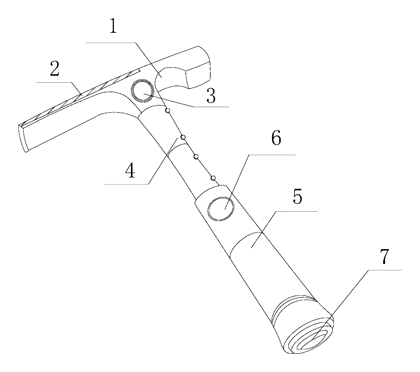
Drawings reproduced from the public patent document for reference.